
I talk to shop owners every week. Most run operations between 10 and 50 people. They’re making parts for aerospace, medical, automotive—you name it. And the question I hear more than any other right now is some version of: “What do I actually need to invest in to stay competitive?”
It’s a fair question. The industry is changing fast. The workforce challenge isn’t going away—we’re looking at nearly 1.9 million manufacturing jobs that could go unfilled by 2033 if nothing changes. Tariff uncertainty, rising costs, and customers expecting faster turnarounds have made the last couple years feel like a pressure cooker for a lot of shops.
So what actually matters? What separates the shops that are growing from the ones that are struggling?
Here’s my list. It’s not about chasing every shiny new technology. It’s about the fundamentals that make a real difference on the shop floor.
1. Multitasking Machines and Five-Axis Capability
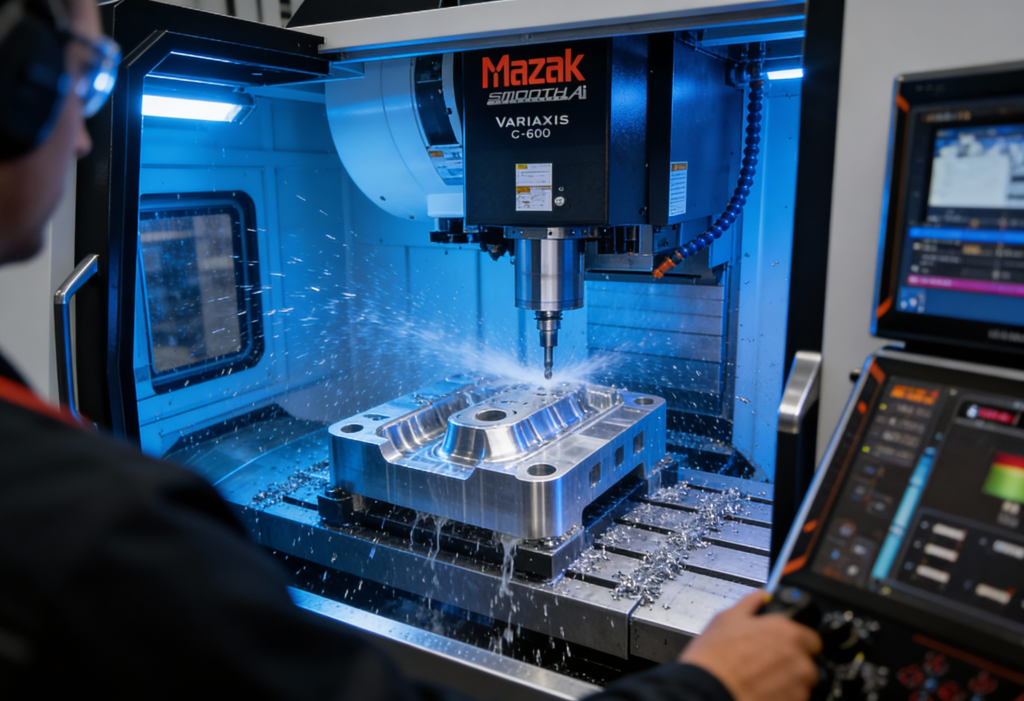
This isn’t new advice, but it bears repeating because I still see shops hesitating. Five-axis machining centers have become the standard for competitive shops. Not because every job requires simultaneous five-axis cutting—most don’t—but because five-axis positioning dramatically reduces setups and improves accuracy.
Parts come off more complete. Less handling means fewer errors. Jobs that used to require three or four setups now run in one.
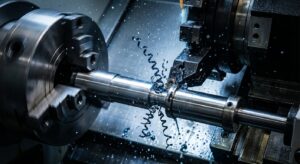
The same goes for multitasking lathes. A machine that can turn, mill, and drill in a single setup changes your throughput entirely. Yes, they’re more complex. But modern CAM software has made programming these machines far more accessible than it was even five years ago.
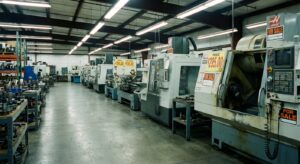
If you’re running a job shop with standard three-axis mills and two-axis lathes, you’re at a disadvantage against competitors who can quote faster cycle times and better first-pass quality.
2. Automation That Fits Your Shop
Automation doesn’t mean replacing your workforce. It means freeing your skilled people to do skilled work.
The shops I see doing well have figured out how to use automation strategically. That might be a collaborative robot loading and unloading a lathe. It might be a pallet system on a horizontal machining center. It might be automated part inspection.
The labor math is straightforward. With 415,000 manufacturing job openings sitting unfilled as of mid-2025, you’re not going to solve your capacity problem by hiring alone. You solve it by making the people you have more productive. That’s what automation does—it multiplies the output of your existing team.
Don’t overcomplicate it. Start with the repetitive tasks that eat up your operators’ time. Machine tending is usually the low-hanging fruit. The ROI on a well-implemented cobot cell can be measured in months, not years.
3. Real Measurement Capability
Every shop needs quality control. But “good enough” measurement isn’t good enough anymore.
A coordinate measuring machine (CMM) is essential if you’re doing precision work. It handles complex geometries that would take forever with manual gauges, and it creates the documentation that aerospace, medical, and automotive customers require. No CMM means no traceability, and no traceability increasingly means no contracts.
Beyond CMMs, 3D scanning like the HP DesignScan is becoming practical for more shops. Scanners don’t just measure specific features—they capture the entire part geometry. That’s valuable for reverse engineering, for catching dimensional creep before it becomes a problem, and for inspecting features that nobody thought to call out on the print but that still matter to fit and function.
The quality equipment you invest in pays for itself in scrap reduction and customer confidence. Shops that can prove their work wins work.
4. Shop Management Software That Actually Works
I’ve visited shops that still schedule on whiteboards. I’ve seen shops running on spreadsheets that would make your head spin. It works until it doesn’t.
Modern ERP and MES systems give you visibility you can’t get any other way. Where is every job right now? What’s actually running on each machine? Where are your bottlenecks? Which customers are profitable and which ones are killing your margins?
The best systems now connect directly to your machines. Real-time monitoring means you know immediately when a machine goes down, when cycle times drift, when utilization drops. That data lets you make decisions based on reality instead of guessing.
Integration matters too. Your scheduling system should talk to your quoting system. Your quality system should talk to your shipping system. Disconnected data means disconnected decisions.
If you’re still managing a 20-person shop with Excel and tribal knowledge, you’re leaving money on the table.
5. Digital Twins and Simulation
One of the biggest changes in the last few years is how shops are using simulation before they ever cut metal.
A digital twin is a virtual copy of your machine, your fixtures, your tooling—everything. You can prove out programs completely before they touch the shop floor. Crashes become something you catch in software, not something that costs you a spindle replacement and three weeks of downtime.
This is especially valuable for five-axis work and complex multitasking programs where visualization gets hard. Being able to see exactly what’s going to happen, from every angle, at any point in the program, changes how confidently you can run new jobs.
The technology has gotten more accessible too. Many CAM packages now include simulation capabilities that were premium add-ons a few years ago.
6. 3D Printing for Fixturing and Prototyping
Additive manufacturing isn’t replacing machining. Anyone who tells you otherwise doesn’t understand either technology.
But 3D printing has found its place in machine shops, and it’s mostly in fixturing. Need a custom soft jaw? Print it overnight. Need a check fixture for a complex contour? Print it. Need a prototype to validate form and fit before you commit to production? Print it.
The shops using printers this way save time on every new job. Custom workholding that used to take days to machine can be ready the next morning. That speed compounds across dozens of jobs per month.
Don’t buy a metal printer expecting to compete with your Haas. Do buy a decent FDM or resin printer and watch how often it saves you time and money on fixturing and setup.
7. Skilled People (and a Plan to Develop Them)
No technology replaces a good machinist. Period.
But good machinists are harder to find than ever. The workforce is aging—about 26% of manufacturing workers are now 55 or older. The pipeline of new talent isn’t keeping pace with retirements. And the skills required are changing as machines get more capable.
The shops that are winning the talent war have figured out a few things. They’re investing in training, both for new hires and existing employees. They’re partnering with local technical schools. They’re paying wages that actually compete for skilled labor—average manufacturing compensation hit $102,000 in 2025 when you include benefits.
They’re also thinking about how technology can help. Newer operators often adapt faster to digital interfaces than to manual methods. AI-assisted CAM tools are making programming more accessible to less experienced staff. These aren’t threats to employment—they’re ways to make your team more capable.
Your best people are your competitive advantage. Treat them like it.
8. Cybersecurity (Yes, Really)
This one didn’t make lists like this a few years ago. It needs to now.
Machine shops are targets. Your IP, your customer data, your production capability—all of it has value to bad actors. Ransomware attacks on small manufacturers have increased dramatically. A shop that can’t run production for two weeks while recovering from an attack may not survive.
Basic cybersecurity hygiene is essential. Segment your networks. Back up your data offsite. Train your people not to click on phishing emails. Keep your software updated. If you’re running ancient machines with legacy controls connected to your network, understand the risk that creates.
This is especially important if you’re doing defense work. CMMC requirements are tightening. But even if you’re not in the defense supply chain, a customer data breach or production shutdown can be fatal to a small business.
Protect what you’ve built.
The Bottom Line
The shops that will thrive in 2026 and beyond aren’t necessarily the ones with the biggest capital budgets. They’re the ones making smart investments that multiply the capabilities of their people.
Advanced machines reduce setups and improve quality. Automation makes your workforce more productive. Measurement systems let you prove your work. Software gives you visibility and control. Training keeps your team sharp.
None of this is optional anymore. The baseline for competition keeps rising. Shops that invest in these fundamentals are positioned to grow. Shops that don’t will find it harder and harder to keep up.
If you’re evaluating your own operation, start with where you’re weakest. Usually that’s also where the biggest gains are waiting.
Key Facts: Machine Shop Competitiveness in 2026
- 1.9 million manufacturing jobs could go unfilled by 2033 (Deloitte/Manufacturing Institute)
- 415,000 manufacturing job openings remained unfilled as of June 2025 (Bureau of Labor Statistics)
- 26% of the manufacturing workforce is age 55 or older
- $102,000 average annual compensation for manufacturing employees including benefits
- 65% of manufacturers cite talent attraction and retention as their primary business challenge
- 81% of industrial executives plan to increase AI investments over the next three years (PwC)
- 20.6% of U.S. manufacturing plants operate below full capacity due to labor or skill shortages
Frequently Asked Questions
What’s the most important investment for a small machine shop? It depends on your biggest constraint. For most shops, that’s skilled labor—which makes automation investments the highest priority. A cobot loading a lathe can recoup its cost in under 18 months while freeing your skilled operator for setup, programming, and problem-solving.
Is five-axis machining necessary for job shops? Not every job requires it, but the shops winning quotes in 2026 have five-axis capability. The competitive advantage comes from reduced setups and handling, which means faster delivery and better quality. You don’t need to do full simultaneous five-axis cutting to benefit from five-axis positioning.
How do I start with automation if I have no experience? Start small. A collaborative robot tending a single machine is a manageable first project. Many suppliers offer turnkey cells with training and support. The goal isn’t to automate everything—it’s to learn what works in your environment before scaling up.