
Thirty years in this business. I’ve walked shops from Maine to California, inspected machines that had been run hard for decades, and bought equipment that other dealers walked away from. I’ve seen technology fads come and go — CNC was “going to replace machinists” in 1985, and here we are, short on machinists and busier than ever.
But here’s what I’ll tell you plainly: what’s happening with AI and CNC machining right now is real. It is changing how I value machines, how my customers think about used equipment, and what questions I’m getting on the phone. If you run a job shop, a captive machine shop, or any operation with CNC equipment, this matters to you — whether you have one machine or fifty.
This is the most complete resource I’ve put together on AI and used CNC machines. I’ve pulled market data, ROI studies, and technical specs from the sources I trust. I’ve also added what I’ve learned from the shop floor — because no analyst report tells you what it actually feels like when a spindle goes down at 2 AM on a defense contract job.
Read it in order, or jump to the section that’s relevant to you. Either way, you’ll come out of it with a clearer picture of what AI means for the machine you’re buying, the machine you’re running, and the machine you’re trying to sell.
The CNC Machine Tool Market in 2026: Size, Growth, and Context
Before we talk about AI, let’s establish the scale of what we’re discussing.
The global machine tools market was valued at $97.9 billion in 2024 and is projected to reach $137.4 billion by 2030, growing at a compound annual growth rate of 7.0%, according to Grand View Research. Within that, the CNC machining and turning centers segment specifically was valued at $25.99 billion in 2023 and is expected to reach $40.61 billion by 2030 at a 6.6% CAGR.
The broader CNC machines market — encompassing all CNC equipment — was valued at $66.74 billion in 2022 and is projected to reach $132.93 billion by 2030, a CAGR of 10.3%.
This growth is being driven by three forces: reshoring of US manufacturing (accelerated significantly since 2020), the aerospace and defense build-up, and the automotive transition to EV platforms that requires entirely new machining capabilities.
The used machine tool market is a significant portion of this. In my experience, used CNC machines represent roughly 20-30% of the total machine tool transactions in the US by volume — hundreds of thousands of machines changing hands annually. These are real assets serving real shops that can’t or won’t pay new machine prices.
AI is about to make this market more complicated and more interesting simultaneously.
What AI Actually Means in a CNC Context
Let me be precise. “AI” is one of the most abused terms in manufacturing marketing right now. Every control builder is slapping “AI” on their product brochure. So let’s define what we’re actually talking about:
1. Predictive Maintenance (PdM)
Sensors — accelerometers, thermal sensors, current transducers, acoustic emission sensors — monitor the machine’s spindle, bearings, servo drives, and cutting process in real time. Machine learning algorithms analyze this data stream to detect anomaly patterns that precede failure. The system alerts the operator or maintenance team before the part breaks, not after.
This is the most mature AI application in CNC environments. The technology is proven, the ROI is documented, and it is deployable today on machines that weren’t designed for it.
2. Adaptive Control / Process Optimization
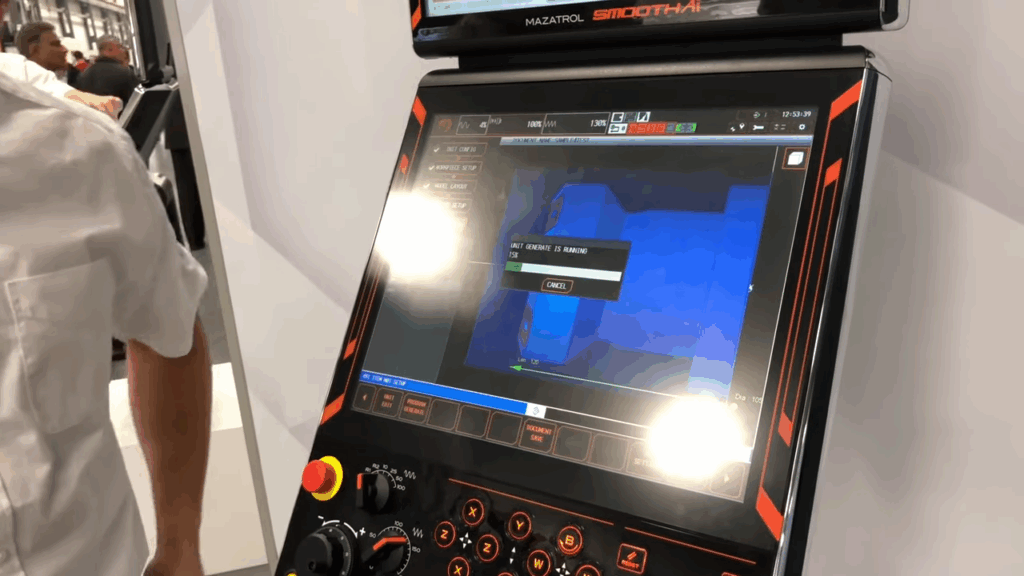
Newer CNC controls — Fanuc’s AI Servo Monitor, Mazak’s SmoothAI, Okuma’s Thermo-Friendly Concept with OSP-P500 — adjust cutting parameters in real time based on actual cutting forces, spindle load, and thermal compensation data. This reduces cycle time, extends tool life, and improves surface finish without operator intervention.
This is less retrofit-friendly than PdM. It generally requires a modern control that has the processing power and software architecture to handle closed-loop adaptive adjustments.
3. Quality Inspection and In-Process Measurement
Vision systems with AI models can inspect features on the machine, in-cycle, without stopping production for a CMM check. Renishaw, Hexagon, and others have mature on-machine probing systems; AI-enhanced vision inspection is the next layer, catching defects that dimensional measurement alone would miss.
4. Intelligent Scheduling and OEE Optimization
Manufacturing Execution Systems (MES) and AI-enhanced planning tools analyze machine utilization, job queues, setup times, and delivery deadlines to optimize how work flows through the shop. This isn’t about what happens on the machine — it’s about which machine gets which job, when.
5. Digital Twin Technology
A digital twin is a real-time virtual model of a physical machine or process. As sensors feed data into the twin, it reflects the actual state of the physical machine — wear levels, thermal state, tool life remaining. Simulation of new programs runs against the digital twin before the real machine cuts a chip.
Digital twin technology for individual machine tools is still early in adoption but is moving fast in larger shops and tier-1 suppliers.
The Business Case: Downtime, ROI, and Real Numbers
In 30 years, I’ve seen a lot of new technology sold on hype. AI predictive maintenance is different because the ROI numbers are real and documented by credible sources. Here’s what the data actually says:
The Cost of Unplanned Downtime
Siemens’ 2024 “True Cost of Downtime” report — one of the most comprehensive studies ever conducted on this subject — found that unscheduled downtime costs the world’s 500 largest companies $1.4 trillion per year, representing 11% of annual revenues. That’s up from $864 billion in the previous study.
The average large manufacturing plant loses 27 hours per month to unplanned downtime, down from 39 hours in 2019 — a reduction attributed largely to early adoption of condition monitoring technologies.
For a mid-sized job shop running multiple CNC machining centers, even a conservative estimate of $5,000–$10,000 per hour of unplanned downtime — accounting for lost production, labor costs, expediting, and potential contract penalties — means a single unexpected spindle failure can cost $50,000–$100,000 or more when you factor in repair time and customer impact.
Predictive Maintenance ROI
McKinsey research on predictive maintenance implementation found that leading organizations achieve 10:1 to 30:1 ROI ratios within 12–18 months of implementation.
More conservative, shop-level data shows:
- 25–30% reduction in maintenance costs through condition-based maintenance replacing scheduled-interval maintenance
- 35–50% reduction in unplanned downtime through early fault detection
- 50%+ improvement in maintenance productivity through prioritized work orders
- 10–20% improvement in OEE (Overall Equipment Effectiveness) through reduced unplanned stops
The predictive maintenance market itself reflects this adoption momentum: valued at $10–11 billion in 2024, it is projected to reach $48 billion by 2029 at a 35%+ CAGR.
What This Means for a Shop Running Used CNC Equipment
I walked a shop in Central Florida last year — 12 machining centers, mix of Haas VF-4s and Mazak Nexus turning centers, average age 8–12 years. They had two unplanned spindle failures in 18 months. Total cost including repair, lost production, and one expedite charge: just under $180,000.
A retrofit sensor package for their 12 machines would run approximately $3,000–$5,000 per machine, or $36,000–$60,000 total. At their downtime cost rate, that’s a payback under 6 months.
That’s the conversation I’m having with buyers now. It used to be: “How’s the spindle?” Now it’s: “How’s the spindle, and what can we put on this machine to tell us when it’s about to go?”
Industry 4.0 and IIoT: Where Manufacturing Is Heading
The Industrial Internet of Things is the infrastructure layer that makes AI in manufacturing possible. Without connected machines sending data, there is no AI to analyze it.
The IIoT market was valued at $289.0 billion in 2024 and is projected to grow at a 12.7% CAGR through 2033, according to IMARC Group. Hardware — sensors, gateways, industrial PCs — retained a 46.73% market share in 2024, with condition monitoring representing the primary use case.
Adoption is accelerating: a survey of 446 US manufacturing professionals across 15 states found that 62% of US manufacturers have embraced IoT technologies, with the shift described as moving from “cautious experimentation to aggressive deployment.”
Mid-sized manufacturers implemented 20% more sensors and IoT devices by 2025 compared to 2023, with predictive maintenance cited as the primary driver in automotive and aerospace sectors.
For used machine buyers, this trend has a direct implication: a machine that can’t participate in a connected shop floor is increasingly a second-class asset. The question “can this machine talk to my MES?” is becoming as important as “can this machine hold tolerance?”
How AI Is Changing Used CNC Machine Valuation
This is where it gets practical for buyers and sellers.
Historically, a used CNC machine was valued on five primary factors: brand, age, spindle hours, condition (cosmetic and mechanical), and included tooling/accessories. Control generation was a secondary factor.
That hierarchy is shifting. I’ve watched it happen in the last two years.
Control Generation Is Now a Primary Valuation Factor
A 2019 Haas VF-3 with the NGC (Next Generation Control) — which supports Ethernet connectivity and third-party monitoring integration — is meaningfully more valuable than a 2019 Haas VF-3 with the older Classic Haas Control, assuming comparable spindle hours and condition. The newer control doesn’t just run programs better; it opens the machine to the IIoT ecosystem.
Same principle applies across brands. A Fanuc 31i-B5 control (OPC-UA native) commands a premium over a 30i in the same machine vintage. A Mazak SmoothG or SmoothX control with Mazak’s SmartBox connectivity option is more valuable than a MATRIX 2 control.
This premium is currently modest — in my estimation, 5–15% in most cases — but it is growing as more shops build connected floor environments and realize they need machines that fit the architecture.
Retrofit Potential Affects Valuation
On the flip side, machines that can’t easily be retrofit — either because of control age, proprietary architecture, or physical condition — face a growing valuation discount as buyers factor in the cost and complexity of getting connectivity.
A Fanuc 0M-C control from the early 2000s can be networked via legacy RS-232 to MTConnect adapters, but it’s not clean. A Siemens 840D sl from 2015 has native OPC-UA. These are different assets even if the machine bodies are comparable.
Documentation and Data History Are Becoming Valuable
Machines that have been connected and monitored generate maintenance histories, performance data, and condition records that are increasingly valuable to buyers. A used machine with 3 years of sensor data — spindle vibration trends, thermal compensation history, alarm logs — is a more knowable asset than one without.
We’re not there yet as an industry in terms of how this data transfers with a machine sale, but it’s coming. Buyers who are asking for maintenance data today are ahead of the curve.
Control Generations and AI-Readiness: What to Look For When Buying
The single most important factor in evaluating a used CNC machine for AI-readiness is the control. Here’s a practical guide by brand:
Fanuc
- Series 0i-F Plus / 30i-B / 31i-B5 / 32i-B (2015+): OPC-UA compatible, FANUC FOCAS2 API for data collection, Ethernet standard. Best choice for AI integration.
- Series 30i-B / 31i-B (2010–2015): FOCAS2 capable, Ethernet, good integration support. Retrofit-friendly with most IIoT platforms.
- Series 30i-A / 31i-A (2004–2010): FOCAS1/FOCAS2 via Ethernet, workable but older architecture. MTConnect adapter required for most platforms.
- Series 0i-D and older: RS-232 serial, very limited native connectivity. Legacy MTConnect adapters exist but expensive.
Mazak
- SmoothAI / SmoothG / SmoothX / SmoothC (2015+): Mazak SmartBox option for MTConnect and OPC-UA. Full AI servo monitor. Best choice.
- MATRIX 2 (2010–2015): Ethernet capable, MTConnect support available, solid platform.
- Fusion 640 / MATRIX (2005–2010): Older architecture, retrofit possible but more complex.
Haas
- NGC — Next Generation Control (2017+): Ethernet, third-party monitoring via MTConnect. Strong community support.
- Classic Haas Control (2010–2016): Limited native connectivity, MTConnect adapters available from third parties.
- Older Haas controls (pre-2010): RS-232 only, limited retrofit options.
Siemens
- SINUMERIK ONE (2020+): Native OPC-UA, digital twin built-in, full Industry 4.0 architecture. Premium choice.
- 840D sl (2006+): OPC-UA available via software option, widely supported by IIoT platforms.
- 840D / 810D: Older architecture, retrofit possible with third-party solutions.
Okuma
- OSP-P500 (2020+): Okuma Connect Plan (OPC), full IoT integration, AI spindle prediction.
- OSP-P300 (2012–2019): Ethernet, MTConnect support, workable platform.
Retrofit vs. New: The Economics of AI-Enabling an Existing Machine
This is the question I get most often right now. “Should I buy a new machine with AI built in, or retrofit my existing equipment?”
The honest answer is: it depends, but the retrofit case is stronger than most shops realize.
The Retrofit Case
A modern IIoT retrofit package — typically including vibration sensors for the spindle and key mechanical components, a temperature monitoring node, current monitoring on the servo drives, an edge computing gateway, and subscription software — runs approximately $3,000–$8,000 per machine depending on the platform and sensor count.
For a shop with 10 CNC machines, that’s $30,000–$80,000 versus $1,000,000+ for 10 new machines. The economics of retrofit are compelling when:
- The machine body (cast iron, spindle, slides) is in good condition
- The control is Ethernet-capable (2010+, generally)
- The machine’s precision still meets your production requirements
- New machine lead times are long (12–24 months has been common post-pandemic)
When New Makes More Sense
New equipment is justified when:
- The existing machine’s accuracy or capability no longer meets part requirements
- The control is so old that retrofit costs approach or exceed machine value
- You need the specific cutting capabilities of a newer machine (larger work envelope, higher spindle speed, 5-axis)
- You’re building a new shop from scratch and want a unified, native IIoT architecture
The key point: AI doesn’t require new equipment. The decision to upgrade should be driven by capability, not connectivity — because connectivity is increasingly solvable without buying a new machine.
The Connectivity Standards That Matter: OPC-UA and MTConnect
Two protocols dominate machine tool connectivity. Understanding them helps you evaluate a machine’s AI-readiness intelligently.
MTConnect
MTConnect is an open, read-only XML-based standard specifically designed for manufacturing equipment. It was developed by AMT (The Association For Manufacturing Technology) and is widely supported across the machine tool industry. Key characteristics:
- Read-only — it can pull data from machines but not send commands
- Lightweight and easy to implement
- Specifically designed for CNC machine data: spindle utilization, axis positions, alarm states, part counts, OEE metrics
- Native support in Mazak, Okuma, Fanuc (via option), Haas NGC
- Used at IMTS across 2,100+ exhibitor booths for real-time machine data display
OPC-UA (Unified Architecture)
OPC-UA is a broader industrial automation standard supporting read/write operations, with strong security features (authentication, encryption) and platform independence. Key characteristics:
- Read/write capable — can send commands as well as receive data
- Secure by design — supports authentication and encryption
- More complex to implement than MTConnect
- The preferred standard for integration with MES, ERP, and cloud platforms
- Native in Siemens SINUMERIK ONE, Fanuc 31i-B5+, Mazak SmoothAI with SmartBox
In practice, the industry is moving toward a joint OPC-UA + MTConnect specification that provides the best of both worlds. For buyers evaluating used machines today, a machine with native OPC-UA or MTConnect support is categorically more valuable than one requiring a workaround adapter.
Brand-by-Brand AI Capabilities: What’s Actually on the Market
Fanuc: AI Servo Monitor and MT-LINKi
Fanuc’s AI Servo Monitor uses machine learning on spindle and servo drive data to detect abnormal patterns before they cause failure. MT-LINKi is Fanuc’s factory data collection and monitoring platform, compatible with their controls going back to the Series 30i. In the used market, Fanuc controls are the most common globally, making the ecosystem of retrofit IIoT tools targeting Fanuc the most mature.
Mazak: SmoothAI and SmartBox
Mazak’s SmoothAI platform provides AI-assisted machining optimization, including spindle anomaly detection, tool life prediction, and adaptive feed control. The SmartBox is a hardware module that adds IIoT connectivity to Mazak machines with older MATRIX 2 controls — an elegant retrofit solution for Mazak’s installed base.
Haas: Machine Monitoring and Next Generation Control
Haas is the largest US-based CNC machine tool manufacturer by volume. The NGC (Next Generation Control) introduced in 2017 has native Ethernet and supports MTConnect out of the box. Haas also offers their own machine monitoring software, and a robust ecosystem of third-party monitoring platforms (Scytec, Memex, MachineMetrics) specifically support Haas machines.
Siemens: SINUMERIK ONE and Digital Native
Siemens SINUMERIK ONE is the most advanced CNC control architecture currently available. It is built as a “digital native” control — digital twin is a native feature, not an add-on. OPC-UA is standard. AI-assisted thermal compensation, predictive maintenance algorithms, and full integration with Siemens’ MindSphere IoT platform are all part of the ecosystem. This is the gold standard for AI-readiness but appears in higher-end machine tools.
Okuma: OSP-P500 and Connect Plan
Okuma’s Connect Plan provides MTConnect and OPC-UA connectivity for their OSP-P300 and P500 controls. The OSP-P500 adds AI spindle prediction and intelligent thermal control. Okuma machines hold their value extremely well in the used market, and the connectivity infrastructure across their newer controls is strong.
What Shops Are Getting Wrong About AI and CNC
In my conversations over the last two years, I see the same mistakes repeatedly.
Mistake 1: Waiting for the “AI Machine” Before Buying
Shops are delaying used machine purchases because they’re waiting for a definitive “AI-ready” machine to appear. It doesn’t exist as a discrete product category. AI-readiness is a spectrum defined by control generation, connectivity options, and retrofit potential. A good-condition Haas VF-3 from 2018 with an NGC control and a $4,000 sensor package is more “AI-ready” than a new machine from a second-tier builder with a closed, non-networked proprietary control.
Mistake 2: Conflating AI with Autonomy
AI in CNC manufacturing today is not robots replacing machinists. It is data-driven decision support — giving operators and maintenance teams better information, faster. The machinist still programs, sets up, and runs the machine. AI helps them know when the spindle bearings need attention before the spindle crashes into a $50,000 part.
Mistake 3: Ignoring the Used Market’s Retrofit Opportunity
The IIoT retrofit market is mature, cost-effective, and specifically built for the installed base of 2010–2020 CNC machines. MachineMetrics, Scytec DataXchange, Memex Merlin, and Forcam all offer platform solutions with proven ROI that deploy on used equipment. The capability gap between a retrofitted used machine and a new connected machine, for predictive maintenance purposes, is smaller than most shops assume.
Mistake 4: Not Asking the Right Questions When Buying
Buyers still ask about spindle hours and tooling. Those matter. But the questions that will matter more over the next five years are: What control generation? Does it have Ethernet? What connectivity protocols does it support? Is the control still supported by the builder? What retrofit options exist?
How to Buy a Used CNC Machine in the AI Era: A Practical Framework
When a customer calls me about a used machine purchase, here’s the framework I walk them through:
Step 1: Capability First
Define exactly what parts you need to make — work envelope, spindle speed, tool capacity, accuracy requirements. AI doesn’t change what the machine needs to cut. Start there.
Step 2: Control Generation Second
Once you’ve identified candidate machines, evaluate the control generation using the guide above. 2015+ is the general threshold for reasonable AI-readiness. 2020+ for native OPC-UA in most brands.
Step 3: Connectivity Audit
Ask specifically: Does it have Ethernet? What protocols are supported — MTConnect? OPC-UA? FOCAS? What’s the control software version? Is it still supported by the builder?
Step 4: Retrofit Cost Estimate
Get a quote from one or two IIoT platform providers on what it would cost to add predictive maintenance monitoring. Use this to compare true total cost of ownership across candidate machines.
Step 5: Spindle and Mechanical Condition
Run a full spindle analysis — vibration spectrum, thermal, runout. Check the slide way condition, the turret indexing, the ATC function. AI can monitor a healthy spindle beautifully. It can’t save a worn spindle.
Step 6: Total Cost of Ownership Over 5 Years
Factor in: purchase price + freight + installation + tooling + retrofit cost + estimated maintenance (using condition data if available) versus new machine alternative + lead time cost. Most used machines win this comparison when the machine body is solid and the control is modern.
Frequently Asked Questions
Can I retrofit AI predictive maintenance onto any CNC machine?
Almost any machine built after 2005 can receive some form of sensor-based monitoring. The quality and depth of integration improves significantly with newer controls. Machines with Ethernet-capable controls (generally 2010+) offer the best retrofit options. Older machines can receive vibration and temperature monitoring via standalone sensor platforms that don’t require control integration.
How much does AI predictive maintenance cost for a used CNC machine?
A basic sensor package with edge gateway runs $3,000–$5,000 per machine. Platform subscriptions typically run $100–$300 per machine per month. Full integration including setup, training, and integration with your MES adds $2,000–$5,000 per machine for initial implementation. Most shops see payback within 12 months.
Will AI make used CNC machines obsolete faster?
No — it extends their useful life. AI predictive maintenance helps shops catch problems early and maintain machines more precisely, extending mechanical life and maintaining accuracy. The obsolescence risk is control age, not machine age.
Does the brand of CNC machine matter for AI-readiness?
Yes, but not as much as the control generation. A 2018 Haas with an NGC control is more AI-ready than a 2018 machine from a premium brand with an older, non-networked control. Focus on control generation and connectivity before brand loyalty.
What is OEE and why does it matter?
OEE — Overall Equipment Effectiveness — is the manufacturing standard metric for machine utilization. It measures the percentage of scheduled production time that is truly productive, accounting for availability (uptime), performance (running at rated speed), and quality (producing good parts). World-class OEE is considered 85%+. Most shops run 60–65%. Predictive maintenance and AI-assisted scheduling are the primary levers for moving OEE. Every percentage point of OEE improvement on a machine running 2 shifts represents meaningful revenue.
Where can I find used CNC machines with modern controls?
Premier Equipment maintains an inventory of used CNC machines across all major brands, with control generation and connectivity information on each listing. We’re based in Altamonte Springs, FL and have been serving US manufacturers since 1990. Call us to discuss what’s available and how it fits your shop’s requirements.
Sources and References
- Grand View Research: Machine Tools Market Size & Forecast 2024
- Grand View Research: CNC Machining and Turning Centers Market Report
- Siemens: The True Cost of Downtime 2024 (Senseye Predictive Maintenance Report)
- McKinsey & Company: Predictive Maintenance ROI Research
- IMARC Group: Industrial IoT Market Size & CAGR Forecast 2025
- Faclon Labs: US Industrial IoT Market Trends & Adoption Report 2025
- ISM World: The Monthly Metric — Unscheduled Downtime (2024)
- AMT — The Association For Manufacturing Technology: MTConnect Standard
- OPC Foundation: OPC-UA Specification and Implementation
- WorkTrek: Predictive Maintenance Cost Savings Research 2025
- Verdantis: Predictive and Preventive Maintenance Statistics 2026