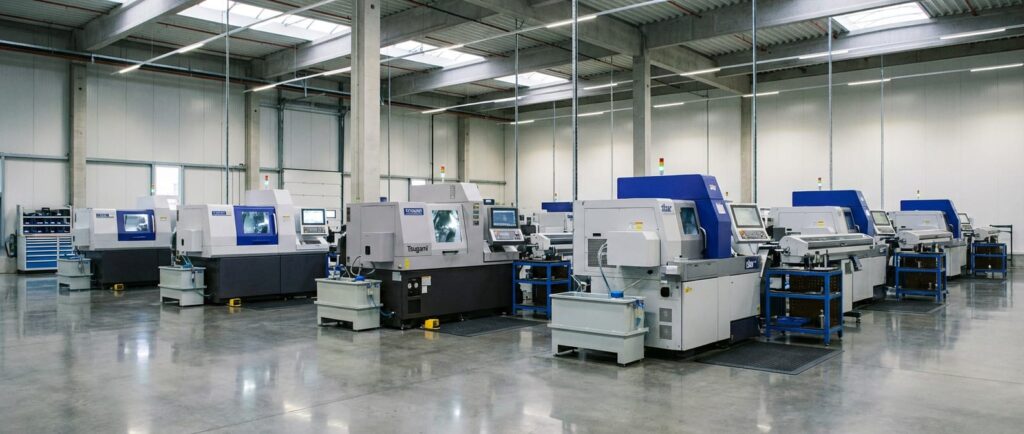

When a shop decides they need a swiss lathe, the next question is almost always: which brand? Citizen, Tsugami, Star, Tornos, Hanwha — the names come up constantly, and the sales pitches for each one tend to blur together. I’ve worked with all of them, and I’ve talked to enough shop owners after the fact to know which questions they wish they’d asked before they bought. This is my attempt to give you that conversation before you’re already committed.
I’ll say upfront: there’s no single best brand. All five of these are serious machines made by serious companies. The right choice depends on what you’re running, what your operators know, and what kind of support you can access when something goes wrong.
The Five Major Players
| Brand | Country | Market Position | Control System | Max Bar Capacity | US Support |
|---|---|---|---|---|---|
| Citizen | Japan | Premium, innovation-focused | CINCOM (proprietary) | Up to 32mm | Strong — Citizen Machinery America |
| Tsugami | Japan | Value + performance balance | Fanuc 32i / Mitsubishi M80 | Up to 32mm | Good — Tsugami/Rem Sales |
| Star | Japan | Precision-first, high rigidity | Fanuc / Star SV-20 proprietary | Up to 32mm | Good — Star CNC America |
| Tornos | Switzerland | Ultra-precision, watchmaking roots | TB-DECO / Fanuc | Up to 38mm | Moderate — longer parts lead times |
| Hanwha | South Korea | Budget-accessible, growing footprint | Fanuc | Up to 32mm | Developing — newer US presence |
Citizen: The Innovation Leader
Citizen is the brand I’d put at the top of the market right now on the innovation side. Their LFV (Low Frequency Vibration) technology — which oscillates the cutting tool to break chips on difficult materials like stainless and titanium — is genuinely useful for shops running medical or aerospace work. It’s not a gimmick; it solves a real chip control problem that plagues swiss lathe work on stringy materials.
The tradeoff is the control system. The CINCOM control is proprietary to Citizen, which means your operators need to learn it specifically, and your CAM post needs to be dialed in for it. If you’re hiring, you’ll find fewer operators with CINCOM experience than Fanuc experience. On the used market, Citizen machines hold their value well — expect to pay a premium compared to equivalent Tsugami or Star machines of the same vintage.
Best fit: Shops running medical or aerospace work who need LFV capability, or operations with dedicated swiss lathe teams who can invest in CINCOM training.
Tsugami: The Value Play
Tsugami is where I point shops that want solid swiss lathe capability without paying the Citizen premium. They run on Fanuc or Mitsubishi controls, which means your operators are more likely to already know the interface, and your CAM posts are more likely to already work. The machines are well-built, the model range is wide, and they’re common enough on the used market that you can usually find something in the configuration you need.
Tsugami doesn’t get the same innovation headlines as Citizen, but that’s not what most shops are buying for. They’re buying for a machine that makes tight-tolerance parts reliably, day after day. Tsugami does that. On the used market, they tend to be priced more accessibly than Citizen for comparable capability — which matters when you’re comparing total cost of ownership.
Best fit: Shops transitioning to swiss turning for the first time, or operations that want Fanuc-based controls to simplify training and programming.
Star: The Precision Purist’s Choice
Star has been building swiss-type lathes since the 1960s, and the machines reflect that history. They’re known for exceptional rigidity and long machine life — shops that bought Star machines in the 1990s are often still running them. The build quality is evident when you look at the castings and the tolerances on the major components.
The consideration with Star is the control situation. Older Star machines often run the Star SV-20 proprietary control, which fewer operators know compared to Fanuc. Newer Star machines have moved toward Fanuc-based controls, which helps. If you’re looking at a used Star machine, confirm which control it has — it affects operator availability and CAM compatibility significantly.
Star America provides good US support, and parts availability is generally solid. For shops that prioritize machine longevity and are willing to invest in Star-specific training, they’re an excellent long-term choice.
Best fit: Shops with existing Star experience, or buyers prioritizing machine longevity and rigidity who are prepared for the learning curve on older controls.
Tornos: When You Need Ultra-Precision
Tornos is the Swiss brand — literally from Switzerland, with roots in the watch industry that invented swiss-style turning. If you’re doing work where 0.0001″ isn’t good enough and you need to go tighter, Tornos is where that conversation starts. They also offer slightly larger bar capacity on some models (up to 38mm), which can matter for specific applications.
The honest caveat: Tornos is a specialist’s machine. The TB-DECO control system has a learning curve, parts and service have historically had longer lead times in the US compared to Japanese brands, and the machines command a premium price. They’re not wrong to cost more — the precision is real — but most shops producing commercial-grade swiss parts don’t need to go there.
Best fit: High-precision aerospace, defense optics, or scientific instrument work where you genuinely need tolerances beyond what the Japanese brands deliver.
Hanwha: The Newcomer Worth Watching
Hanwha is Korean, newer to the US market, and significantly more affordable than the Japanese brands for comparable specs. They run Fanuc controls, which helps with the operator and CAM side of things. For shops that need swiss lathe capability and are price-sensitive, Hanwha is worth a serious look.
My honest reservation is the support network. Hanwha’s US presence is still developing. If you’re in a market where same-day or next-day service matters, verify that support is actually available in your area before committing. That’s less of an issue in major manufacturing regions and more of a concern in areas where the CNC dealer network is thinner.
Best fit: Budget-conscious shops that need basic to mid-level swiss capability and have verified adequate local support, or buyers with strong in-house maintenance capability.
What to Evaluate Beyond the Brand Name
Brand matters, but it’s not the only variable. When you’re comparing specific machines, here’s what I’d weight in your decision:
| Factor | Why It Matters | What to Ask |
|---|---|---|
| Control system | Determines operator learning curve and CAM compatibility | Fanuc or proprietary? What version? Can my CAM post support it? |
| Bar capacity | Must match your largest required bar diameter | What’s the max collet size? Does it support guide bushing-less mode? |
| Sub-spindle | Needed for complete parts in one setup | Is sub-spindle included? How many axes on the sub? |
| Year / generation | Affects control capability, available features, parts availability | What’s the build year? Is the control still supported? |
| Tooling included | Gang plates and collets are expensive | What tooling is included? What collet standard does it use? |
| Bar feeder | Essential for production — verify compatibility | Is a bar feeder included? What brand? Is it synchronized? |
| Service history | Spindle condition is hard to assess visually | Any service records? When was the guide bushing last replaced? |
A Note on Used vs. New for Swiss Lathes
New swiss lathes from Citizen, Tsugami, or Star run $200,000 to $400,000 — and that’s before a bar feeder, tooling, and installation. For most small to mid-sized shops, that’s a large capital commitment for a machine type they may be running for the first time.
A well-maintained used machine from 2015–2020 will run the same parts at the same tolerances as a new machine in most applications. The exceptions are shops that specifically need the latest LFV technology (Citizen) or the newest high-pressure coolant configurations — but those are specific requirements, not universal ones. For a shop’s first swiss lathe, a used machine at a third of the new price is almost always the right financial decision.
| Budget Range | What to Expect on the Used Market |
|---|---|
| $20,000–$45,000 | Pre-2010 machines, older controls, basic swiss capability, limited sub-spindle options |
| $45,000–$80,000 | 2010–2016 era, sub-spindle standard, Fanuc-based controls on most, solid production capability |
| $80,000–$130,000 | 2016–2020 machines, advanced controls, high-speed spindles, near-current capability |
| $130,000+ | Late model (2020+) machines, LFV-capable, full multi-axis, close to new machine performance |
The Practical Takeaway
If you’re running medical or aerospace work and need the latest chip control technology, Citizen is worth the premium. If you want solid swiss capability with the widest operator pool and the most straightforward programming setup, Tsugami or Star are the workhorses I’d recommend. If you need ultra-precision beyond what the Japanese brands deliver, look at Tornos. If budget is the primary constraint and local support checks out, Hanwha deserves a serious look.
If you’re not sure, talk to us before you buy anything. We carry machines from multiple brands, and our job isn’t to sell you a specific name — it’s to match you with the machine that makes sense for your work. Browse our current swiss lathe inventory or get in touch directly.
Frequently Asked Questions
Which swiss lathe brand is easiest to learn for an operator new to swiss turning?
Tsugami or Hanwha, primarily because they run Fanuc controls. Fanuc is the most widely known CNC control in the market — if your operator already runs a Fanuc-controlled conventional lathe, the interface is familiar. Citizen’s CINCOM and Star’s proprietary older controls have steeper learning curves, though newer Star machines have moved toward Fanuc as well.
Are Citizen swiss lathes worth the higher price?
For shops running stainless steel, titanium, or other difficult-to-chip materials in a medical or aerospace context — yes, the LFV technology pays for itself in chip control and reduced spindle interruptions. For shops running brass, aluminum, or easier materials where chip control isn’t a problem, you’re paying for a feature you won’t use. Know your material before you decide.
Is Tornos a good choice for a first swiss lathe?
Generally no, unless you have specific requirements for ultra-high precision that the Japanese brands can’t meet. The TB-DECO control has a steeper learning curve, US service lead times can be longer, and the machines are priced at a premium. For a first swiss machine, a Citizen, Tsugami, or Star in the $50,000–$90,000 range gives you excellent capability with a shorter path to productive operation.
How do I verify a used swiss lathe is in good condition before buying?
The key items: spindle runout (measure at the nose — anything over 0.0001″ TIR warrants concern), guide bushing condition (check for play and wear), axis backlash (indicator test on each axis), and coolant system integrity. Ask for any service history available. If the machine comes with tooling, inspect the gang plates and collets — worn collets mean you’re buying replacements on top of the machine price. If you’re not sure what you’re looking at, our team can walk you through it.