
How a Swiss Lathe Works — And Whether Your Shop Needs One
I get asked about swiss lathes a lot. Usually it’s a shop owner who’s been running conventional CNC lathes for years, watching their customers ask for tighter tolerances on smaller and smaller parts, and wondering whether a swiss machine is the answer. Sometimes it is. Sometimes it’s a $150,000 solution to a problem that doesn’t actually exist in their shop. The difference comes down to understanding what a swiss lathe actually does — and why it does it differently from everything else in your turning department.

The Mechanics: What Makes It Swiss
A conventional CNC lathe grips the workpiece at the headstock and holds it there while the cutting tools move in. The bar is clamped, the tools come to it. Simple and effective for most turning work.
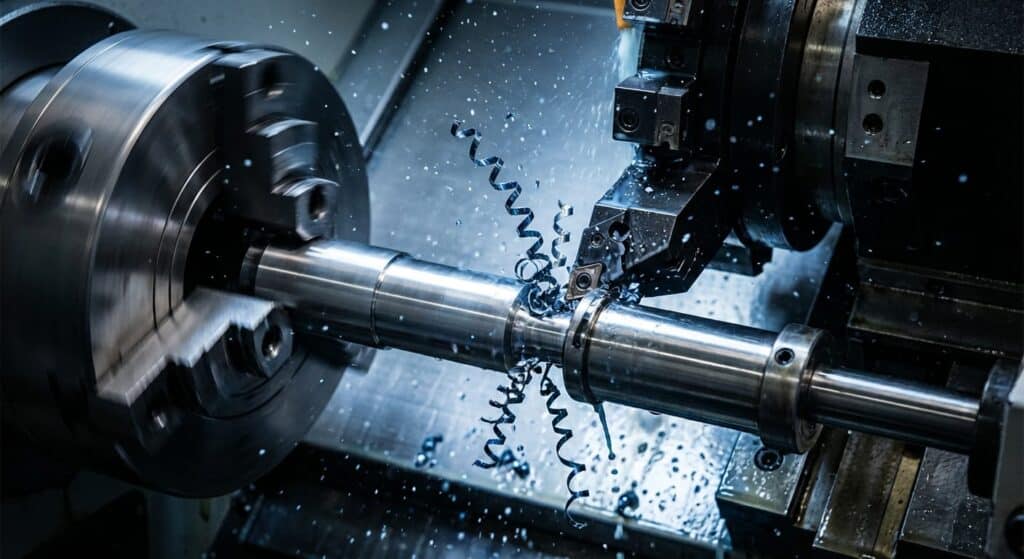
A swiss lathe flips that logic. The bar stock feeds continuously through a guide bushing — a precision bore located just millimeters from the cutting tools — and the headstock itself slides along the Z-axis, advancing the material into the cut zone. The guide bushing provides support right at the point of contact, which eliminates the deflection you’d get on a long, slender part sticking out unsupported from a conventional chuck.
That guide bushing is the key. It’s what allows swiss lathes to hold tolerances of ±0.0001″ on parts that are inches long but only a few millimeters in diameter. Without it, those parts would deflect under cutting pressure and your tolerances would be all over the place. With it, the cutting point is always supported, cycle after cycle.
Most CNC swiss machines also have a secondary spindle located behind the main cutting area. As a part is completed and parted off, the secondary spindle grabs it and performs backside operations — drilling, tapping, facing — before ejecting it into a bin. The operator’s involvement in each individual part is minimal. You load the bar feeder, set up the program, and the machine runs.
Swiss Lathe vs. Conventional CNC Lathe: A Direct Comparison
Here’s where I see shops get confused. Swiss lathes aren’t just “more precise” CNC lathes. They’re a different machine for a different job. Using one where you don’t need it is like running a race car on a gravel road — technically impressive, wildly impractical.
| Swiss Lathe | Conventional CNC Lathe | |
|---|---|---|
| Headstock | Slides along Z-axis | Fixed in place |
| Bar support | Guide bushing at the cutting point | Chuck only — no support along bar length |
| Part size sweet spot | Under 1.25″ diameter, long L/D ratio | Larger diameter chucking work |
| Tolerances | ±0.0001″ achievable | ±0.0005″ typical |
| Setup complexity | High — guide bushing, collets, gang tooling | Lower — standard chuck and turret |
| Production style | Bar-fed, high-volume, lights-out capable | Batch or job shop, operator-involved |
| Secondary ops | Built-in with sub-spindle | Requires separate setup or machine |
| Price (used) | $20,000–$150,000+ | $8,000–$80,000+ |
What Swiss Lathes Are Actually Built For
Swiss machines exist because of a specific manufacturing problem: how do you make very small, very precise, very complex parts at volume without having an operator touch every single one? The answer, developed originally for Swiss watchmakers in the 1870s, was to support the workpiece at the cutting point and feed it continuously from a bar.
Today, that same approach dominates four industries in particular: medical devices, aerospace fasteners, automotive fuel systems, and electronics connectors. In all four, you’re typically making parts under 32mm in diameter, in large quantities, to tolerances that most conventional lathes can’t reliably hit.
| Application | Why Swiss Makes Sense |
|---|---|
| Bone screws & implants | Tight OD tolerances, biocompatible materials, no manual handling between ops |
| Aerospace fasteners | High L/D ratios, titanium and Inconel, precise thread forms |
| Fuel injector components | Micron-level tolerances, high volume, consistent surface finish |
| Dental abutments | Complex geometry, small diameter, multiple ops in one setup |
| Electronic connector pins | Brass, copper alloys, extremely tight concentricity requirements |
If your work doesn’t land in one of those buckets — if you’re mostly running larger diameter parts, job shop quantities, or work where ±0.001″ is perfectly acceptable — a swiss lathe is probably not the right call. You’d be paying a premium for capability you won’t use, and dealing with setup complexity that will slow you down on every job.
The Guide Bushing Question
One thing worth knowing: not all swiss lathes run with a guide bushing installed. Some newer models — Citizen’s LFV machines, for example — can operate in a “guide bushing-less” mode for shorter parts where remnant material is a concern. The traditional bushing setup wastes roughly one bar diameter in remnant for every bar you run. On expensive material like titanium or Inconel, that adds up fast.
When you’re evaluating a used swiss lathe, find out whether it supports guide bushing-less operation and what collet sizes are available. The bushing bore has to match your bar diameter closely — you can’t just run any bar size through any machine. This is one of the more common surprises shops encounter after they’ve already bought a machine.
A Word on Setup Time
I’ll be honest with you: swiss lathes are not easy to set up. The guide bushing needs to be fitted to your bar stock diameter, the collets need to match, the gang tooling needs to be dialed in, and the sub-spindle timing has to sync with your main program. An experienced swiss lathe operator is a real asset — and in today’s labor market, they’re not easy to find.
This isn’t a reason not to buy one. It’s a reason to go in with clear eyes. A swiss lathe running a high-volume job it was set up for is incredibly productive. A swiss lathe sitting idle while you try to find someone who knows how to run it is an expensive mistake.
If you’re considering your first swiss machine, I’d recommend starting with a Citizen, Tsugami, or Star model with a Fanuc control. There’s more operator knowledge in the market for those machines, more support resources, and more collet and tooling availability than you’ll find for less common brands. The learning curve is real; don’t make it harder than it needs to be.
What It Actually Costs
New CNC swiss lathes from Citizen, Tsugami, or Star typically run between $200,000 and $400,000 depending on configuration and bar capacity. That’s before tooling, a bar feeder, and coolant system upgrades.
On the used market, prices vary significantly by age, brand, and condition:
| Machine Type | Typical Used Price Range | What You’re Getting |
|---|---|---|
| Older single-spindle (pre-2010) | $20,000–$45,000 | Fanuc control, limited sub-spindle, basic swiss capability |
| Mid-generation (2010–2017) | $45,000–$90,000 | Sub-spindle standard, better control options, more tooling positions |
| Late model (2018+) | $90,000–$150,000+ | LFV capable, high-speed spindles, advanced control, near-new capability |
| With bar feeder included | Add $5,000–$25,000 | Depends on brand, capacity, and condition of the feeder |
Financing on used swiss lathes follows the same application-only process as any other CNC equipment we sell — terms from one to six years, up to $500,000. The monthly number on a $80,000 machine over five years is a lot more manageable than it sounds when you’re looking at the sticker price.
The Bottom Line
A swiss lathe is a highly specialized machine. If your shop makes high volumes of small, precision parts — particularly for medical, aerospace, or automotive customers — it will almost certainly pay for itself. If you’re running a general job shop with varied part sizes and modest volumes, you’re better served by a capable CNC turning center with live tooling and a sub-spindle.
If you’re not sure which side of that line you’re on, I’m happy to talk through your specific work. We see a lot of shops, and I can usually tell pretty quickly whether a swiss lathe makes sense for what someone is running. Browse our current swiss lathe inventory or reach out directly — no pressure, just a straight conversation.
Frequently Asked Questions
Can a swiss lathe run large diameter parts?
Swiss lathes are designed for bar stock up to 32mm in diameter for most models, with some configurations reaching 38–42mm. They’re not suited for large-diameter chucking work — that’s where a conventional CNC lathe or turning center is the right choice. If you’re running parts over 2 inches in diameter, a swiss machine almost certainly isn’t the answer.
How long does it take to learn to run a swiss lathe?
More than a standard CNC lathe. An operator with conventional CNC lathe experience will typically need several weeks to become comfortable with a swiss machine, and months to become genuinely proficient at setup. The guide bushing setup, collet selection, and gang tooling arrangement are all different from what they’re used to. Fanuc-controlled machines have a shallower learning curve than proprietary controls.
Do I need a bar feeder with a swiss lathe?
For production work, yes — practically speaking. The entire design of a swiss lathe is oriented around continuous bar feeding. You can run short blanks manually, but you lose the cycle time and labor efficiency advantage that makes swiss machines worth buying in the first place. Most used swiss lathes either include a bar feeder or have a compatible model available.
What’s the difference between a CNC swiss lathe and an automatic screw machine?
“Automatic screw machine” is the older term for the same general machine category — cam-driven predecessors to today’s CNC swiss lathes. They were built for the same job (high-volume small parts) but use mechanical cams rather than computer control. You’ll still find them in listings, and they’re cheap, but CNC swiss lathes are dramatically more flexible, faster to set up for new jobs, and hold tighter tolerances.