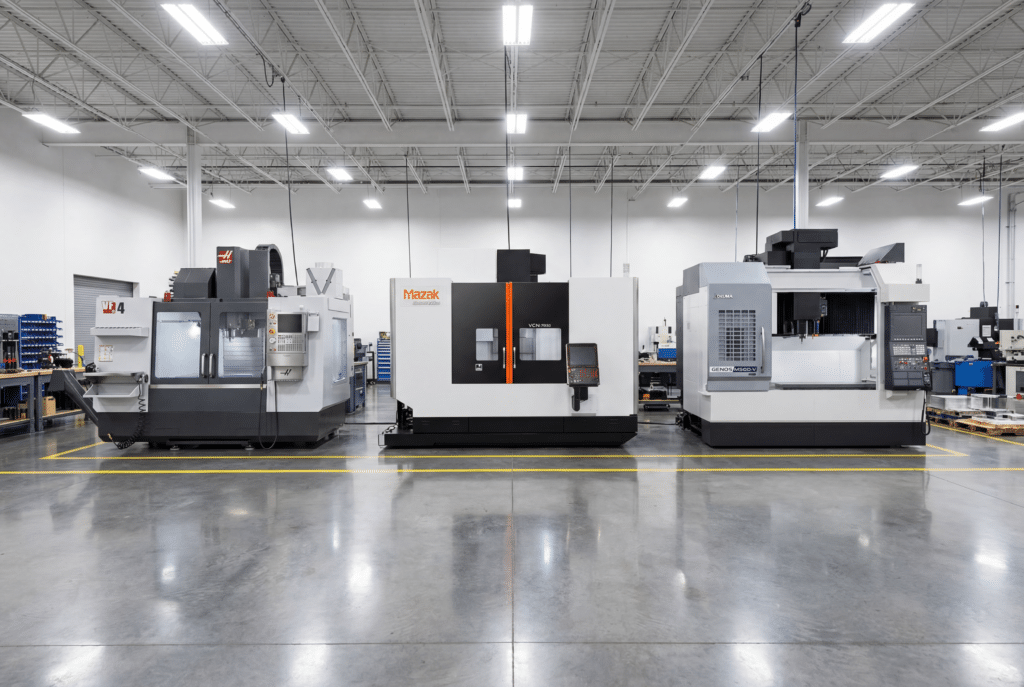

Haas, Mazak, and Okuma Compared
Every week I talk to shop owners trying to figure out which CNC mill to buy. It’s one of the biggest decisions you’ll make—get it right and you’ve got a machine that pays for itself many times over. Get it wrong and you’re stuck with equipment that doesn’t fit your work, costs too much to maintain, or sits underutilized because your team can’t run it efficiently.
The vertical machining center (VMC) is still the backbone of most American job shops. It’s versatile, relatively affordable, and handles the majority of milled parts that come through the door. But not all VMCs are created equal, and the brand you choose matters more than most people realize.
I’m going to break down three of the most common brands we see in shops across the country: Haas, Mazak, and Okuma. Each has its strengths. Each has situations where it’s the wrong choice. Understanding the differences will help you make a smarter buying decision—whether you’re looking at new equipment or shopping the used market.
View
The Three Philosophies
Before we get into specifications, understand that these three manufacturers approach CNC milling from fundamentally different perspectives.
Haas is the American pragmatist. Gene Haas built the company on the idea that reliable, user-friendly CNC machines shouldn’t cost a fortune. Everything is made in Oxnard, California. The control system is proprietary and designed for simplicity. The business model is high volume, competitive pricing, and an extensive dealer network that makes parts and service accessible anywhere in the country.
Mazak is the Japanese performance builder. With over 100 years of machine tool experience, Mazak makes some of the most capable machines in the industry. They manufacture in Japan and Kentucky, depending on the model. Their Mazatrol control system is legendary for conversational programming. The machines are built heavier, run faster, and cost more—but for shops pushing their equipment hard, the ROI can justify the premium.
Okuma is the precision specialist. Also Japanese, also over 100 years old, Okuma has built its reputation on thermal stability and long-term accuracy. Their Thermo-Friendly Concept actively compensates for temperature changes during machining. The OSP control is powerful and open. For shops doing tight-tolerance work over long production runs, Okuma machines hold accuracy better than almost anything else in their class.
These aren’t just marketing differences. They reflect real engineering choices that affect how the machines perform in your shop.
Haas: The Workhorse That Makes Sense for Most Shops
The Haas VF series is probably the most common VMC in American job shops, and there’s a good reason for that. A new Haas VF-2 runs around $60,000-$80,000 depending on options. A comparable Mazak or Okuma will cost 40-60% more for similar specifications.
That price difference isn’t because Haas machines are poorly made. They use cast-iron construction with heavy ribbing for vibration damping. They’re accurate enough for general machining work. And the Haas control is genuinely one of the easiest to learn in the industry.
Where Haas excels:
The VF-2 gives you a 30″ x 16″ x 20″ work envelope, 30 horsepower, and 8,100 RPM in the standard configuration. That handles probably 80% of what comes through a typical job shop. Setup is straightforward. Programming is intuitive. Training a new operator takes days, not weeks.
Parts availability is exceptional. Haas has over 170 Factory Outlets worldwide, and because there are so many Haas machines in the field, aftermarket support is strong too. When something breaks at 2 AM on a Thursday night, you can usually get parts by Friday morning.
The used market for Haas is deep. A 10-year-old VF-2 in good condition runs $25,000-$35,000. That’s an incredible entry point for a shop adding capacity or a startup getting off the ground.
Where Haas falls short:
If you’re machining hard materials—tool steel, Inconel, titanium—the Haas will get the job done, but not as efficiently as heavier machines. The construction is lighter than Mazak or Okuma equivalents. You’ll need to back off feeds and speeds to avoid chatter, which means longer cycle times.
For high-volume production where the machine runs three shifts pushing hard, Haas machines tend to need more maintenance and show wear faster than premium alternatives. The machine isn’t designed for that use case.
And if you need extreme accuracy over long runs, thermal drift becomes a factor. Haas doesn’t have the sophisticated thermal compensation systems that Okuma includes as standard.
Best fit: Job shops running mixed work, prototyping, softer materials like aluminum, shops where ease of use and total cost of ownership matter more than maximum performance.
Mazak: When Performance Justifies the Price
Mazak machines cost more because they do more. The construction is heavier. The spindles are faster. The rapid traverse rates are higher. Everything about the machine is built to remove material quickly and accurately.
A Mazak VCN-530C (roughly comparable to the Haas VF-2) lists around $120,000-$150,000 new. You’re paying nearly double. But you’re also getting a 15,000 RPM spindle versus 8,100, rapid traverse of 1,417 IPM versus 1,000, and a machine that’s built to run hard shifts without complaint.
Where Mazak excels:
Aluminum machining is where Mazak really shines. The high spindle speeds let you run small-diameter end mills at proper surface feet per minute. Faster rapids reduce non-cutting time on large parts. Aerospace shops running aluminum structural components often find Mazak machines finish jobs 25-40% faster than Haas equivalents.
The Mazatrol control system is genuinely remarkable for on-machine programming. An experienced operator can write programs conversationally without touching CAM software. For shops running custom one-off parts, this saves significant time. The control also handles G-code, so you’re not locked into the Mazak ecosystem.
Build quality is outstanding. Mazak machines are built to hold accuracy under heavy cutting loads and maintain that accuracy for decades with proper maintenance. The resale value reflects this—used Mazaks hold their value better than almost any other brand.
Multi-tasking is where Mazak has no equal. Their INTEGREX series combines turning, milling, and now grinding in a single setup. For shops making complex parts that would otherwise require multiple machines, INTEGREX machines can transform your entire production process.
Where Mazak falls short:
The Mazatrol control has a learning curve. Operators coming from Haas or Fanuc backgrounds need real training to become productive. If your shop has high turnover or relies on operators who work across multiple brands, the training overhead adds up.
Cost. There’s no way around it. For shops that don’t need the performance, a Mazak is over-buying. If your typical job runs fine on a Haas, spending twice as much for a Mazak isn’t smart.
Service costs are higher. Parts are more expensive. Finding third-party support isn’t as easy as with Haas.
Best fit: High-production environments, aerospace aluminum work, shops machining hard materials at volume, operations where cycle time directly impacts profitability.
Okuma: The Accuracy Machine
Okuma occupies a specific niche that neither Haas nor Mazak quite fills. Their machines are built for stability, accuracy, and consistency over time. The Thermo-Friendly Concept isn’t marketing—it’s a measurable engineering advantage that keeps parts in tolerance even as the machine heats up through a shift.
The Genos M560-V is Okuma’s answer to the mid-range VMC market. It gives you a 41″ x 22″ x 18″ work envelope, 15,000 RPM spindle, 30 horsepower, and that thermal stability system as standard. New pricing runs around $130,000-$160,000 depending on options.
Where Okuma excels:
For tight-tolerance work, especially over long production runs, Okuma is hard to beat. The double-column construction is among the heaviest in class. The machine maintains accuracy as shop temperature changes through the day. Parts that need to hold tenths over 8-hour runs stay in tolerance without constant adjustment.
The OSP control is powerful and open. It supports standard G-code, offers excellent canned cycles, and integrates well with third-party monitoring and automation systems. Okuma has invested heavily in connectivity features that matter for shops moving toward smart manufacturing.
Titanium and Inconel machining is where Okuma’s rigidity pays off. The 146 ft-lbs of spindle torque on the Genos M560-V handles demanding cuts in exotic materials without the chatter you’d get on lighter machines.
The collision avoidance system is excellent. For shops running complex five-axis work or developing new programs, the ability to simulate and catch crashes before they happen protects your spindle investment.
Where Okuma falls short:
The OSP control isn’t as intuitive as Haas for new operators. It’s powerful, but power comes with complexity. Training takes longer.
Chip management on the Genos series has been a consistent complaint in the field. The machines don’t flush chips as aggressively as some competitors, which can cause issues with certain operations. It’s manageable, but it’s a real consideration.
The dealer network isn’t as extensive as Haas. Depending on your location, parts and service response times may be longer.
Best fit: Aerospace and medical manufacturing, tight-tolerance production work, shops running hard materials, operations where dimensional stability over long runs is critical.
Used Market Considerations
The used market tells you a lot about what these machines are worth to real shops.
Haas: Deep inventory at every price point. A 2015-2018 VF-2 in good condition runs $30,000-$45,000. Because there are so many machines out there, you can be selective about condition, options, and hours. Great value for shops adding capacity on a budget. View latest machines >
Mazak: Holds value exceptionally well. A 10-year-old VCN-530C might still command $60,000-$80,000 in good condition. The machines last, and buyers know it. Fewer units available at any given time, so you may need to wait for the right one. View latest machines >
Okuma: Similar value retention to Mazak. The Genos M560-V in good condition from the 2015-2018 era runs $50,000-$70,000. Thermal stability features remain effective long-term, so older Okumas still hold accuracy. A well-maintained Okuma can outlast many newer machines from other brands. View latest machines >
When buying used cnc machines, hours matter less than maintenance history and application. A machine with 15,000 hours that ran aluminum in a climate-controlled shop may be in better shape than one with 5,000 hours that was pushed hard cutting tool steel with poor chip evacuation.
Making the Decision
Here’s how I’d summarize the choice:
- Buy a Haas if: You need reliable, versatile milling at a reasonable price. Your work is mixed. Your operators vary in experience. You value simplicity and serviceability. You’re not pushing exotic materials or extreme tolerances.
- Buy a Mazak if: Speed and performance directly impact your bottom line. You’re running high volumes. Aluminum is a significant part of your work. You have skilled operators who can leverage the Mazatrol control. You can absorb the higher purchase and operating costs.
- Buy an Okuma if: Accuracy and stability over time matter most. You’re doing tight-tolerance work. Temperature variation in your shop is a factor. You’re machining hard materials. You want a machine that holds accuracy for decades.
The wrong choice isn’t buying from the wrong brand—it’s buying capabilities you don’t need or skipping capabilities you do. Match the machine to your work, not to what looks impressive on the showroom floor.
Key Specifications Comparison
| Specification | Haas VF-2 | Mazak VCN-530C | Okuma Genos M560-V |
|---|---|---|---|
| X Travel | 30″ (762mm) | 41.3″ (1,050mm) | 41.3″ (1,050mm) |
| Y Travel | 16″ (406mm) | 21.3″ (530mm) | 22″ (560mm) |
| Z Travel | 20″ (508mm) | 20.1″ (510mm) | 18.1″ (460mm) |
| Spindle Speed | 8,100 RPM | 15,000 RPM | 15,000 RPM |
| Spindle Power | 30 HP | 30 HP | 30 HP |
| Rapid Traverse | 1,000 IPM | 1,417 IPM | 1,575 IPM |
| Tool Capacity | 24+1 | 30 | 32 |
| New Price Range | $60K-$80K | $120K-$150K | $130K-$160K |
| Used Price (2015-18) | $30K-$45K | $60K-$80K | $50K-$70K |
Frequently Asked Questions
Can a Haas cut hard materials like tool steel?
Yes. The saying that Haas can only cut aluminum is false. You can machine any material on a Haas—you just won’t do it as efficiently or aggressively as on heavier machines. For occasional hard material work in a job shop environment, a Haas handles it fine. For production work in hard materials, look at Mazak or Okuma.
Is the Mazak control hard to learn?
Different, not necessarily harder. Mazatrol conversational programming is actually easier for simple parts than writing G-code. But operators coming from Fanuc or Haas controls need time to adjust. Budget for training if you’re adding Mazak to a shop that runs other brands.
How long do these machines last?
With proper maintenance, all three brands can run productively for 20+ years. Okuma machines are particularly known for holding accuracy long-term due to their thermal compensation systems. The key is maintenance—a well-maintained Haas will outlast a neglected Mazak every time.
Which brand has the best resale value?
Mazak and Okuma hold value better as a percentage of original cost. But because Haas machines cost less initially, the absolute dollar depreciation may be similar. A Haas that depreciates from $70K to $35K loses the same $35K as a Mazak that goes from $140K to $105K—but the Mazak holds 75% of its value versus 50%.
What about five-axis?
All three manufacturers offer five-axis machines. Haas UMC series provides an affordable entry point. Mazak VARIAXIS and Okuma MU-V series are premium options with more capability. The same brand characteristics apply—Haas for value and simplicity, Mazak for speed and productivity, Okuma for accuracy and stability.
Key Facts to Consider: CNC Vertical Mills
- Vertical machining centers hold 52.6% of the global CNC mill market share
- The CNC VMC market is projected to grow by $1.09 billion between 2025-2029
- Average hourly earnings for CNC machinists reached $29.51 in December 2025
- 80% of new industrial mills now feature 5-axis capability
- A quality CNC mill with proper maintenance can last 15-20+ years
- The Asia-Pacific region accounts for 38% of global CNC market share