
Which CNC Turning Center Fits Your Shop?
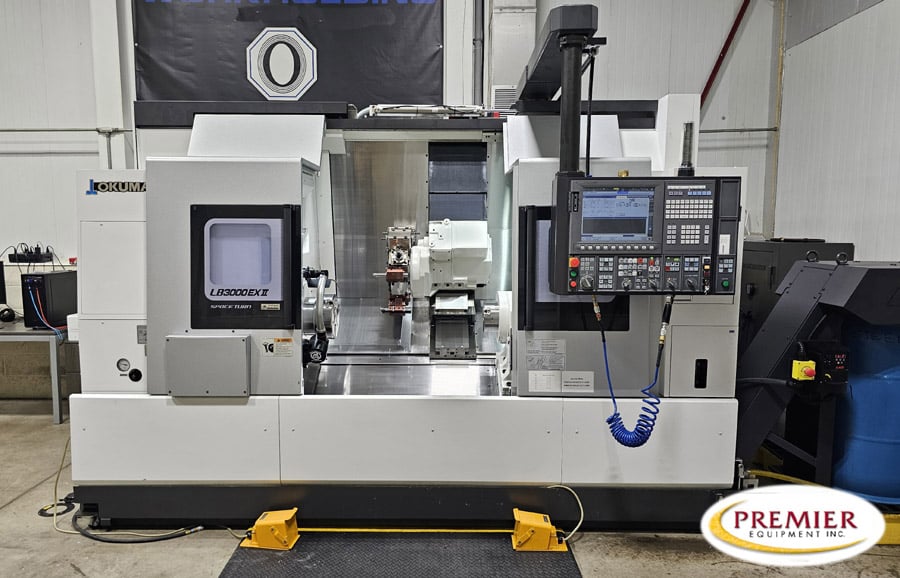
The Okuma LB3000EX II and the DMG Mori NLX 2500 are always at the top of every serious buyer’s list of mid-size CNC turning centers. Both are the best examples of Japanese and German-Japanese engineering, and both have a lot of fans among precision manufacturers all over the world.
But which one really belongs in your shop?
We’ve seen these two machines go head-to-head many times since we’ve been helping manufacturers find the right equipment for 37 years. The answer isn’t always clear-cut; it depends a lot on what you’re making, how you’re running your business, and where your shop is headed. Let’s look at the real differences.
Two Different Design Philosophies
It’s helpful to know what each manufacturer is trying to do before getting into the details. The LB3000EX II is part of Okuma’s “Affordable Excellence” line, which includes machines that offer top-of-the-line performance at a lower price. For decades, the LB series has been their main 2-axis lathe, and it has gotten better with each generation of real-world feedback.
DMG Mori’s NLX 2500, on the other hand, came about when the German company DMG and the Japanese company Mori Seiki merged. The end result is a machine that combines the German sense of precision engineering with the Japanese sense of discipline in manufacturing. The NLX series took the place of the older SL and NL lines. It used what it learned from both of them.
Both machines are made in Japan, which is important for buyers who care about quality. The Okuma is made at their Oguchi facility, and the NLX is made at DMG Mori’s Iga campus.
Comparison Table
| Feature | Okuma LB3000EX II | DMG Mori NLX 2500 |
|---|---|---|
| Max Turning Diameter | 340 mm (13.4″) | 366 mm (14.4″) |
| Bed Length Options | 500–1300 mm | 500, 700, 1250 mm |
| Spindle Speed | 4,000–5,000 RPM | 4,000 RPM |
| Spindle Power | 30 kW (40 HP) | 18.5 kW (25 HP) standard (higher options available) |
| X-Axis Travel | 260 mm (10.24″) | 260 mm (10.2″) |
| Z-Axis Travel | 500–1000+ mm options | Varies by model (500–1250 mm) |
| Bar Capacity | Up to 3″ (larger w/ big-bore) | Varies by spindle option |
| Thermal Management | Thermo-Friendly Concept, <5 microns drift | Base casting cooling, ribbed bed structure |
| Control System | OSP-P300 (Windows-based, in-house) | CELOS over Mitsubishi or Siemens |
| Live Tooling Speed | 6,000 RPM | 10,000 RPM (BMT built-in motor turret) |
| Y-Axis Travel | ±55 mm | Varies by configuration |
| Turret Type | 12-position; conventional driven turret | 12-position BMT turret (high rigidity) |
| Build Location | Oguchi, Japan | Iga, Japan |
| Price (New, Typical) | $170k–$200k (MYW config) | 15–20% higher than Okuma |
| Price (Used Market) | $80k–$120k | Similar; CELOS models command higher premiums |
| Best For | Heavy cuts, tough alloys, thermal stability | High-speed milling, precision, Industry 4.0 integration |
Core Specifications Compared
The LB3000EX II and NLX 2500 both work in similar areas, but there are some important differences between them.
The LB3000EX II has a maximum turning diameter of 340mm (13.4″) and bed lengths that range from 500mm to 1300mm, depending on how it is set up. With Okuma’s PREX motor technology, the standard spindle can spin at 4,000 to 5,000 RPM and has 30 kW (40 HP) of power. The X-axis can move 260 mm (10.24 in), and the Z-axis can move anywhere from 500 mm to over 1000 mm. The standard configurations have a 3″ bar capacity, but you can make it bigger with the big-bore option.
The DMG Mori NLX 2500 has a maximum turning diameter of 366mm (14.4″) and comes in bed lengths of 500mm, 700mm, and 1250mm. With 18.5 kW (25 HP) in the standard configuration, the spindle speed can reach 4,000 RPM. However, there are options with more power available. The machine’s X-axis travel is the same as the Okuma’s at 260mm (10.2″), and it can move quickly on both axes at 30 m/min.
The Okuma has more spindle power right out of the box: 40 HP compared to 25 HP on the standard NLX. This is important if you’re working with tough alloys or hogging material. DMG Mori, on the other hand, sells spindle packages with higher output that fill this gap.
Thermal Stability and Accuracy
Both companies have spent a lot of money on thermal management, and they should have because dimensional drift is bad for precise work.The Thermo-Friendly Concept is the main idea behind Okuma’s approach. It uses sensors all over the machine to keep an eye on and make up for thermal growth. The LB3000EX II’s box slant-bed design makes it naturally stiff, and the thermal system keeps changes in size to less than 5 microns over time. This feature is especially useful for shops that don’t have strict climate control.
DMG Mori fights back with their own ways to cool things down, such as base casting cooling and a box-type bed with a ribbed column structure that spreads heat evenly. The NLX platform focuses on low noise and vibration levels, as well as thermal stability. This is because the machine was originally designed for precision-focused tasks like making medical devices.
In real life, both machines are very accurate in production settings. The Okuma is better for shops with less controlled environments, while the DMG Mori is better for climate-controlled facilities where it can reach its full precision potential.
Control Systems: OSP vs. CELOS
This is where the differences in philosophy are most clear. The way you control these machines is very different.
Okuma OSP-P300: Okuma makes their own control systems. They’re one of the few CNC builders that don’t use Fanuc, Siemens, or Mitsubishi for their brains. The OSP-P300 runs on a Windows-based platform with an open architecture that makes it easy to move files around. People who are used to PC interfaces can quickly adapt.
Okuma’s Machining Navi system is part of the control. It looks at cutting conditions and suggests the best settings to cut down on chatter. The Collision Avoidance System also makes a virtual model of the machine and stops crashes before they happen. Setting tool and work offsets is very easy to do, and many operators say it’s easier to understand than Fanuc-based systems.
One strange thing is that the OSP control doesn’t use the usual G54/G55 work coordinate systems. It uses only one work offset, but the shifts can be different. If your programmers are used to Fanuc machines, this will take some getting used to.
DMG Mori CELOS: The NLX 2500 runs on CELOS, which is DMG Mori’s unified interface layer that sits on top of Mitsubishi or Siemens controls, depending on how the machine is set up. CELOS makes it easy to use all of DMG Mori’s products. Once you learn it, you can use any of their machines.
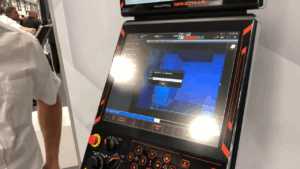
The touch screen looks like a tablet and has apps for different tasks. It’s especially good at managing jobs, keeping records, and connecting to other systems. The control’s features show that DMG Mori has worked hard on connectivity and Industry 4.0 integration. The Mitsubishi Meldas control, usually the M730UM, is what controls the machine itself. It lets you program it in G-code and talk to it.
Live Tooling and Multi-Axis Capability
Both machines can be set up with milling, Y-axis, and sub-spindles, which turn a lathe into a real turning center.
The Okuma LB3000EX MYW (Milling, Y-axis, second spindle) comes with live tooling that works at 6,000 RPM in its standard configuration. The Y-axis can move ±55mm, which is enough for most operations that are not centered. The sub-spindle has the same capabilities as the main spindle, which lets you machine complicated parts in one go.
The NLX 2500 SY variant from DMG Mori has live tooling at 10,000 RPM, which is a big plus for working with aluminum or any other job where faster milling speeds cut down on cycle time. The built-in motor turret (BMT) design puts the motor right in the turret, which stops the power losses that come with live tool systems that use belts.
On paper, this is one area where the NLX is better. Those extra RPMs help shops that do a lot of milling work, especially on softer materials. The Okuma’s 6,000 RPM works well for most jobs in shops that mostly turn but do some milling work on the side.
Turret Design and Tool Capacity
Both machines come with 12-position turrets as standard, but the specifics are different.
The BMT (Built-in Motor Turret) on the NLX 2500 is known for being very stiff and accurate. Because of the integrated motor design, there is less vibration during milling and better surface finishes on complicated parts. Changes of tools happen quickly, in 0.27 seconds per station.
Okuma’s turret has a more traditional driven design, but it makes up for this with strong construction and a track record of dependability. Some people say that the bigger turret envelope on some DMG Mori setups gives boring bars and long tools more room to move around.
Service, Support, and Parts Availability
This is where people actually make decisions about what to buy. A machine is only as good as the people who support it.
Okuma has a strong dealer network in North America, with parts warehouses and service technicians spread out all over the country. Their technology center in Charlotte, North Carolina, takes care of training and major service needs. Most of the time, replacement parts for common items come within 24 to 48 hours.
In the last few years, DMG Mori has greatly streamlined its US operations by using company-owned facilities instead of independent distributors. Their parts warehouse in Dallas says they can ship common parts the same day, and they’ve spent a lot of money on remote diagnostic tools. Service response times differ by region, but their direct model usually gives people the same experience every time.
Neither company leaves customers in the lurch. But in some places, one brand may be more popular than the other in stores. Check out how service works in your area before you buy either machine.
Pricing and Total Cost of Ownership
The price of these machines can change a lot depending on how they are set up, how the market is doing, and how good everyone is at negotiating. That being said, some general patterns still hold.
When you add in tooling, chip conveyors, and other necessary parts, a new Okuma LB3000EX II MYW (with milling, Y-axis, and sub-spindle) usually costs between $170,000 and $200,000. The prices of DMG Mori’s similar NLX 2500 SY models are usually 15–20% higher, but this gap changes.
Used examples save a lot of money on both platforms. An Okuma LB3000EX II with a good number of hours on it could cost between $80,000 and $120,000, depending on its age and how it is set up. The DMG Mori NLX 2500 units are in the same price range, but the newer generations with CELOS cost more than the older ones.
The total cost of ownership includes more than just the price of the item. Think about the costs of rebuilding spindles, upgrading controls, and investing in tooling systems. Both machines use standard Kitagawa chucks and common tooling systems, which makes it less likely that you’ll get stuck with one.
Which Machine Fits Your Shop?
After all these comparisons, how do you decide?
If your shop needs to make heavy cuts and remove a lot of material quickly, think about the Okuma LB3000EX II. The higher stock spindle power can handle tough materials without any problems. You need built-in thermal stability because you’re running in a store without strict climate control. You value the in-house control philosophy, or your operators already know how to use Okuma controls. You want to get the most out of your money, so budget is important.
If milling is a big part of your turning center work, the DMG Mori NLX 2500 is a good choice because those extra live tool RPMs add up. Your shop has embraced Industry 4.0 connectivity, and you want machines that work together without any problems. You like that all of your DMG Mori machines can be controlled in the same way. When making lighter cuts, accuracy is more important than raw power.
Many shops successfully run both brands at the same time, giving each machine work based on its strengths. Both options are good; they both show real quality that was designed for production settings.
Finding the Right Machine at the Right Price
Both manufacturers’ new machines demand a significant financial commitment. When properly inspected and certified, used machinery can provide nearly the same capabilities at a much lower cost.
At Premier Equipment we keep fresh inventory of Okuma LB3000 and DMG Mori NLX CNC turning centers. Every machine is inspected by our technicians before it is placed on our floor, and we are able to guide you through the particular advantages of the units that are available.
Our staff has the expertise to match the ideal machine to your actual production needs, regardless of whether you’re ready to buy or are just beginning your research. We don’t just sell you whatever happens to be in stock. Speak with our CNC specialists about what you’re producing and how to improve it.