
Are They Ready for Your Shop?
I’ve been in the used CNC equipment game for quite a while. I’ve seen controls evolve from punch tape to touchscreens. I’ve watched “game-changing” technologies arrive and depart, while the core principles of producing quality parts remain unchanged.
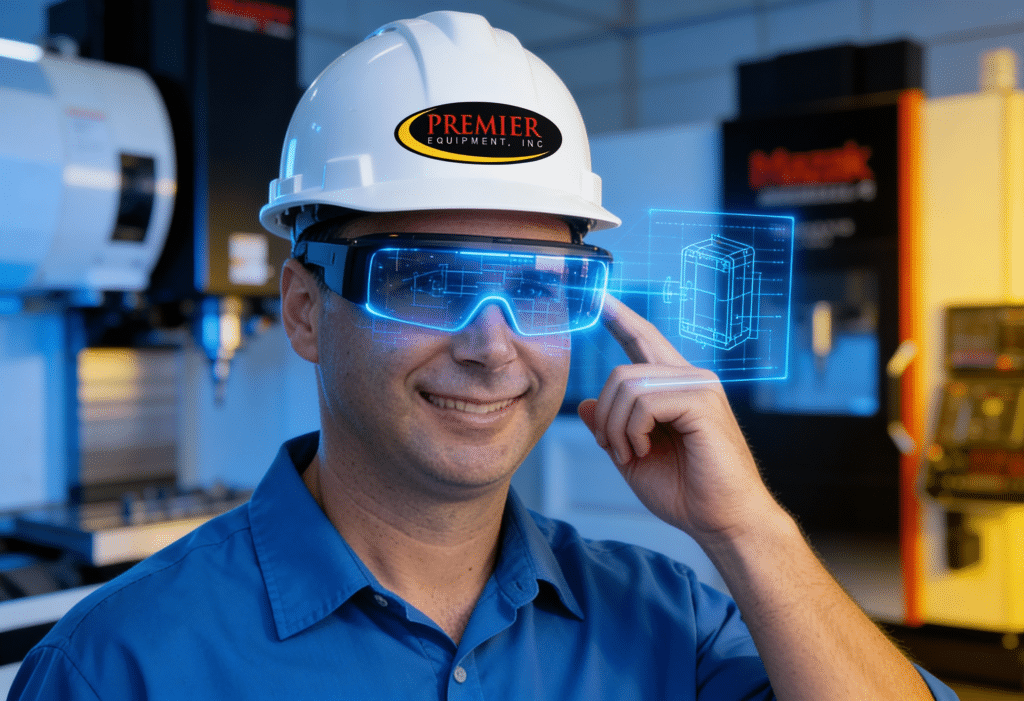
So, when CES 2026 came around and the buzz centered on smart glasses for the shop floor, I took notice. Not because I was eager to wear a computer on my face, but because I speak with machinists, shop owners, and production managers daily. I needed to know: would this actually benefit American manufacturers, or was it just another costly diversion?
Here’s my take.
What Actually Got Announced at CES 2026
Two announcements piqued my interest.
The Vuzix Ultralite Pro Enterprise Platform snagged a CES 2026 Innovation Award. These glasses, tipping the scales at less than 80 grams, accommodate prescription lenses and are built for all-day use in professional settings. Vuzix has been a player in the enterprise AR arena for quite some time, and this platform is aimed at logistics, field service, and delivering step-by-step work instructions. They showcased live applications at the event, including warehouse picking and maintenance assistance.
Siemens revealed a partnership with META to integrate what they’re calling “Industrial AI” into Meta Ray-Ban glasses. Siemens claims that workers using these glasses will get hands-free, real-time audio guidance, safety information, and operational feedback. Roland Busch, Siemens’ CEO, stated during the keynote that “Industrial AI is no longer a feature; it’s a force that will reshape the next century.”
That’s a bold claim. Siemens is also constructing what they say will be the world’s first fully AI-driven manufacturing plant at their Erlangen, Germany electronics factory, beginning this year. The smart glasses are part of their larger plan to link digital twins, manufacturing execution systems, and shop floor operations using AI.
These announcements suggest that industrial smart glasses have advanced beyond the prototype phase. The technology is now lighter, more comfortable, and more functional than earlier versions. Significant industrial companies are putting real capital into it.
The question I keep returning to is a straightforward one: does any of this actually assist the average machine shop?
The Shops I Talk To Every Day
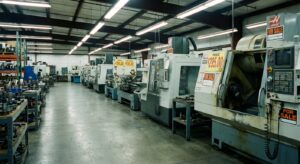
I collaborate with a diverse array of manufacturing companies and machine shops nationwide—everything from aerospace and medical device manufacturers to automotive plants, job shops, and large-scale production facilities. These aren’t the giants of industry, the Fortune 500s with their expansive R&D departments. Instead, I’m dealing with practical business owners, often running operations with ten to fifty employees, who need equipment that delivers a tangible return on investment.
When I speak with these individuals about their most pressing difficulties, certain themes consistently emerge:
The struggle to find and retain skilled operators is relentless. The workforce shortage isn’t just a buzzword; it’s a constant, everyday struggle. Shops are vying for a dwindling number of seasoned machinists while simultaneously attempting to train newcomers who lack any experience with manual machines.
Downtime is a margin killer. When a spindle fails or a control system malfunctions, every hour spent troubleshooting translates directly into lost revenue.
Three days of waiting for a service technician? That’s just more money down the drain.
Efficiency in setup is paramount. With a high-mix, low-volume environment, you’re always changing gears. The shops that thrive are the ones that can adapt quickly, without compromising on the end product.
Training is a lengthy process. It can take months, even years, to get a new operator fully up to speed on intricate CNC machinery. And while that happens, seasoned professionals are retiring, taking their decades of expertise with them.
These are the core issues. Any new technology needs to tackle at least one of these challenges to be truly valuable.
Where Smart Glasses Might Actually Help
I’m naturally hesitant, but I can imagine practical uses for industrial AR glasses within CNC operations. Here’s where this technology might actually prove its worth:
Setup and Changeover Support
Picture this: you’re at a machine, ready to start a new job, and the tool offset values, fixture alignment guides, and setup sequences are all right there, in your line of sight. No more trekking to the computer for the setup sheet. No more flipping through a binder. No more scrolling on a tablet while trying to juggle a tool holder.
For shops that juggle multiple setups during a single shift, this could significantly cut down on changeover time. Even a five-minute savings per setup can really add up over a year of production.
Remote Troubleshooting and Service
This is where I envision the most immediate impact. A technician equipped with smart glasses can instantly share their view with a remote specialist. That expert, in turn, can offer real-time guidance, point out specific parts, and lead the technician through the necessary diagnostic procedures.
Imagine a maintenance tech simply donning the glasses and showing us the problem firsthand; we could resolve issues much more quickly. The same principle holds true for OEM support, factory service teams, and contracted technicians.
While this won’t eliminate the need for physical service on major repairs, it could significantly cut down on downtime when it comes to diagnostics and troubleshooting.
Training and Education
The shortage of skilled labor shows no signs of easing. Shops are under pressure to get new operators up to speed quickly and preserve the valuable knowledge held by seasoned machinists before they retire.
Smart glasses offer a solution, projecting work instructions, safety protocols, and process guidance directly onto the task at hand. Rather than passively watching a training video and then struggling to recall it at the machine, new operators can learn by doing. The guidance is right there, with them.
This approach also provides a means to document that hard-to-define, often unspoken knowledge. That experienced machinist who knows the ins and outs of your oldest Mazak? His expertise can be captured and shared with the next generation using the same glasses.
Real-Time Machine Monitoring
Modern CNC machines churn out a staggering volume of data: spindle load, indicators of tool wear, thermal readings, and cycle times, to name a few. Much of this information resides within the machine’s control system or is funneled into a monitoring system, where it’s checked at intervals.
Imagine smart glasses providing pertinent alerts and status updates directly in an operator’s field of vision, all without disrupting their workflow. They could spot a troubling spindle load trend before it triggers an alarm. They could also see that a tool is nearing its change interval before it impacts the quality of the parts being produced.
Implementing this requires a connection between the glasses and your existing machine monitoring systems, which does introduce some complexity. However, for shops already embracing Industry 4.0 connectivity, it’s a natural progression.
The Questions Nobody Is Answering Yet
Here’s where my skepticism kicks in. The CES announcements covered impressive technology. What they didn’t cover is equally important.
- What does this actually cost? Enterprise AR hardware comes with a hefty price tag. So do the software licenses, the integration work, and the support that follows. When a 25-person company is considering a $25,000 investment in AR technology versus a $55,000 machine tool, the machine tool often comes out on top. I’ve yet to see any credible pricing or return-on-investment projections for small and mid-sized manufacturers.
- What about durability? Shop floors are a world of coolant, metal shavings, airborne particles, and the constant clamor of machinery. Consumer electronics simply aren’t built for this. The question is, can these glasses withstand the rigors of a genuine manufacturing setting? How often will they need to be replaced? And what happens if they take a tumble into the chip conveyor?
- How hard is integration? Displaying static work instructions is straightforward enough. However, the real challenge lies in pulling real-time data from machine controls, linking with ERP and MES systems, and then getting everything to sync up with the workflows already in place. Most shops, unfortunately, lack the dedicated IT personnel needed to handle these complex integrations.
- Will operators actually use them? I’ve witnessed many tech acquisitions that seemed promising during presentations, only to languish unused because the people on the ground resisted the shift. Machinists, after all, are a practical bunch. If those glasses introduce any sort of hindrance or slow them down, they’ll be consigned to a drawer.
- What’s the maintenance burden? Every piece of tech needs its share of updates, fixes, and, eventually, a complete overhaul. Shops are already juggling the demands of their current gear. So, any new system they bring on board has to justify the extra work.
These points don’t criticize the technology itself. Instead, they highlight the practical questions that any business owner should consider before making a financial investment.
The Siemens Factor
I want to address the Siemens announcement specifically because it’s different from standalone AR glasses.
Siemens builds industrial automation systems, PLCs, and manufacturing software used in factories worldwide. The Siemens and Meta smart glasses initiative ties into their broader platform, which includes digital twin technology, manufacturing execution systems, and industrial other AI tools the company is building.
If you’re already running Siemens controls or software, their glasses could eventually integrate directly with your existing infrastructure. That’s a different value proposition than buying standalone AR hardware and trying to connect it yourself.
Siemens also announced they’re partnering with NVIDIA to build what they call an “Industrial AI Operating System” and will deploy it at their own factory in Germany as a proof of concept. That tells me they’re serious enough to bet their own operations on the technology.
For shops invested in the Siemens ecosystem, this is worth watching closely. For everyone else, it’s interesting but not immediately actionable.
My Recommendation for American Manufacturers
Here’s my bottom line after watching CES 2026 and thinking about what it means for the shops we work with:
- Don’t buy anything yet. The technology has matured, but the ecosystem for small and mid-sized manufacturers isn’t ready. Pricing, integration, support, and real-world durability all need to be proven.
- Do pay attention. Industrial smart glasses have reached a turning point. The hardware problems are largely solved. Major industrial players are investing seriously. This isn’t vaporware anymore.
- Focus on fundamentals first. If you’re struggling with operator training, look at your existing documentation and processes before considering AR solutions. If downtime is killing you, invest in preventive maintenance and reliable equipment. Technology works best when it improves solid foundations rather than papering over weak ones.
- Watch the early adopters. Large manufacturers and Siemens’ own facilities will be the testing ground for these technologies. Let them work out the bugs and prove the ROI. The lessons they learn will eventually benefit everyone.
- Ask your equipment partners. We’re tracking these developments because they’ll eventually affect how CNC machines are operated, maintained, and serviced. When the technology makes sense for shops like yours, we’ll help you evaluate it.
The Bigger Picture
Manufacturing technology has always evolved. The shops that thrive are the ones that adopt useful innovations at the right time—not too early, not too late.
Smart glasses for the shop floor are real. The technology works. CES 2026 proved that industrial AR has graduated from concept to commercial product.
Whether it makes sense for your shop today is a different question. For most American manufacturers, the answer is probably “not yet, but soon.”
I’ll keep watching, keep talking to the people actually running machines, and keep sharing what I learn.