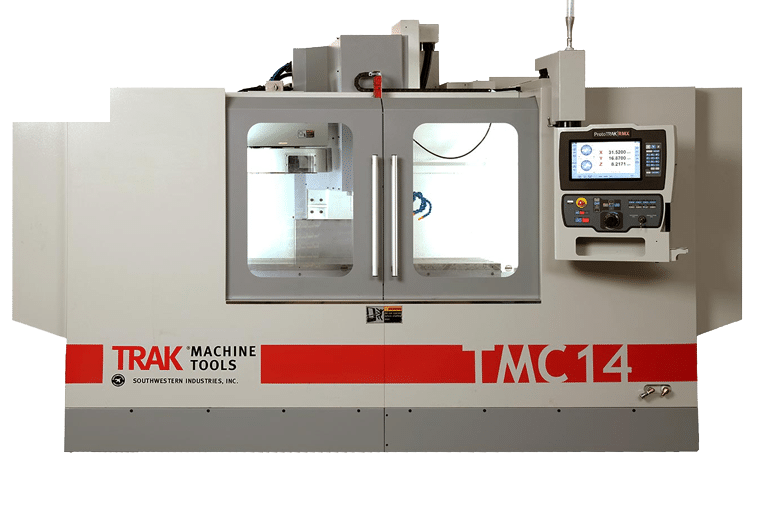
Top TRAK models and specs to know
Specs vary by year, control, options, and exact configuration. Confirm all details on the machine listing before quoting work around a used TRAK.
| TRAK series or model |
Machine type |
Typical specs |
Buyer note |
| DPM KX2 |
CNC bed mill |
ProtoTRAK KMX control, 49 inch x 9 inch table, 31 inch x 16 inch x 23.25 inch travels, 3 HP motor, R8 spindle taper. |
Compact toolroom bed mill for shops that want manual feel with CNC control. |
| DPM RX2 |
CNC bed mill |
ProtoTRAK RMX control, 49 inch x 9 inch table, 31.75 inch x 16 inch x 23.25 inch travels, 3 HP motor, R8 spindle taper. |
Good fit for lower volume toolroom work where space and usability matter. |
| DPM RX3 |
CNC bed mill |
ProtoTRAK RMX control, 50 inch x 10 inch table, 31.5 inch x 17 inch x 25.5 inch travels, 5 HP motor, 40 taper spindle. |
A common used TRAK DPM search because it steps up to a 40 taper and 5 HP motor. |
| DPM RX5 |
CNC bed mill |
ProtoTRAK RMX control, 50 inch x 12 inch table, 41 inch x 20.5 inch x 24 inch travels, 5 HP motor, 40 taper spindle. |
Better fit when a shop needs more X and Y travel than the RX3. |
| DPM RX7 |
CNC bed mill |
ProtoTRAK RMX control, 76 inch x 14 inch table, 60 inch x 23.5 inch x 23 inch travels, 7.5 HP motor, 40 taper spindle. |
Larger bed mill option for longer parts and heavier table work. |
| K3 KMX and K3 RMX |
CNC knee mill |
10 inch x 50 inch table, 32 inch table travel, 16 inch saddle travel, 5 inch quill travel, R8 spindle, 3 HP motor. |
Good for toolrooms, schools, prototype work, and shops that still value manual knee mill workflow. |
| TRL 1630RX |
Toolroom CNC lathe |
16 inch swing over bed, 30 inch distance between centers, 2.12 inch spindle bore, 150 to 2,500 rpm spindle range. |
Smaller TRAK lathe option for toolroom turning and short run work. |
| TRL 1845RX |
Toolroom CNC lathe |
18 inch swing over bed, 45 inch distance between centers, 2.36 inch spindle bore, 80 to 850 and 250 to 2,500 rpm ranges. |
Practical middle range TRAK lathe for many repair, prototype, and short run jobs. |
| TRL 2470RX |
Toolroom CNC lathe |
24 inch swing over bed, 70 inch distance between centers, 4.09 inch spindle bore, 40 to 670 and 100 to 1,800 rpm ranges. |
Worth checking when length and spindle bore matter. |
| TRL 3060RX, 30120RX, 30200RX |
Larger toolroom CNC lathes |
33 inch swing over bed, 60 inch to 200 inch distance between centers, 6.30 inch spindle bore depending on model. |
Larger TRAK turning options for longer shaft work and bigger parts. |
What TRAK is known for
TRAK Machine Tools, a Southwestern Industries brand, is best known for toolroom machines built around the ProtoTRAK CNC. The machines are popular because they let an operator work manually when that is faster, then switch into CNC for repeat work, profiles, hole patterns, and short production runs. That is why TRAK often shows up in job shops, maintenance shops, schools, repair departments, and prototype rooms.
Used TRAK buyers are usually not shopping for the highest production machine on the floor. They are usually looking for a practical mill or lathe that one skilled machinist can use without turning every small job into a full programming project. That makes the control version, handwheel feel, machine condition, and installed options especially important.
What to check before buying a used TRAK
For a used TRAK mill, ProtoTRAK mill, or TRAK lathe, check:
- ProtoTRAK control version, such as KMX, RMX, SMX, or older controls.
- Whether the machine is 2 axis, 3 axis, DRO, or CNC configured.
- Table size, travels, spindle taper, spindle speed range, and motor horsepower.
- Handwheels, servo response, backlash, ballscrews, scales, and overall axis feel.
- Quill condition on knee mills and bed mills.
- Power drawbar, coolant, guards, glass scales, offline programming, DXF converter, and other software or machine options.
- Manuals, software version, service history, and whether the machine can be powered up.
- Parts and support availability for the exact machine generation.
A used TRAK can be a smart buy, but the right machine depends on how the shop actually works. A school may care more about ease of use and safety. A maintenance department may care about fast one-off repairs. A job shop may care about repeatability, DXF import, and whether the control can handle the work without slowing the machinist down.
Options that can make a TRAK more useful
The option package matters on used TRAK machines. Useful items can include electronic handwheels, power drawbar, glass scales, coolant pump, table guard, chip tray, splash shield, work lamp, DXF converter, offline programming, rotary interface, auxiliary functions, and current software support. On TRAK lathes, check turret options, programmable spindle speed, chuck size, spindle bore, steady rest needs, and whether the machine is set up for the type of turning your shop actually does.
Premier can help review the listing details and talk through whether a used TRAK makes sense for your work. If a machine is missing a feature, the decision is not only whether the option exists. The real question is whether the machine still makes financial sense after parts, installation, downtime, and operator training are considered.
Useful TRAK support and manufacturer resources
TRAK has strong official support resources in the United States, including service, manuals, software, replacement parts, and support guides. For used TRAK inventory, quote requests, financing, rigging, and shipping, contact Premier first.
- TRAK Machine Tools official website
- TRAK official contact page
- TRAK customer support page
- TRAK LinkedIn page
Why buy a used TRAK through Premier Equipment
Premier has been in the used CNC business since 1988. Even if the current TRAK page has no live inventory, the page should still help buyers and sellers find the right next step. Buyers can ask Premier about incoming TRAK machines or comparable used mills and lathes. Sellers can use Premier's
sell your CNC machine page if they have a TRAK mill, ProtoTRAK mill, TRAK DPM, or TRAK lathe to sell.
For a used TRAK, the buying decision comes down to fit. Premier can help compare the machine type, control, travels, spindle, installed options, and budget against the work your shop needs to run.
FAQs about used TRAK CNC machines
What types of TRAK machines are common on the used market?
Common used TRAK machines include TRAK DPM bed mills, ProtoTRAK mills, TRAK knee mills, TRAK TRL toolroom lathes, and Southwestern Industries machines with ProtoTRAK controls. Availability changes often, so contact Premier if no TRAK machines are currently listed.
Is ProtoTRAK the same as TRAK?
TRAK is the machine tool brand from Southwestern Industries. ProtoTRAK is the CNC control used on many TRAK machines and retrofits. Buyers often search both names, such as used TRAK mill, used ProtoTRAK mill, and ProtoTRAK mill for sale.
What should I check before buying a used TRAK mill?
Check the control version, axis configuration, table size, travels, spindle taper, spindle speed, quill condition, ballscrews, backlash, handwheels, software options, and whether manuals or support resources are available for that exact machine.
Are TRAK machines good for short run work?
TRAK machines are often used for short run production, toolroom work, repair work, prototypes, and training environments because operators can work manually or use CNC as needed. The right fit depends on the machine condition, control, options, and work being run.
What if Premier does not currently have a used TRAK available?
Contact Premier anyway. Used CNC inventory changes often, and Premier may know about incoming equipment or similar machines. Call
(407) 786-2000 or email
quotes@premierequipment.com with the TRAK model, control, mill or lathe type, and budget you need.