
I’ve been in the used CNC equipment business long enough to know that certain conditions make the used market more attractive — and certain conditions make it less so. Right now, we’re in one of those periods where the case for buying used is as strong as I’ve seen it in years. The reason is straightforward: tariffs have pushed new machine prices up significantly, and the used market hasn’t moved the same way.
That’s not spin. It’s math. And I want to walk through what’s actually happening, because there’s a lot of noise out there and it’s worth cutting through it if you’re sitting on an equipment decision right now.
What Tariffs Are Actually Doing to Machine Tool Prices
The 2026 tariff environment has hit manufacturing from two directions simultaneously.
First, steel and aluminum tariffs — 25% on steel imports, 10% on aluminum — have driven up material input costs. The ISM’s prices-paid index hit 70.5 in February 2026, the highest since June 2022, with steel and aluminum cited as the primary drivers. If you’re machining steel or aluminum parts, your material costs are up. Your customers are feeling it too.
Second, and more directly relevant to equipment decisions: most CNC machine tools sold in the US are imported or contain significant imported components. Mazak machines come from Japan. DMG Mori from Germany and Japan. Citizen, Tsugami, and Star swiss lathes from Japan. Okuma from Japan. Even Haas — the most domestic option in the market — sources components globally. Tariffs on industrial machinery and their components flow directly into the price you pay at the dealer.
| Machine Category | Primary Manufacturing Country | Tariff Exposure | Est. Price Impact |
|---|---|---|---|
| CNC Swiss Lathes (Citizen, Tsugami, Star) | Japan | High — full machine import | 8–15% increase on new pricing |
| Vertical Machining Centers (Mazak, DMG Mori) | Japan / Germany | High — full machine or major components | 8–12% increase |
| CNC Turning Centers (Okuma, Doosan) | Japan / South Korea | High — full machine import | 7–12% increase |
| Haas CNC (US-made) | USA | Moderate — component tariffs | 3–6% increase |
| Used CNC machines (existing US inventory) | N/A — already in country | None | No direct tariff impact |
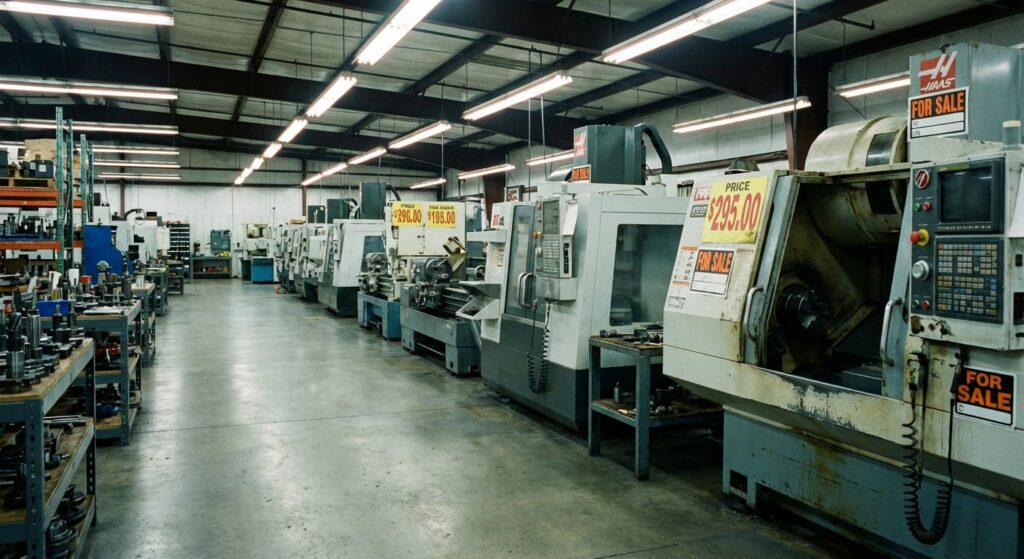
The last row is the point. Used machines already in the US don’t carry new tariff exposure. They were priced and imported before the current rounds took effect. A used Citizen swiss lathe sitting in our facility in Altamonte Springs doesn’t get more expensive because of a tariff announced last month.
The New vs. Used Price Gap Has Widened
I want to be precise here rather than vague. The new-vs-used price gap for CNC equipment has always existed, but it’s widened in 2025–2026. Here’s what that looks like in practice:
| Machine Example | New Price (approx. 2024) | New Price (approx. 2026) | Used Price Range (2015–2020 vintage) | Approx. Savings vs. New |
|---|---|---|---|---|
| CNC Swiss Lathe (Citizen L20) | $230,000–$260,000 | $255,000–$290,000 | $55,000–$100,000 | 60–80% |
| CNC Turning Center (Mazak QT-200) | $120,000–$140,000 | $130,000–$155,000 | $30,000–$65,000 | 55–75% |
| Vertical Machining Center (Haas VF-2) | $75,000–$90,000 | $80,000–$98,000 | $20,000–$45,000 | 50–70% |
| HMC (Mazak HCN-5000) | $350,000–$420,000 | $380,000–$460,000 | $90,000–$180,000 | 60–75% |
These are rough ranges, not quotes. Every machine is different, and condition matters enormously. But the directional picture is clear: you’re looking at 50–80% savings on comparable used equipment, and that gap has grown as new prices have moved up.
The Counterargument — and Why It Usually Doesn’t Hold Up
I hear the same objection every time: “But a new machine comes with a warranty, the latest features, and I know exactly what I’m getting.” That’s fair. Let me respond to each part.
Warranty: New machine warranties are typically one to two years. After that, you’re paying for service either way. A well-maintained used machine from a reputable dealer — with documented inspection — isn’t dramatically more risky than a new machine once you’re past year one.
Latest features: For most production work, the features that matter — sub-spindles, live tooling, Y-axis, Fanuc controls — have been standard on quality machines for over a decade. If you genuinely need a feature that only exists on a machine built in the last two years (Citizen’s latest LFV iteration, for example), then yes, buy new. But that’s a specific requirement, not a general one.
Knowing what you’re getting: This is the most legitimate concern, and it’s why who you buy from matters. We inspect every machine that comes through our facility. Our team has 75+ combined years of shop experience — we know what wear looks like, and we’re not going to sell a machine we’d be embarrassed to stand behind. That’s not a marketing line; it’s what 37 years in this business demands of you if you want to still be here.
What Shops Are Actually Doing Right Now
The manufacturers turning to leasing and flexible payment models as equipment costs rise — that trend is real and accelerating. We’re seeing it too. More shops are asking about financing terms because the capital outlay for new equipment has gotten harder to justify in a single budget cycle.
At the same time, the shops that were already considering used equipment have gotten more serious about it. When the price of a new machine goes up 10–15% in 18 months, the math on used equipment gets notably better. We’ve seen more inbound from shops that were previously new-machine buyers who are now at least having the used conversation.
That’s not a bad thing. It’s shops making rational decisions in a rational way, which is what shop owners do.
How to Think About a Used Equipment Purchase in This Environment
| Question | What to Consider |
|---|---|
| Do I need this capacity in the next 6 months? | If yes, used equipment gets you there faster and at lower cost than waiting for a new machine delivery (typically 6–18 months lead time) |
| Is the feature set of a 5–10 year old machine sufficient? | For most turning and milling work, yes. Verify specific requirements before ruling out older vintages. |
| Can I find a qualified operator? | Fanuc-controlled machines give you the largest operator pool. Proprietary controls narrow your options. |
| What’s my total cost of ownership? | Factor in price, freight, installation, tooling, and first-year service. Used machines typically win on total cost even accounting for potential early maintenance. |
| What’s the resale value if my needs change? | Quality machines from major brands (Mazak, Haas, Fanuc-based) hold value reasonably well. Avoid niche brands with thin used markets. |
The Bottom Line
Tariffs have created an unusual market condition: new machine prices are rising while used machine prices, largely already in the US and priced before the latest tariff rounds, haven’t moved the same way. That gap is real, it’s measurable, and it’s worth factoring into your equipment decision if you’re in the market.
This isn’t a permanent condition — it will normalize over time. But right now, in March 2026, the used CNC equipment market represents unusually strong value relative to new. If you’ve been sitting on a decision, this is probably a good time to make it.
Browse our current CNC inventory or reach out directly. We’ll give you a straight assessment of what’s available, what it will actually cost you to get running, and whether it makes sense for your shop.
Frequently Asked Questions
Are tariffs making used CNC machines more expensive too?
Used machines already in the US don’t carry direct tariff impact — they were imported and priced before the current rounds took effect. However, if demand for used equipment increases significantly as shops shift away from new purchases, prices can rise due to tighter supply. We haven’t seen a dramatic shift yet, but it’s a reasonable thing to watch over the next 6–12 months.
How much longer do new CNC machine lead times take versus buying used?
New CNC machines from major Japanese and German manufacturers typically have lead times of 6–18 months from order to installation, depending on configuration and current factory schedules. Used machines already in a dealer’s facility can often ship within weeks. For shops that need capacity before a contract deadline or to meet growing order backlogs, that lead time difference alone can justify the used equipment decision.
Should I wait for tariffs to change before buying equipment?
Tariff policy is unpredictable. Waiting for policy certainty is a reasonable instinct, but it can also mean missing a window of strong demand. If your shop has a genuine capacity need today, waiting 6–12 months for the tariff environment to clarify means running at your current limits for that entire period. Most shops I talk to are better served by making the decision on the merits of their current situation rather than trying to time policy changes.