
How can shops decide when the part gets big
Large part work has a way of exposing the limits of the machines already on the floor.
A job that looks good on paper turns into a handling problem. A bore is too deep. The part is too tall. The setup eats the margin. The operator has to move the work too many times. The shop can make the part, but it cannot make it cleanly enough, fast enough, or profitably enough.
That is usually when the buying conversation opens up.
Do we need a used CNC boring mill?
A VBM?
A VTL?
A used CNC horizontal machining center?
There is no one answer. The part points the way.
The machine is not the strategy
Shops do not buy a boring mill because the term has search volume. They buy it because the current process is costing them time, accuracy, capacity, or work they cannot quote.
That is the editorial lesson you see in the better machine tool publications. Modern Machine Shop writes past the machine type. Their strongest articles usually start with a shop problem: fewer setups, hard to reach features, large part access, operator limitations, automation, chip control, or the need to win a different class of work.
That is how our Premier Equipment team looks at used equipment, too.
The machine is the answer only after the work is understood.
When a boring mill belongs in the conversation
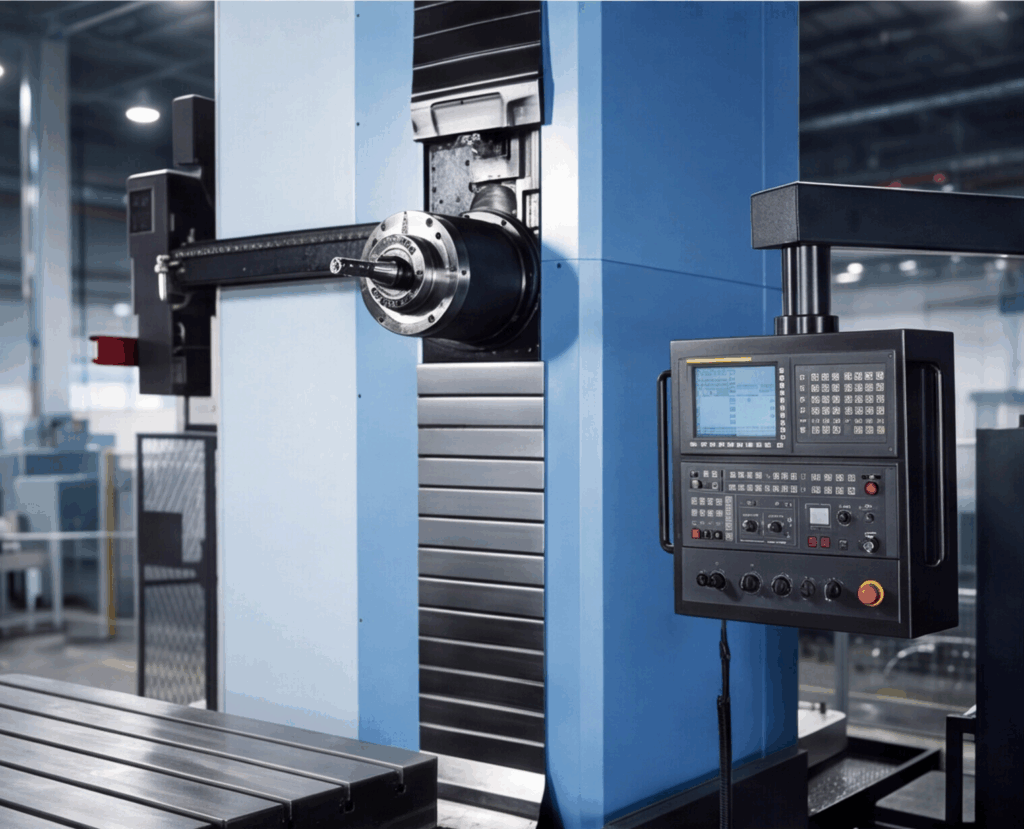
A boring mill starts to make sense when the job needs long travels, spindle access, table capacity, and the ability to machine large bores or surfaces without fighting the setup the whole time.
Horizontal boring mills are often a fit for housings, weldments, castings, machinery bases, large rectangular parts, energy components, repair work, and side-access machining. The horizontal spindle gives you access that a vertical machine may not.
A boring mill buyer should think about the work envelope first:
- How large is the part?
- Where does the spindle need to reach?
- How much table load is needed?
- Does the part need side access?
- Is a rotary table part of the process?
- What material is being cut?
- How much horsepower and rigidity does the job need?
That is not a formal inspection checklist. It is the real buying conversation. If those answers do not fit the machine, the rest of the listing does not matter.
When a VBM or VTL may be the better route
A vertical boring mill or vertical turning lathe may make more sense when the part sits better on a vertical table. Big round parts often do. Rings, valves, wheels, flanges, large castings, and heavy components may be easier to load and support vertically.
That is where Premier’s used CNC VTL and VBM category comes in. A buyer looking for vertical boring mill for sale may actually need a VBM. A buyer looking for a used boring mill may discover the work belongs on a VTL with the right configuration.
The point is not to force the part into the category. The point is to let the part decide which category deserves the first look.
When an HMC deserves a look
A horizontal machining center is not a boring mill, but some buyers should compare both. If the work is repeatable, palletized, multi-side, and production driven, an HMC may solve the problem better than a boring mill.
The advantage is workflow. Pallets, tombstones, chip evacuation, and repeat setups can make a horizontal a strong production machine. If the part size and travels fit, a horizontal may keep the shop moving faster than a big one-off boring setup.
If the job is massive, awkward, or needs true boring mill reach, the HMC may not be enough. Again, the part decides.
What the buyer should bring to the dealer
The best calls we get are not always the longest. They are the clearest.
A useful first call sounds like this:
“We are quoting a family of housings. The largest one is this size. We are fighting the current setup on this bore. The material is this. We need to hold this tolerance. We have this control on the floor now. The job starts in this window. We have this much room.”
That kind of call saves time. It lets us look past the category name and into fit, availability, condition, tooling, freight, rigging, financing, and timing.
Buyers get in trouble when they hide the hard parts of the job. Maybe the timeline is tight. Maybe the building is tight. Maybe the budget needs used CNC financing. Maybe the shop wants to step into bigger work but does not yet know what machine style fits the work it wants to win.
That is normal. It is better to say it early.
Used equipment can change the timing
New equipment has its place. Some buyers want the factory support, installation, training, and warranty structure that comes with a new machine. That can be the right call.
Used equipment is often a different decision. A shop may have a contract now. A current machine may be down. A buyer may need capacity faster than a new machine lead time allows. Or the shop may want to step into a larger machine without tying up the same amount of capital.
Used is not automatically the right answer. The strongest used CNC argument is timing, project justification, budget, and the ability to put capacity into the building when the work is there.
That is why inventory matters. We make updates to our website frequently, and our team can talk through what is on hand, what is incoming, and what may be a better fit than the machine a buyer first asked about.
Condition and context matter more than a pretty listing
Used boring mills, VBMs, VTLs, and horizontals are serious purchases. A clean photo helps, but it does not answer the real questions.
You want context:
- What type of work did the machine run?
- Was it in a high-care shop or a rough environment?
- What control is on it?
- What tooling or accessories are included?
- Can it be seen under power?
- What will it take to move it?
- Does it match the building and the job?
The Association for Manufacturing Technology tracks machine tool orders because machine investment follows real manufacturing confidence and capacity needs. That bigger market context matters, but your shop still has to answer a smaller question, will this machine make your next project and work easier to win and easier to run?
A better first step
If you are unsure whether the job points toward a boring mill, VBM, VTL, or HMC, do not start by locking yourself into one category. Start with the part and the constraint.
If the constraint is side access and large travels, look at used CNC boring mills. If the constraint is large round work and vertical loading, look at used CNC VTL and VBM machines. If the constraint is repeat production with multi-side access, compare used CNC horizontals.
Then call Premier at (407) 786-2000 or email quotes@premierequipment.com. Send the part details and the problem you are trying to solve. We will help you narrow the field before you waste time chasing the wrong machine.
FAQ
Is a boring mill the same as a machining center?
No. A boring mill is typically chosen for large workpieces, long travels, and boring or facing work that needs reach and rigidity. A machining center may be better for repeatable production, palletized work, and smaller parts that fit its travels.
When should I look at a VBM instead of a horizontal boring mill?
Look at a VBM when the part is large, heavy, and better supported on a vertical table, especially if the job involves vertical boring, facing, or large round work.
Can a horizontal machining center replace a boring mill?
Sometimes, but not always. An HMC can be a strong fit for repeat production and multi-side machining, but a boring mill may be needed for larger parts, longer travels, heavier cuts, or specific access needs.
Why does Premier ask about the part before recommending a machine?
The part defines the work envelope, table load, spindle access, tooling, control needs, and facility requirements. The wrong category can look right online and still be wrong on the floor.
Does Premier carry boring mills, VTLs, VBMs and horizontals?
Premier carries used CNC boring mills, VTL and VBM machines, horizontal machining centers, vertical mills, lathes, 5-axis machines, and other used CNC equipment as inventory is available.