
Own a Used Doosan, HELLER? Here’s What It Really Means If You Have One, Or Are Looking.
On January 28, DN Solutions — the Korean company most of you still call Doosan — closed a $227 million deal to buy HELLER, the German horizontal machining center maker. Two brands a lot of our customers own. Now under one roof.
I’ve gotten about a dozen calls about it since the news broke. Mostly variations of the same three questions: Will my parts dry up? Is my resale value going to drop? Should I wait to buy?
28 January: The Korean company that most of you still call Doosan, DN Solutions, closed a $227 million deal to buy HELLER, the German horizontal machining center maker. A lot of our customers have two brands. Now all under one roof.
I’ve gotten a dozen calls on it since it’s been in the news. Mainly permutations of the same three questions: Will my parts dry out? Will it affect my resale value? Should I hold off buying?
Here’s what I’m telling people.
What Actually Happened
January 28, 2026 DN Solutions Completes the Acquisition of HELLER Group.
They purchased 100% of the shares for approximately $227 million U.S.
The deal had to pass muster with regulators in Germany, the U.S. and U.K., and it did.
DN Solutions is now the world’s third-biggest machine tool maker. With HELLER added, the company will generate about $2.4 billion in annual revenue and produce more than 13,400 machines a year. That’s a scale that means they are in real competition, not just nipping at the heels, with Mazak and DMG MORI for the first time.
If you’ve been around long enough to remember when Daewoo Heavy Industries divested its machine tool division in 2016 to become Doosan Machine Tools, then DN Automotive purchased the business in 2022 and rebranded it as DN Solutions, this is the third corporate identity for the same Korean machine tool operation in ten years. But the machines are machines. The factories are still the factories. The badges are always changing.
The key thing the press release got right
HELLER stays HELLER. The brand isn’t being absorbed or renamed. The Nürtingen, Germany headquarters stays open. The Redditch, U.K. plant stays open. Thorsten Schmidt is still running HELLER. Won-jong Kim is still running DN Solutions. Their first joint public appearance was at SIMTOS in Seoul in April — which gives you a sense of how seriously they’re treating this as a partnership and not a hostile takeover.
That matters. Brand-preservation language in press releases isn’t always worth the paper it’s printed on — we’ve all watched companies promise to honor an acquired brand and then quietly bury it in three years. But in this case, the strategic logic actually requires HELLER to stay HELLER. DN Solutions didn’t spend $227 million to buy a name they were going to throw away. They spent it to buy 130 years of German precision-engineering credibility in industries (aerospace, automotive powertrain, defense) where the Korean badge alone wouldn’t open the door.
Why DN Solutions Actually Did This
Honestly, I think DN Solutions had a credibility ceiling in 2 markets they wanted to break into: high-end aerospace and high-end European automotive powertrain. Their Puma lathes and DNM mills compete very well on price and reliability in the broad middle of the market. But when a tier-one aerospace company writes a spec for a $1.2 million HMC cell, the names that come up are Mazak HCN, DMG MORI NHX, Makino a-Series and HELLER MCH or H-series. Not a Doosan.
Buying HELLER is the badge DN Solutions could not buy with marketing. “Now if you’re a Pratt & Whitney supplier or a German OEM looking at HMCs, you have the same parent company with machines up and down the price-and-prestige curve. That’s what $227 million bought you.
Kim Won-jong’s public framing was “combining DN Solutions’ global scale and leading digital platforms with HELLER’s deep technical expertise in precision engineering.” That is CEO language for what I just said in English .
If You Own a Doosan or DN Solutions Machine
Nothing changes for you this year. Probably nothing changes for you next year either. Run your machine.
Longer term — say two to four years out — here’s what I’d expect:
- Parts and service get stronger, not weaker. A bigger combined dealer network is a bigger combined dealer network. Mills CNC in the U.K. and DN Solutions America in the U.S. now have HELLER’s service depth behind them, and vice versa.
- Spindle and ballscrew engineering gets better. HELLER’s spindle and motion-control DNA is going to start showing up in DN Solutions’ next-generation machines. Probably not the 2026 lineup, but by 2028 you’ll see it on the spec sheets.
- Resale stays stable, with slight upward pressure. The Doosan/DN Solutions name just got more credible by association. That helps used values.
Here’s what nobody’s talking about, though
In the past, brand consolidations have driven up parts pricing. Not dramatically, but steadily. In every machine tool acquisition I’ve seen over the last 30 years—and I’ve seen a lot of them—the spare parts pricing on the acquired brand creeps up 8% to 12% within the first two years. Sometimes more . The reason is simple: the bigger company has more pricing power, and the folks who used to negotiate parts contracts at the smaller company aren’t at the table anymore.
So if you have a Doosan and have been delaying a spindle rebuild or a major ballscrew replacement – this is the year. Get a quote now. Now use the quote. That same part is going to be a lot more expensive in 2027.
If You Own a HELLER HMC
Your situation just got better in a way most HELLER owners don’t realize yet.
Here’s the truth about HELLER in the U.S. used market for the last decade: the machines are extraordinary, but the dealer-and-support story has been thin. HELLER has had a U.S. operation, but it’s never been at the scale of Mazak, Haas, DMG MORI, or even DN Solutions. That meant used HELLER prices have been chronically depressed relative to what the iron is actually worth. A 2014 HELLER MCH 400 or H 4000 with low spindle hours regularly trades 15% to 20% below where an equivalent Mazak HCN trades, not because the machine is worse — it isn’t — but because used buyers worry about parts and service support in three years.
That worry just dropped. Maybe not all the way, but materially. The combined DN Solutions + HELLER service network is going to be the third-largest in the world. If you own a HELLER right now, your resale floor just got firmer. If you own a HELLER and you’re waiting to sell or trade up, give it 12 to 18 months for the market to fully price in the new reality.
Caveat I owe you: Korean acquisitions of German engineering can go one of two ways. Sometimes it’s genuine investment — capital flows in, the German engineering teams get bigger R&D budgets, the product gets better. Sometimes it’s cost-engineering — components get sourced cheaper, build quality slowly drifts toward the parent company’s middle of the curve. I have no inside information on which direction this goes. We won’t really know until the 2028 model-year HELLERs ship. For now, the language and the public commitments are pointing in the right direction.
If You’re Shopping a Used Doosan or HELLER This Year
This is the section I’ve had the most calls about. Let me be direct.
Used Doosan / DN Solutions
Still one of the best value plays on the used market. A clean used Doosan Puma 2600 with sub-spindle and Y-axis runs in the high $60s to low $90s depending on year and hours — you’re getting probably 85% of the capability of a comparable Mazak Quick Turn at 60% of the used price. The Doosan DNM 5700 is a workhorse 3-axis VMC that’s priced like an older Haas VF-3 but builds parts like a much more expensive machine.
The acquisition doesn’t change any of this. If anything, it raises the floor over the next two to three years.
Used HELLER
This is the more interesting one. Used HELLER MCH-series and H-series HMCs have been priced for buyers who were nervous about support. That pricing assumption is going to update. Not overnight, but it’s going to update.
If you’ve been on the fence about a used HELLER — specifically an H 4000 or H 6000 (4-axis) or an F 5000 or F 6000 (5-axis) — this is the year to buy. I’d rather have a 2014 HELLER H 4000 with 12,000 spindle hours at today’s prices than a comparable Mazak HCN at Mazak’s prices. The work the HELLER does is at least as good, and you’re buying it before the used market re-rates.
The Bigger Story: DN Solutions + HELLER vs. Mazak vs. DMG MORI
Step back and look at the HMC market for a second.
Mazak’s HCN line is the volume leader in the U.S., backed by their multi-pallet pool integration and a service network nobody touches. DMG MORI’s NHX line is the premium-precision play. Makino owns the high-end mold-and-die and aerospace tiers. Until last month, HELLER and Doosan were both fighting Mazak and DMG MORI from the outside — HELLER from the precision side, Doosan from the value side.
Combine them, and suddenly there’s a company that can compete with Mazak on volume and service network and compete with DMG MORI on precision and aerospace credibility. Same parent company. Two badges, one combined R&D budget, one combined supply chain, one combined dealer network. The full brand-by-brand picture of the used HMC market is here, but the short version is: the top of the HMC market just went from two real choices to three.
For shops in the HMC market, this is good news. More competition between top-tier suppliers means used prices stay rational and new-machine pricing pressure stays alive. The shops that lose are the ones that already paid Mazak or DMG MORI prices on the assumption those were the only two real choices for premium HMC work. There’s a third one now.
The 3 Models I’d Watch in the Combined Lineup
1. HELLER H 4000 / H 6000 (4-axis HMC)
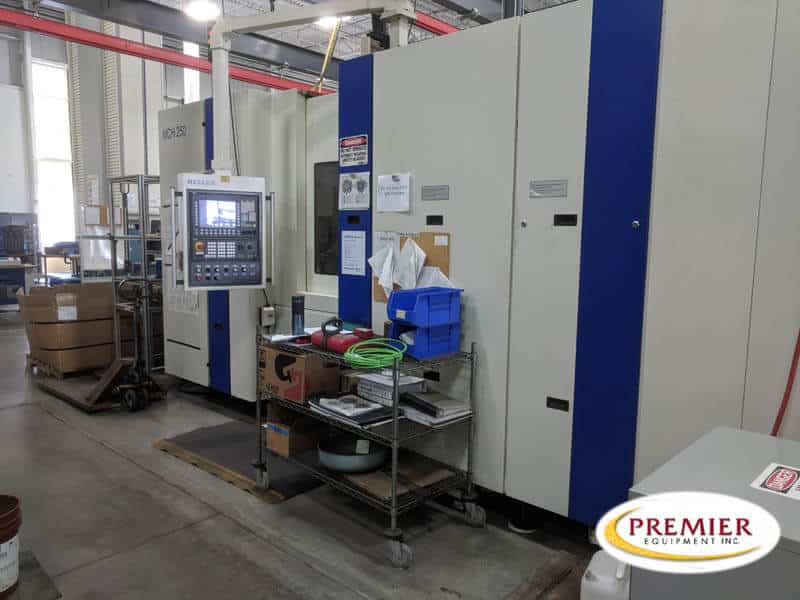
The best HMC value play on the used market right now. Pallet sizes from 400mm to 630mm depending on configuration. Built in Germany or the U.K. depending on year. Siemens 840D control. These machines were built to run automotive powertrain in three-shift production, so anything you can find with under 15,000 spindle hours has effectively been broken in. We’ve had a few come through our floor in Altamonte Springs and they don’t stay long.
2. HELLER F 5000 / F 6000 (5-axis HMC)
If you’re an aerospace job shop or a complex-part medical shop and you’ve been pricing new DMG MORI NHX or Makino a-Series and choking on the number — a used F-series HELLER is the conversation we need to have. HSK-A 100 spindle, swivel head or tilt head depending on configuration, rack-type tool magazine with serious capacity. The build quality is brutal in the good way.
3. DN Solutions HM 6300 (the existing Doosan HMC)
This is the one to watch over the next 24 months. The HM-series is DN Solutions’ existing HMC line — perfectly capable today, priced like Doosan, sized 500mm and 630mm pallets. Within the next product cycle, you’re going to start seeing HELLER engineering DNA in these machines. The 2028 generation is going to be a different beast. Used 2018-2022 HM 6300s are priced as Doosans today. By 2027 they’re going to be priced as something closer to HELLER-influenced HMCs, which means values hold or climb. Buying now is buying ahead of the curve.
What Doesn’t Change
The fundamentals of buying a used CNC machine don’t change because of a corporate acquisition. The things I tell every used buyer to look at — spindle hours, cutting hours versus power-on hours, control generation, way wear, ballscrew condition, the maintenance history if you can get it — those are the same whether the badge says Doosan, DN Solutions, HELLER, Mazak, or anything else.
Premier has been selling Doosan and HELLER machines on the used market for as long as both brands have existed in the U.S. We’re going to keep doing it. The 50,000 square foot floor in Altamonte Springs will keep having HMCs from both brands moving through it. The 38 years of relationships with end-users, riggers, and parts suppliers don’t go away because two companies merged.
If anything, this deal makes our job easier. We sell on machine fundamentals and price, not on brand mystique. When the corporate noise dies down, the question for the buyer is still the same one it’s always been: does this specific machine, at this specific price, with this specific control and these specific hours, make sense for this specific shop’s work? That’s the conversation I’d rather be in than the one about logos.
Mike’s Take — Wait, Buy, or Trade Up?
Quick version, by situation:
- If you own a Doosan or DN Solutions machine and it’s running well: do nothing. Maybe pull forward any major parts or service work you’ve been deferring.
- If you own a HELLER and you’re happy with it: do nothing. Resale floor just got firmer if you ever want to trade up.
- If you’re shopping a used Doosan or DN Solutions: buy now. Pricing today is still Doosan pricing. That re-rates upward over the next 24 months.
- If you’re shopping a used HELLER: buy this year. The used market hasn’t fully priced in the new dealer-support reality yet. The window where you can buy German HMC iron at “nervous about support” prices is closing — see what’s currently on our HMC floor.
- If you’re shopping a new HELLER or DN Solutions machine: wait until after SIMTOS and IMTS 2026 to sign anything. The combined company is going to start announcing joint products and revised lineups. You want to see what’s on the roadmap before you commit.
FAQ
Is Doosan still Doosan?
No, and hasn’t been since 2022. Doosan Machine Tools became DN Solutions when DN Automotive bought the business. Most U.S. shops still call them Doosan out of habit. The machines are the same machines.
Will HELLER still be built in Germany?
Yes. The Nürtingen, Germany headquarters and production site stays open. So does the Redditch, U.K. plant. DN Solutions has publicly committed to continued investment in HELLER’s overseas production facilities.
Will my Doosan parts get more expensive?
Probably, over the next two to three years. Historically, machine tool acquisitions push spare parts pricing up 8% to 12% within 24 months. Nothing dramatic, but real. If you have a major parts purchase coming — spindle rebuild, ballscrew replacement, way regrind — get the quote in 2026.
Should I avoid HELLER on the used market because parts might be hard to find?
No. The opposite is now true. The combined DN Solutions + HELLER service network is going to be the third-largest in the world. Parts support for HELLER in the U.S. just got stronger, not weaker.
What’s the difference between a HELLER H-series and an F-series?
H-series is 4-axis (rotary B-axis table). F-series is 5-axis (rotary B-axis plus a swivel or tilting head for the fifth axis). F-series is what you want for complex aerospace, medical, or mold-and-die contours. H-series is the workhorse for automotive powertrain and high-volume production machining.
Will the combined company actually compete with Mazak and DMG MORI?
Yes. That’s the whole point of the deal. DN Solutions + HELLER combined will do around $2.4 billion in annual revenue and build over 13,400 machines a year. They now have a real product story across the full HMC price-and-prestige curve, from value (Doosan/DN Solutions) to high-end precision (HELLER). For shops in the HMC market, more competition is good news.
Are used HELLER machines a good buy for a first-time HMC owner?
Honestly, no. HELLER machines are precision production tools — they’re built for shops that already know how to run an HMC and want best-in-class spindle and motion accuracy. A first-time HMC owner is better served by a used Doosan HM-series or a used Mazak HCN where the operator learning curve is gentler and the support network is broader. If you’re moving up from your second or third HMC, then HELLER becomes interesting.
If You’re Actually Shopping This Right Now
Here’s what’s on our floor this week: used HMCs from Doosan, DN Solutions, Mazak, and DMG MORI — most under 12,000 spindle hours, most with full tool packages, all inspected by my team before they go on the listing.