
What the MX Strategy Means for Shops Buying New and Used
If you follow the CNC industry at all, you’ve probably noticed that DMG MORI doesn’t do anything small. While other builders are launching individual machines or opening a facility here and there, DMG MORI is trying to reshape how the entire manufacturing process chain works — from the digital planning stage all the way through to the finished part leaving the machine. They’re calling it Machining Transformation, or MX, and whether you agree with the ambition or think it’s overreach, it’s worth understanding because it’s driving everything DMG MORI does right now.
Here’s what’s happening, what’s actually useful, and where it connects to the used equipment market.
The MX Strategy: What It Actually Is
Machining Transformation isn’t a single product — it’s DMG MORI’s framework for how they think manufacturing should evolve. It rests on four pillars: Process Integration, Automation, Digital Transformation (DX), and Green Transformation (GX). The core idea is that shops should be consolidating operations onto fewer, more capable machines rather than running parts across five or six different setups on five or six different pieces of equipment.
DMG MORI’s president, Dr. Masahiko Mori, has been remarkably specific about the end goal. He’s stated publicly that DMG MORI’s mission is to reduce the total number of machining centers installed worldwide from five million to one million by 2055. The idea is that one advanced 5-axis or multitasking machine with integrated automation can replace several conventional 2-axis or 3-axis machines — reducing floor space, operators, energy consumption, and work-in-progress inventory.
Is that realistic? For large aerospace and medical manufacturers, probably yes. For a 20-person job shop running aluminum brackets? Maybe not entirely. But the underlying principle — do more in fewer setups on more capable equipment — is hard to argue with. And it’s the philosophy that shapes every machine DMG MORI designs and sells today.
The LASERTEC 65 DED Hybrid: Six Processes, One Machine
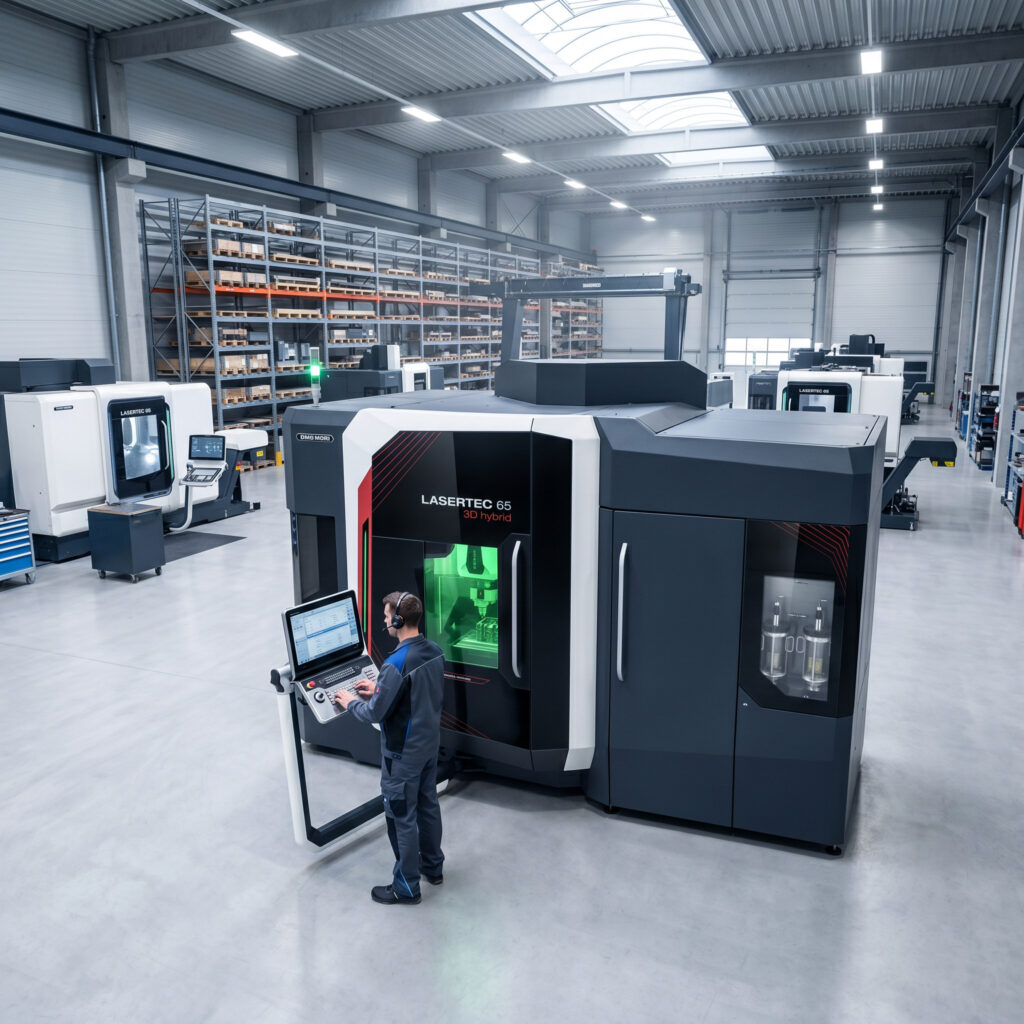
If you want to see the MX philosophy taken to its extreme, look at the LASERTEC 65 DED hybrid 2nd Generation. Built on DMG MORI’s proven monoBLOCK platform, this 5-axis machining center integrates six manufacturing processes into a single setup: milling, turning, grinding, laser preheating, directed energy deposition (additive manufacturing via powder nozzle), and 3D scanning.
What does that actually look like in practice? You can additively build up material — adding wear-resistant coatings, repairing high-value components, or creating complex multi-material geometries — and then mill, turn, and grind the part to finished dimensions without ever unclamping it. The 2nd Generation model increased the workpiece envelope by 170% over the original, with a new MultiJet nozzle that improves build-up rates by 35% and reduces per-part costs by 47% according to DMG MORI.
I’ll be honest — the LASERTEC 65 DED hybrid is not a machine most of our customers are buying. It’s aerospace, defense, energy, and advanced medical territory. But it represents where process integration is heading, and the underlying monoBLOCK platform that it’s built on is the same architecture used in DMG MORI’s more conventional 5-axis machines. That lineage matters when you’re evaluating used DMG MORI equipment.
5-Axis and the DMU/monoBLOCK Series
Take away the additive and hybrid stuff and most shops will actually relate to DMG MORI’s product line with the DMU monoBLOCK series. These machines have earned their stripes in the shop floor – a solid cast construction that gives you serious rigidity and thermal stability in a footprint that won’t have you knocking out a wall. The DMU 65 monoBLOCK offers a footprint of just 12 square meters, bringing 5-axis capability to shops that thought they didn’t have the floor space.
The 2nd Generation monoBLOCK models feature updated spindle technology, extended automation interfaces and the new CELOS X control platform. CELOS X runs on a large, touchscreen ERGOline X panel and integrates with DMG MORI’s job management, monitoring and predictive maintenance capabilities – essentially the company’s answer to the need for smarter, more connected shop floors.
From the automation side DMG MORI now has over 58 solutions from 14 product lines. These include integrated pallet handling systems, such as the PH Cell, through to autonomous mobile robots such as the AMR 2000. Most shops like that it’s modular — you can start with a pallet changer on a monoBLOCK and work up to a full cell automation as your production justifies it.
The New Pfronten Training Center: Investing in People
One of the more significant developments from DMG MORI’s Open House Pfronten 2026 was the inauguration of their new 4,500-square-meter training center at their Pfronten headquarters in Germany. This isn’t a token classroom — it’s a three-story facility that accommodates up to 150 apprentices, dual-study students, and trainees, taking them from basic machining fundamentals on conventional equipment all the way through to advanced automation, robotics, AI, and digital manufacturing.
Why does a training center in Germany matter to a shop in Ohio? Because the skilled labor shortage affects every CNC builder’s customers, and a builder that invests this heavily in training infrastructure is building the next generation of operators and programmers who will know their machines cold. For shops running DMG MORI equipment, that pipeline of trained technicians and service personnel has real long-term value.
U.S. Events: Technology Days in Chicago and Beyond
DMG MORI’s U.S. event calendar for 2026 is active. The Technology Days Chicago event runs May 5–6, 2026 at their Hoffman Estates, Illinois facility, featuring live demonstrations of machines including the NLX 2500 2nd Generation, the NTX 2500 3rd Generation, the ULTRASONIC 65 2nd Generation, and the LASERTEC 30 SLM 3rd Generation additive manufacturing system. They’re also featuring machines built locally at DMG MORI Manufacturing USA, which is a notable emphasis on domestic production.
The event covers MX and Machining Transformation concepts, CELOS X digital solutions, additive manufacturing, and DMG MORI Qualified Products (DMQP) partner integrations. If you’re considering DMG MORI equipment — new or used — these events are worth the trip because you can see the machines cut metal, talk to applications engineers, and get a feel for how the automation and digital tools work in practice.
DMG MORI also recently demonstrated their AI-integrated CNC process chain at Hannover Messe 2026, showcasing complete machining of a titanium rear keel bearing with AI-supported work preparation, tool management, and energy analysis. The focus on aviation, aerospace, medical, die/mold, and semiconductor applications is consistent across all their events and reflects where DMG MORI sees their highest-value customer segments.
What This Means for Used DMG MORI Buyers
Here’s where I want to talk numbers. DMG MORI machines are premium equipment. They’re expensive new, and they hold their value on the secondary market. But the MX strategy and the constant push toward newer platforms means that shops upgrading to the latest monoBLOCK 2nd Generation or the newest NLX/NTX turning centers are cycling out previous-generation machines that are still extremely capable.
The sweet spot right now is DMU 50 and DMU 65 monoBLOCK 5-axis machines from the 2015–2020 era. The monoBLOCK construction is proven, the machines are compact, and they run on well-supported HEIDENHAIN or Siemens controls. You won’t get CELOS X, but the mechanical platform underneath is the same architecture DMG MORI is still building on today. That’s a lot of 5-axis capability for significantly less than a new machine.
On the turning side, NLX 2500 and NLX 3000 lathes remain strong performers: box-way construction, BMT turrets, Y-axis and sub-spindle options. If your work demands turn-mill capability, NTX 1000 and NTX 2000 multitasking machines were top-of-the-line when they were new and still outperform most production requirements today.
Shops looking for more accessible entry points into DMG MORI quality should consider DMC V and CMX V series vertical machining centers for 3-axis or 3+2 work. And if unattended machining is on your roadmap, NHX 4000 and NHX 5000 horizontals are hard to beat. Most come with pallet changers already installed, and the horizontal spindle orientation handles chip evacuation naturally.
We carry DMG MORI equipment across our inventory, including 5-axis mills, turning centers, multitasking machines, and horizontals. If you’re looking for DMG MORI quality at a price that works for your shop, we can help.
Browse our used DMG MORI inventory or call us at (407) 862-8338. Our team knows these machines inside and out.
Frequently Asked Questions
What does DMG MORI’s Machining Transformation (MX) strategy actually mean for a small shop?
MX is all about bringing manufacturing processes together on fewer, more capable machines – reducing setups, floor space and operator dependency. The most practical takeaway for a small shop is the move toward 5-axis machining and multitasking. If you are currently running a part on a 3 axis VMC and then switching it over to a lathe, an MX aligned approach would be to run both operations on a single turn-mill or 5 axis machine. But you don’t need the whole digital platform from DMG MORI to take advantage of that philosophy, even a used 5-axis or multitasking machine from any major brand offers the same process integration advantage.
Are used DMG MORI machines expensive to maintain and service?
DMG MORI machines typically run on HEIDENHAIN, Siemens, or FANUC controls, all widely supported with extensive parts and service networks. The machines themselves are built to tight tolerances with premium components, which means they tend to hold accuracy longer than budget alternatives. Service can be accessed through DMG MORI’s own network or through independent CNC service providers familiar with these platforms. Spare parts are available through DMG MORI’s online parts shop, which has improved parts access significantly in recent years. Overall, the total cost of ownership is competitive with other premium builders like Mazak and Okuma.
How does DMG MORI’s 5-axis monoBLOCK compare to Mazak or Okuma 5-axis machines?
All three builders make great 5-axis platforms, but they do it differently. DMG MORI’s monoBLOCK has a one-piece cast construction with a trunnion table design that emphasizes rigidity and compact footprint. The VARIAXIS series from Mazak uses a similar trunnion approach, but with the MAZATROL control, which many operators prefer for its conversational programming. Okuma, on the other hand, takes a totally different approach. Its MU-series runs on the proprietary OSP control with the Thermo-Friendly Concept for thermal stability, and it is attractive to shops that run long unattended cycles. Choosing the right option boils down to what your operators prefer for control, your local service network and the particular work envelope you require. All three hold their value well on the used market.
Sources
- DMG MORI — Machining Transformation (MX) Overview
- LASERTEC 65 DED hybrid 2nd Generation — Product Page — DMG MORI USA
- More Productive Thanks to Hybrid Complete Machining — LASERTEC 65 DED — January 2026
- LASERTEC 65 DED Hybrid 2nd Gen. Advances Multi-Process Additive Manufacturing — MTDCNC, February 2026
- Progress Report on DMG MORI’s Machining Transformation — Aerospace Manufacturing and Design
- DMG MORI Open House Pfronten 2026 — December 2025
- DMG MORI Open House 2026 — Machine Maker — December 2025
- DMG MORI’s New Training Campus — MTDCNC — March 2026
- DMG MORI Technology Days Chicago 2026 — MTDCNC — April 2026
- DMG MORI Integrates AI Across CNC Turn-Mill Process Chain — Hannover Messe — April 2026
- DMG MORI Digital Transformation at EMO — September 2025
- DMG MORI, Haimer Expand Strategic Partnership — Production Machining, November 2025