
If Mazak has been busy expanding facilities and launching premium platforms, Haas has been busy doing what Haas does best: filling gaps in their lineup, making automation more accessible, and keeping prices at a level where shops of all sizes can actually participate. Over the past year, Haas has rolled out an extensive product refresh that spans new vertical mills, lathes, gantry machines, automation packages, and even their own tooling line. And they’ve been active on social media showing exactly how real shops are using this equipment.
Here’s what’s worth paying attention to, and what it means for shops in the market right now.
The Product Lineup Has Never Been This Deep
Haas has always had a broad catalog, but what they’ve done recently is genuinely impressive in terms of filling every conceivable niche.
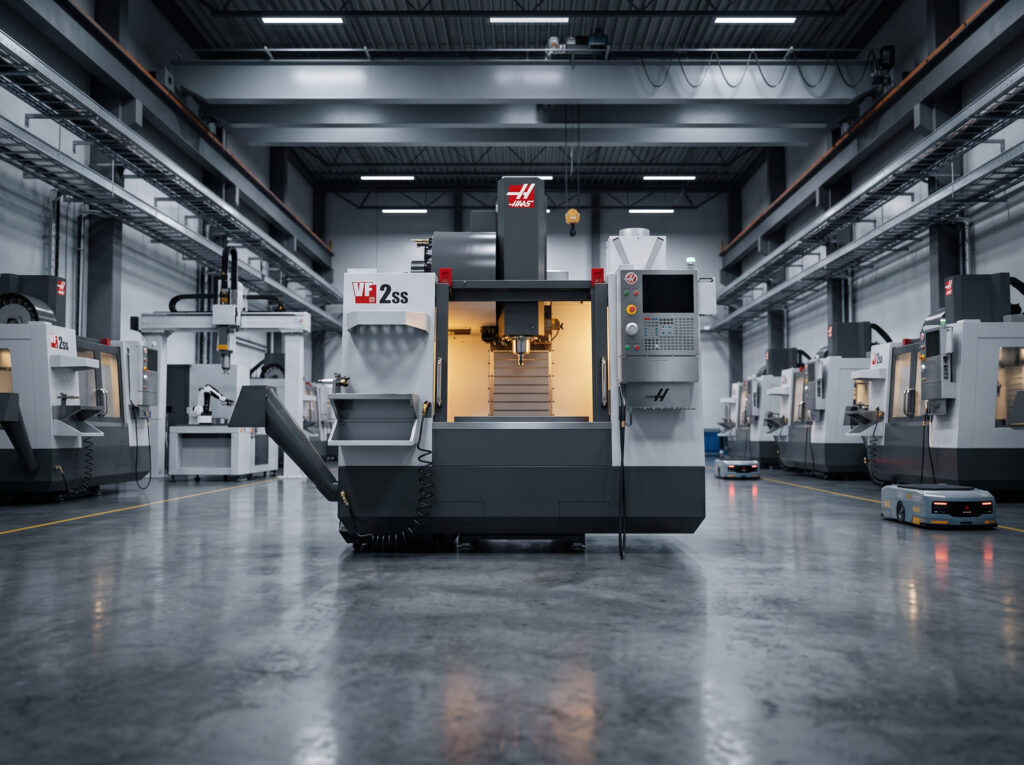
On the milling side, the VF and VM Super-Speed series continue to get refined. The VF-2SS remains their most popular Super-Speed model, and the entire SS lineup features 12,000-rpm inline direct-drive spindles, ultra-fast side-mount tool changers, and high-speed rapids on all axes. For shops that need to move fast on aluminum or do a lot of drill-and-tap work, these machines punch well above their price point. The VM series continues to serve the mold and die crowd with configurations optimized for precision surface finishing.
Where things get really interesting is on the larger end. The GM-1 gantry mill gives shops a heavy-duty 3-axis platform with 121 by 61 by 16 inches of travel, built for large-part machining like airframe components, large plates, and long extrusions. The GM-1XT extends that X-axis travel to 142 inches. These are cast-iron construction machines with 40-taper inline direct-drive spindles, and for the price they represent a genuinely compelling entry into gantry machining that was previously dominated by European and Japanese builders at much higher price points.
The VS-3-5AX takes things even further — it’s a large-frame, bed-style machining center with 5-axis cutting capacity, a 20,000-rpm HSK-A63 spindle, and a 70+1 tool side-mount tool changer. The dual-axis head supports the spindle from both sides for rigidity and handles parts up to 10,000 pounds. Is it competing with a DMG Mori or Okuma bridge mill? Honestly, no. But for composite work, aluminum aerospace structures, and mold finishing, it opens doors for shops that couldn’t previously afford 5-axis gantry capability.
And the 5-axis UMC line — the UMC-500, UMC-750, and UMC-1000 — continues to be one of the best value propositions in simultaneous 5-axis machining. These machines are showing up in shops that never thought they could afford 5-axis, and that’s exactly the market Haas is targeting.
Lathes: Bigger Bores, Dual Spindles, and Box Ways
The lathe side of the Haas catalog has been getting steady attention too. The ST-55 sits at the top of the turning lineup with a 12.5-inch bore, 34.5-inch swing, 55 hp vector drive, and front and rear A1-20 spindle noses. This is an oilfield and heavy industry machine, and it fills a need that smaller Haas turning centers can’t touch. The ST-45 and ST-50 round out the large-bore options for shops working with pipe, large diameter stock, or heavy forgings.
The DS (dual-spindle) models — the DS-25Y and DS-30Y — are where Haas is making its clearest “done-in-one” play. These machines combine dual-spindle turning with Y-axis, C-axis, and live tooling through a 12-station BMT65 turret. The opposed spindles support fully synchronized turning with on-the-fly part pass-off. For shops running parts that currently require two operations on two machines, this is a straightforward ROI calculation.
Then there’s the SB Series, the box-way lathes. For shops doing heavy-duty cutting where rigidity and vibration damping matter more than speed, the SB-28, SB-35, and their Y-axis variants offer the high dynamic stiffness and load-bearing capacity of traditional box-way construction with the same easy-to-use Haas control found across the entire product line. These machines are built for interrupted cuts, tough materials, and applications where a linear-guideway lathe would chatter.
Automation: Haas Is Making It Harder to Say “We Can’t Afford It”
This might be the most significant part of the Haas story right now. They’ve built out a complete automation ecosystem that integrates directly through the Haas control — no third-party integrator required.
The cobot kits start with the HC10, a 10 kg capacity collaborative robot that comes as a complete plug-and-play package including dual pneumatic grippers, protective barriers, a mounting base, a parts table, and all necessary hardware and cables. For shops that have been putting off automation because of cost and complexity, this is designed to remove both excuses.
The robot packages scale up from there. The HRP-2 handles 25 kg parts with a 6-axis industrial robot, mounting pedestal, software interface, electrical interface box, safety guarding, and all necessary hardware. The HRP-3 adds even more capacity. All of these control directly from the Haas machine — same interface your operators already know.
Then there are the pallet pool systems, which let shops load multiple jobs across multiple pallets and run unattended. The onboard Haas pallet scheduler lets you prioritize jobs, skip work you don’t need, and squeeze in rush orders. For UMC and VMC owners, this is genuinely useful automation that doesn’t require a systems integrator or a PhD in robotics.
And the Robotic Pallet Loaders combine a Haas 25 kg robot with a loading station, light curtain, pallet rack, and zero-point pallets for high-mix, low-volume or high-volume production. It’s all plug-and-play with the Haas control.
The Pocket Mill: CNC for Under $30K
I have to mention the Pocket Mill because it represents something philosophically important about where Haas is headed. This is a legitimate 40-taper vertical machining center — not a hobby machine — that starts at approximately $27,000. It can run on single-phase or three-phase power. You can add a 10-pocket tool changer, upgrade the spindle to 6,000 or 8,000 rpm, bolt on a 4th or 5th axis rotary, and run actual production parts.
Is this the machine for a production shop doing 10,000 parts a month? Obviously not. But for startup shops, schools, garage machinists, prototype operations, and secondary-op machines, it’s a genuine CNC at a price point that removes the barrier to entry. And it runs the same Haas control as every other machine in their lineup, which means an operator who learns on a Pocket Mill can step onto a VF-5 without missing a beat.
Social Media: Showing Real Work, Not Just Brochure Shots
One thing I’ll give Haas credit for is their social media presence. Their X accounts (@Haas_Automation and @HaasUK) consistently highlight practical innovations rather than corporate marketing fluff. Recent posts have featured smart fixturing setups, robot packages positioned as “new coworkers” for shorthanded shops, and 5-axis window machining techniques demonstrated by actual customers.
They’ve been sharing content from shops like Marvel Machining showing what’s possible with multi-axis capability, and regularly referencing their leadership in multi-axis machining since 1983. The focus is consistently on measurable performance and longevity — how many parts per shift, how many years the machine runs, what the actual ROI looks like. That kind of content resonates with the shop owners I talk to every day because it’s not theoretical. It’s chips flying and parts coming off.
What This Means for Used Haas Buyers
Here’s the thing about Haas that makes the used market so compelling: they build a lot of machines. Haas is the largest machine tool builder in North America by unit volume, and that volume creates a healthy, liquid used equipment market. Parts are everywhere. Every HFO (Haas Factory Outlet) in the country can service these machines. Your operators probably already know the control.
When Haas releases new models — like the gantry mills, the SB box-way lathes, the expanded DS dual-spindle line — the previous-generation machines from shops upgrading to the new stuff enter the used market at significant discounts. And because the Haas control has been essentially the same architecture for years, even a machine from 2012 runs fundamentally the same software as one built last year.
Used Haas Models That Get the Job Done at the Right Price
If the new Super-Speed VF mills caught your eye, used VF-2SS and VF-3SS machines from the 2015–2020 era are outstanding values. You get the same 12,000 rpm direct-drive spindle and fast tool changer in a proven package. Standard VF-2 and VF-3 models are even more affordable and they remain the workhorses of the American job shop for good reason.
If the DS-30Y dual-spindle has you thinking about done-in-one turning, used Haas ST-20Y, ST-30Y, and ST-35Y machines give you live tooling and Y-axis capability at a fraction of the dual-spindle price. They won’t do the sub-spindle handoff, but for a lot of shops, the Y-axis and C-axis on a single-spindle lathe is the more practical first step.
For shops attracted to the UMC 5-axis machines, used UMC-750 units from 2016–2020 represent some of the best value in 5-axis machining, period. The trunnion design is proven, the control is intuitive, and the machines are compact enough for most shop floors.
And for anyone looking at the SB box-way lathes for heavy-duty turning, used Haas ST-40 and ST-45 machines offer big-bore, high-horsepower turning at prices that make the math easy. The linear guideways on the ST series handle most applications just fine, and you’ll find plenty of inventory to choose from.
We carry Haas equipment across our entire inventory — VF mills, ST and SL lathes, UMC 5-axis machines, and EC horizontals. Give us a call and we’ll match you with the right machine.
Browse our current used Haas inventory, or call us at (407) 862-8338. We’ve been selling used Haas machines for 37 years — we know what holds up and what to look for.
Frequently Asked Questions
Is a used Haas CNC machine a good investment for a small shop?
For most small to mid-size job shops, used Haas machines are one of the best investments you can make. The Haas control is the most widely used CNC platform in North America, which means your operators probably already know it or can learn it fast. Parts and service are readily available through the HFO network, and the machines hold up well when properly maintained. We see Haas VF mills and ST lathes from the 2010–2018 era running production parts every day in shops across the country.
What’s the difference between a Haas ST series lathe and an SB box-way lathe?
The ST series uses linear guideways, which provide faster rapid traverse speeds and are ideal for most general-purpose turning, lighter cuts, and higher-speed applications. The SB series uses traditional box-way construction, which provides superior vibration damping, higher rigidity, and better performance for heavy interrupted cuts, tough materials, and large-diameter work. If you’re doing a lot of heavy roughing in steel or Inconel, box ways are worth considering. For general job shop work, the ST series is typically the better fit.
How does Haas automation compare to standalone robot integrators?
The biggest advantage of Haas automation — cobots, robot packages, and pallet pools — is that everything integrates directly through the Haas control. You don’t need a third-party integrator, a separate PLC, or specialized programming knowledge. Your machinists can set up and run the automation from the same interface they use to run the machine. The tradeoff is flexibility: a standalone integrator can build a custom cell that serves multiple machines from different manufacturers. But for shops adding automation for the first time, the Haas plug-and-play approach is hard to beat on cost, simplicity, and time to production.
Sources
- Haas Automation — Product Pages
- Haas VF-2SS Super Speed Vertical Mill
- Haas GM-1 Gantry Mill
- Haas GM-1XT Extended Gantry Mill
- Haas VS-3-5AX Large-Frame 5-Axis VMC
- Haas DS-30Y Dual-Spindle Turning Center
- Haas SB Series Box Way Lathes
- Haas Pocket Mill
- Haas CNC Machine Automation Systems
- Haas Cobot Kits
- Haas Robotic Pallet Loaders
- Haas VMC Automation
- Haas Automation UK — Robot & Cobot Packages
- Haas Automation — Wikipedia