
A Practical Guide for CNC Shops
I talk to shop owners every week who are turning down work. Not because they don’t have the machines — because they don’t have the people to run them. The skilled labor shortage in CNC machining isn’t a future problem. It’s the reason your competitor just lost a contract and the reason you’re paying overtime rates for Saturday shifts that still aren’t enough.
According to a study by Deloitte and The Manufacturing Institute, the U.S. manufacturing sector could face a shortfall of 2.1 million skilled workers by 2030, at a potential cost of $1 trillion to the economy. The Bureau of Labor Statistics projects roughly 35,400 machinist openings every year through 2033, mostly to replace retirements — not to fill new positions. The median age of machinists is pushing 47 years old, and machine shops specifically have the oldest workforce of any manufacturing subsector at a median age of 49.
The math is clear: you cannot hire your way out of this. But you can engineer your way through it. That’s where unattended machining comes in — and it doesn’t require buying a fleet of new equipment to get started.
What Unattended Machining Actually Means
Let me be clear about terminology, because “lights-out manufacturing” gets thrown around in ways that don’t reflect reality for most shops. True lights-out — where a facility runs with zero humans on site for entire shifts — is real, but it’s the domain of high-volume production operations with significant engineering resources. Okuma’s Dream Site factories in Japan, for example, run automated cells 24/7 with skeleton staffing, and Okuma reports 30% higher throughput and up to 50% shorter lead times from that approach.
For most small to mid-size shops — the 10 to 50-person operations we work with every day — the realistic goal isn’t fully dark. It’s what I’d call “lights-sparse” machining: running machines unattended for an extra shift or two with one operator monitoring multiple cells remotely, then having your day crew pick up where automation left off. That might mean running your lathes through a second shift with bar feeders and probing, or loading up a pallet pool on your HMC at 4:30 PM and letting it run until your crew walks in at 7 AM.
The goal isn’t to eliminate operators. It’s to multiply what each operator can produce and capture the 16 hours per day your machines are currently sitting idle.
The Technology That Makes It Work
Unattended machining isn’t one product — it’s a combination of technologies working together. Here’s what matters most.
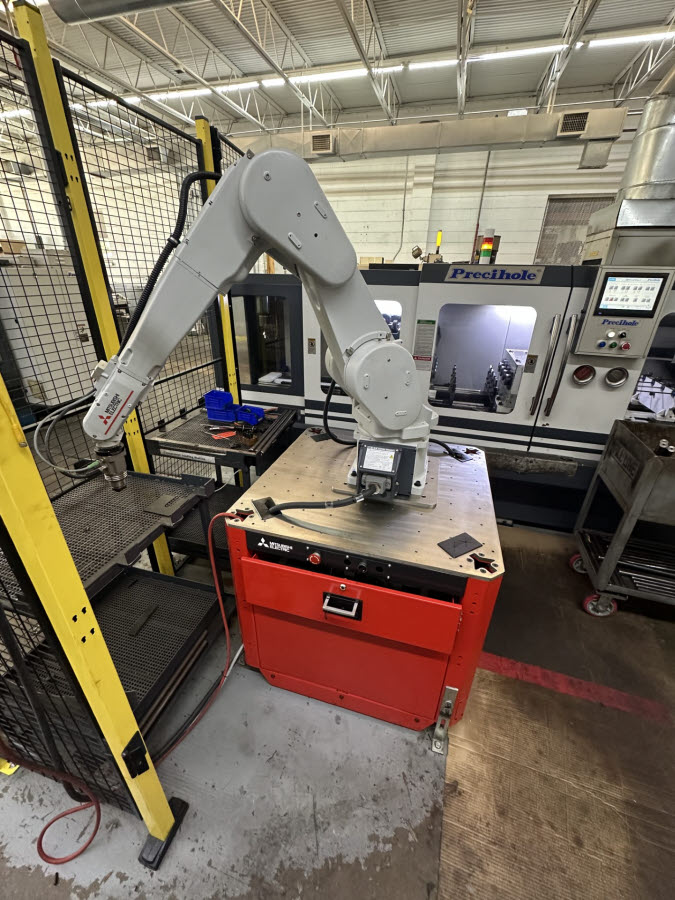
Automated part loading is the foundation. For lathes, that usually means a magazine-style bar feeder that continuously supplies raw stock without operator intervention. For mills, you’re looking at pallet changers, pallet pool systems, or robotic part loaders. Haas offers plug-and-play cobot kits starting with 10 kg capacity that integrate directly through their control. Mazak’s Ez LOADER uses a standalone cobot with a programmable logic controller for hassle-free integration. Okuma offers everything from basic bar feeders to full FMS solutions through their Factory Automation Division. The common thread across all these brands is that the automation integrates through the machine control itself — you don’t necessarily need a separate PLC or a third-party integrator to get started.
In-process probing is what turns unattended operation from risky to reliable. A spindle-mounted or turret-mounted probe lets the machine verify workpiece position before cutting, measure critical features mid-cycle, and detect tool wear or breakage before it becomes a scrap problem. Renishaw is the name most shops know here, and their probing systems are available for virtually every CNC brand. When your machine can check its own work and adjust offsets automatically, you’re removing the most common reason an operator needs to babysit a cycle.
Tool life management is critical for extended unattended runs. Most modern CNC controls — including Haas, Mazak MAZATROL, Okuma OSP, and FANUC — support tool life counters that track usage and automatically call a sister tool when the primary reaches its limit. The control swaps to the backup tool without stopping the program. For a 12-hour unattended run, having redundant tooling in the magazine is the difference between waking up to finished parts and waking up to a crashed spindle.
Chip management and coolant systems are the unglamorous essentials that shops underestimate. A chip conveyor that clogs at 2 AM stops your production just as effectively as a broken tool. High-pressure coolant systems improve chip evacuation in deep bores and pockets, and coolant chillers maintain thermal stability over long runs. These aren’t optional accessories for unattended work — they’re requirements.
Remote monitoring closes the loop. Even in unattended operation, someone needs to know if a machine stops. Most current-generation CNC controls offer some form of remote notification — Haas has HaasConnect, Mazak offers MAZATROL DX and iCONNECT, and third-party systems like Caron Engineering’s MiConnect can aggregate alerts from mixed-brand shop floors. At minimum, you want a text or email notification when a machine alarms out. Better yet, mount a camera inside the enclosure so your on-call person can diagnose the issue without driving to the shop.
Which Machines Are Best Suited for Unattended Operation
Not every machine type automates equally, and this is where realistic expectations matter.
CNC lathes are the easiest starting point. They come standard with hydraulic workholding, most have chip conveyors, and adding a bar feeder is a straightforward bolt-on. A lathe with a bar feeder, probing, and a parts catcher can run unattended for hours with minimal investment beyond the feeder itself. If you’re running families of bar-fed parts, this is the lowest-risk, highest-return entry point into unattended production.
Horizontal machining centers are the most automation-friendly milling platforms. The horizontal spindle orientation means gravity helps with chip evacuation instead of fighting it. Pallet changers are standard or available on most HMCs, and pallet pool systems can queue up multiple jobs for extended unattended runs. If you’re evaluating a used machine specifically for unattended capability, an HMC with a pallet changer should be near the top of your list.
Vertical machining centers require more thought. Chip evacuation is the primary challenge — chips tend to accumulate on the workpiece and around the vise instead of falling clear. You’ll need a good chip conveyor, high-pressure coolant or air blast, and reliable workholding. Adding a cobot or robotic loader to a VMC is absolutely doable, but it adds complexity compared to the inherent automation-friendliness of a lathe or HMC.
Multitasking machines — turning centers with milling capability — are increasingly viable for unattended work because they reduce the number of setups required. If your part currently requires a lathe operation followed by a mill operation with a manual transfer between machines, a multitasking machine eliminates that handoff entirely. One setup, one machine, one unattended run.
How to Make Unattended Machining Work on Used CNC Equipment
Here’s the part of this conversation that doesn’t get enough attention: you don’t need a brand-new machine to run unattended. The vast majority of CNC machines built in the last 15 years have the control architecture, connectivity, and option packages to support some level of unattended operation. The key is knowing what to look for and what to add.
Start by evaluating whether the machine has (or can accept) a bar feeder or pallet changer interface. Most used Mazak Quick Turns, Haas ST-series lathes, Okuma LB-series lathes, and Doosan Lynx models were built with bar feeder interfaces ready to go. Used Mazak HCN and Haas EC-series horizontals typically come with pallet changers already installed.
Next, check for probing capability. If the machine has a Renishaw or equivalent probe interface in the control — even if the probe itself isn’t installed — adding one is a relatively inexpensive retrofit. Many used machines were sold with probing options that the original owner never fully utilized, which means the hardware and wiring are already in place.
Tool magazine capacity matters for unattended runs. A machine with a 20-tool magazine can run unattended on a single job, but if you want to stage sister tools for redundancy, you’ll want 40 or more positions. Used machines with side-mount tool changers or expanded magazines are worth the premium in this context.
Finally, make sure the chip conveyor and coolant system are in good working order. These are the components most likely to have been neglected on a used machine, and they’re the ones that will shut you down during unattended operation. A good chip conveyor and a functioning coolant chiller are non-negotiable.
At Premier Equipment, we see shops building highly capable unattended cells around used Mazak Quick Turn 200 and 250 lathes with bar feeders, used Haas EC-400 horizontals with pallet changers, and used Okuma MB and MA-series HMCs. These are proven platforms with strong automation ecosystems, and they’re available at prices that make the ROI math work for a 15-person shop — not just for a Fortune 500 operation.
Browse our current inventory, or call us at (407) 862-8338. We can help you identify used machines that are ready for unattended operation — or close to it with a few smart upgrades.
Frequently Asked Questions
Can any CNC machine run unattended, or does it need to be a specific type?
Any CNC machine can theoretically run unattended, but some platforms are far better suited than others. Lathes with bar feeders are the easiest entry point because hydraulic workholding and chip conveyors are typically standard. Horizontal machining centers with pallet changers are the most automation-friendly milling option. Vertical machining centers require more attention to chip evacuation and part loading, but they can run unattended with the right accessories — a cobot or APL, in-process probing, and reliable coolant management. The most important factors are machine reliability, automated workholding, tool life management, and a way to monitor the machine remotely.
How much does it cost to set up a used CNC machine for unattended operation?
The cost varies widely depending on what the machine already has and what you need to add. A magazine bar feeder for a used lathe typically runs $15,000 to $30,000 installed. A Renishaw probing system can be added for $5,000 to $15,000 depending on the machine and configuration. Cobot packages from Haas start around $30,000 to $50,000 as plug-and-play kits. If the used machine already has a pallet changer and probing, your additional investment might be minimal — perhaps just a coolant chiller and remote monitoring setup. Most shops see payback within 6 to 18 months through increased output and reduced per-part labor costs.
Does running unattended mean I need fewer operators?
Not necessarily — and for most shops, that’s not even the goal. Unattended machining lets each operator manage more machines and produce more parts per shift. Instead of one operator standing in front of one machine loading parts all day, that same operator can oversee three or four automated cells while spending their time on higher-value tasks like programming, quality inspection, and setup for the next job. The shops I talk to aren’t laying people off because of automation. They’re finally able to accept the work they’ve been turning down because they didn’t have enough hands on the floor.
Sources
- Deloitte and The Manufacturing Institute — 2.1 Million Manufacturing Jobs Could Go Unfilled by 2030
- U.S. Bureau of Labor Statistics — Machinists and Tool and Die Makers Occupational Outlook
- Deloitte — A Shrinking Workforce May Thwart US Manufacturing Ambitions
- Modern Machine Shop — 4 Key Growth Opportunities to Boost the CNC Machining Workforce
- Okuma — Lights On or Lights Off: Shop Automation Shines
- MSC Industrial Supply — Lights-Out Manufacturing: Essential Elements for Automation
- Production Machining — Checklist for Lights-Out Manufacturing
- Production Machining — Getting Ready for Lights-Out Manufacturing
- Haas Automation — Cobot Kits
- Mazak — Ez Machines at Expo Manufactura 2026
- Renishaw — Machine Tool Probing
- Caron Engineering — Lights-Out Machining Solutions
- AMT — Lights-Out Manufacturing
- National Association of Manufacturers — 2.1 Million Jobs Study