
What It Is, Why It Matters, and What It Means for Used Okuma Owners
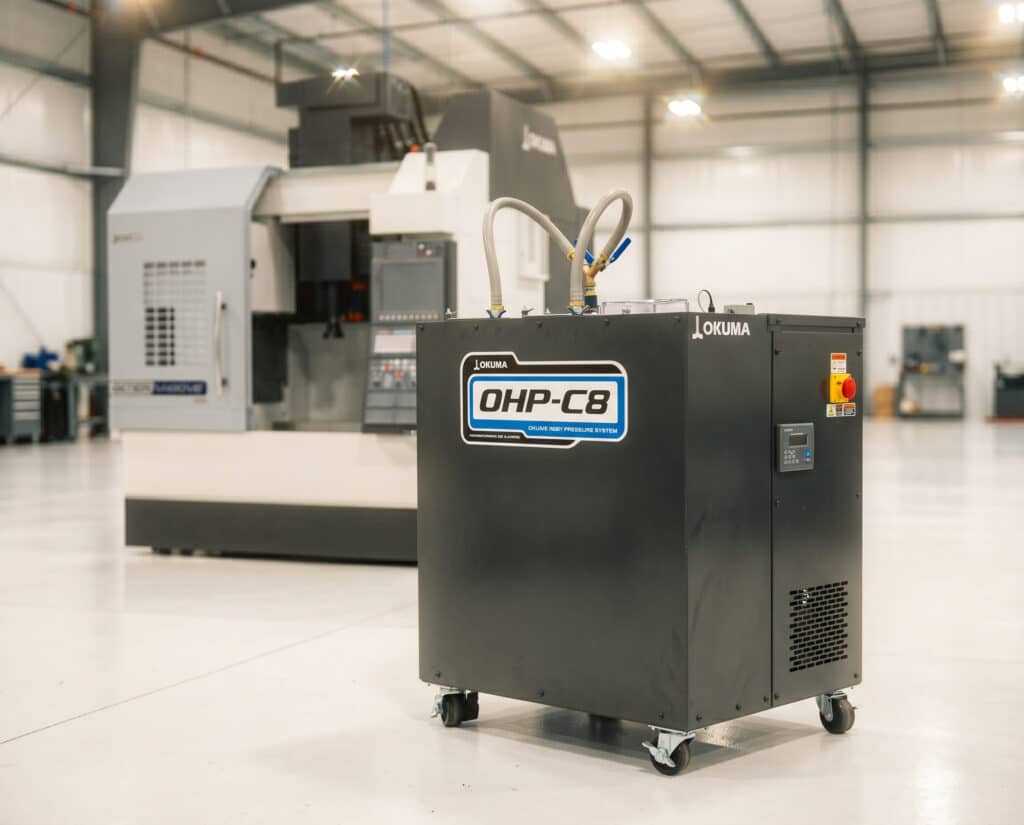
Okuma just quietly made a move that tells you a lot about where the CNC industry is heading. On April 14, 2026, Okuma America announced the release of their new High-Pressure Coolant System, branded the OHP. It’s not a new machine tool. It’s not a new control. It’s a peripheral — a coolant delivery system designed to bolt onto Okuma lathes, multi-function machines, and machining centers.
And honestly, that’s exactly what makes it interesting. Because the story here isn’t just about coolant pressure. It’s about Okuma building out a complete single-source ecosystem where the machine, the control, the automation, and now the supporting peripherals all come from one manufacturer and work together seamlessly. For shops running Okuma equipment — new or used — that ecosystem approach has real practical value.
What the OHP Actually Does
FYI: OHP stands for Okuma High-Pressure
Let me walk through the specs, because they matter.
The OHP system delivers 1,000 PSI of coolant pressure at a variable flow rate of up to 8 gallons per minute. That’s serious pressure — roughly 10 to 15 times what a standard machine tool flood coolant system delivers. At that pressure, coolant isn’t just washing chips away. It’s breaking chips at the point of cut, penetrating the tool-to-workpiece interface, and removing heat far more effectively than low-pressure flood can manage.
Filtration is handled by dual 7-by-32-inch, 5-micron quick-change filter bags. The 5-micron rating is worth noting — that’s fine enough to keep your coolant clean enough for high-pressure nozzles without clogging. The quick-change design means filter swaps don’t require tools or extended downtime. There’s also a dirty-filter alarm built into the system, so operators get a clear alert when the filters need service instead of finding out the hard way when coolant pressure drops mid-cut.
The system uses a 50-gallon vertical reservoir with a built-in feed and supply pump, runs on standard 208/230V power with a 480V option, works with both water-based coolants and suitable oils, and comes with a two-year parts warranty. The footprint is compact — 36 inches long by 28 inches wide by 42 inches high, weighing 850 pounds. It’ll fit alongside most machines without eating up valuable floor space.
One of the quieter but genuinely useful features is the plain-English PLC messaging. Rather than cryptic alarm codes that send your operator scrambling for a manual, the OHP communicates in straightforward language. That kind of design detail tells you Okuma is thinking about the operator experience, not just the engineering spec sheet.
Why High-Pressure Coolant Matters More Than You Think
I’ll be direct: high-pressure coolant is one of those technologies that looks like a nice-to-have on paper but becomes a must-have the moment you start running it. Here’s why.
When you’re cutting tough materials — stainless steels, Inconel, titanium, high-temp alloys — your biggest enemies are heat buildup at the cutting edge and stringy chips that wrap around the tool or workpiece. Standard flood coolant at 100–150 PSI doesn’t have the energy to break through the boundary layer of heat at the cut zone. It flows over the surface without actually reaching where the work is happening. At 1,000 PSI, coolant penetrates that boundary layer, reaches the cutting edge, and does its job.
The practical results are measurable. Shops running high-pressure coolant consistently report longer tool life — sometimes 2 to 3 times longer — because the cutting edge stays cooler and experiences less thermal shock. Surface finishes improve because chips break cleanly instead of smearing or welding to the workpiece. And cycle times often come down because you can push feeds and speeds harder when the thermal management is handled.
For shops doing aerospace work, medical components, or energy-sector parts — all markets where Okuma machines are heavily represented — this isn’t a marginal improvement. It can genuinely change your cost-per-part equation.
The Bigger Picture: Okuma’s Single-Source Strategy
The OHP launch needs to be understood in the context of what Okuma has been building over the last several years. Okuma is the only major CNC builder that manufactures its own machines, controls, drives, motors, encoders, spindles, and automation systems — everything comes from Okuma. Their OSP control platform is proprietary and tightly integrated with the machine hardware. Their Factory Automation Division partners with automation OEMs to develop turnkey solutions. And now, with the OHP, they’re extending that integration to coolant delivery.
Wade Anderson, Okuma’s VP of Engineering and Factory Automation, put it well in the announcement: the OHP is about creating easy-to-implement manufacturing systems to support efficiencies and growth. That’s not marketing language — it reflects a genuine engineering philosophy. When your coolant system talks to the same PLC architecture as your machine control, and your operators can read status messages in plain English on the same interface they use to run programs, you remove friction from the production process.
This ecosystem approach is also reinforced by Okuma’s leadership positioning in the broader industry. Jim King, Okuma America’s President, CEO, and COO, was appointed to the Board of Directors of AMT (The Association for Manufacturing Technology) effective April 2026. That puts Okuma’s top executive in a strategic role shaping policy and direction for the entire U.S. manufacturing technology industry. It signals that Okuma isn’t just building machines — they’re positioning themselves as an industry leader with a voice in how American manufacturing evolves.
What This Means for Used Okuma Owners
Here’s where I want to bring this home for the shops we work with every day.
If you’re already running a used Okuma lathe, HMC, or multitasking machine, the OHP system is designed to integrate with Okuma equipment. That means shops running used Okuma LB-series lathes, Multus multitasking machines, MB and MA-series horizontal machining centers, and Genos vertical mills can potentially add this system to their existing setup. You’d want to verify compatibility with your specific model and control generation, but the OHP is built with Okuma’s installed base in mind — not just new machine sales.
Even if the OHP itself isn’t the right fit for your application or budget, the underlying principle applies: high-pressure coolant capability is increasingly important for competitive machining, and there are aftermarket options from companies like ChipBLASTER and LNS that work across CNC brands. When you’re evaluating a used Okuma (or any used CNC machine), checking whether it was spec’d with through-spindle coolant capability or has the plumbing to accept an HPC system is a smart question to ask. Many used Okuma machines were ordered with through-spindle coolant options that the original owner may not have fully utilized.
We carry a wide selection of used Okuma CNC machines — lathes, horizontals, verticals, and multitasking platforms. If you’re looking for an Okuma with high-pressure coolant capability already built in, or a machine that can accept an aftermarket system, our team can help you find the right one.
Browse our used Okuma inventory or call us at (407) 862-8338.
We’ve been selling Okuma machines since day one — 37 years and counting.
Frequently Asked Questions
Will Okuma’s new OHP system work with older used Okuma machines?
The OHP is meant to deliver coolant to Okuma machine tools, and its PLC messaging and integration are based on Okuma’s platform. Whether it’s compatible with a specific older model depends on the machine’s control generation, plumbing configuration, and through-spindle or through-turret coolant capability. If you have a used Okuma with an OSP-P200 or newer control, the integration will probably be easy. If you have an older OSP control, you should ask your Okuma dealer if it will work with it. Aftermarket high-pressure coolant systems from companies like ChipBLASTER can be used with almost any CNC machine, even if the OHP itself doesn’t fit.
What’s the difference between standard flood coolant and high-pressure coolant at 1,000 PSI?
Most CNC machines have standard flood coolant that runs at about 50 to 150 PSI. Its main job is to wash chips away from the cutting zone and keep things cool. At 1,000 PSI, coolant becomes an active cutting tool. It breaks chips at the point of formation and gets rid of heat much more effectively by going through the heat boundary layer at the tool tip. The practical benefits are that tools last longer (often 2 to 3 times longer in tough materials), the surfaces are smoother, chips are easier to control in deep bores and pockets, and feeds and speeds can be pushed harder. It has the most effect when cutting stainless steels, high-temperature alloys, titanium, and other hard-to-cut materials.
Is high-pressure coolant worth adding to a used machine, or should I just buy a new machine with it?
For most shops, adding high-pressure coolant to a used machine is a lot cheaper than buying a new one. A good aftermarket HPC system costs between $10,000 and $30,000, depending on the pressure rating and configuration. This is a lot less than the $150,000 or more it costs to buy a new machine. Adding HPC to your Okuma, Mazak, Haas, or other branded used CNC is one of the best ways to get more value out of your machine. This is especially true if you’re machining materials where tool life and surface finish directly affect your profits.
Sources
- Okuma Introduces New High-Pressure Coolant System — Official Press Release — April 14, 2026
- Okuma OHP Product Page — Okuma America
- Okuma Introduces High-Pressure Coolant System — MTDCNC — April 17, 2026
- Okuma Introduces New High-Pressure Coolant System — Practical Machinist — April 2026
- Okuma America Launches High-Pressure Coolant System — Machine Maker — April 2026
- Okuma Launches High-Pressure Coolant System for CNC Machines — Canadian Mining Journal — April 14, 2026
- Okuma America Corp. Leader Appointed to AMT Board — Modern Machine Shop — March 2026
- Jim King AMT Appointment — Official Press Release — March 19, 2026
- Okuma — Lights On or Lights Off: Shop Automation Shines — Okuma America
- Okuma OSP Suite — Okuma America