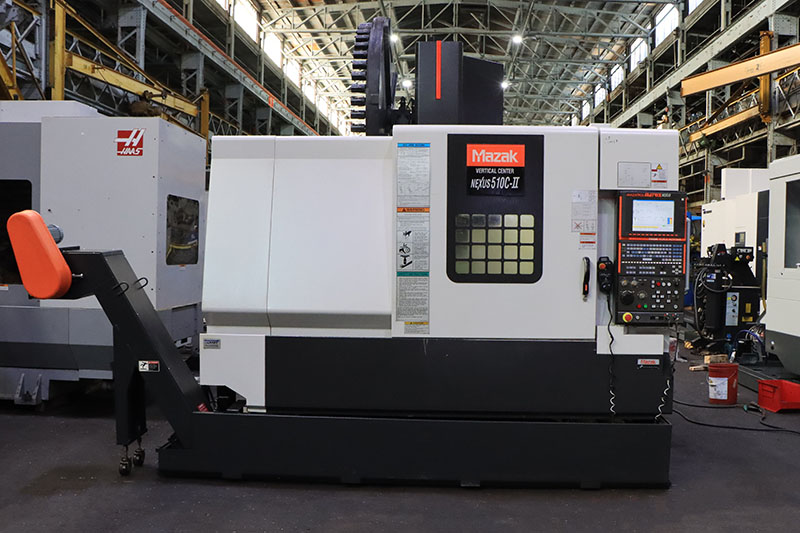

A used Mazak with a larger tool magazine can look like the easy choice. More pockets should mean fewer interruptions. Sometimes they do. Sometimes they hold tools the shop rarely uses while the same setup problems continue.
The useful question is not how many tools the machine can store. It is how many usable positions your recurring work needs, including duplicate tools and any space lost to large cutters. That answer comes from a tool list, not a preference for the biggest number in an equipment listing.
When comparing used Mazak CNC mills, treat magazine capacity as a production requirement. A machine with enough room for the right tools can simplify the schedule. One that falls short can force repeated tool changes between jobs. Buying substantially more capacity than you need also deserves a reason.
Start with the jobs that will share the machine
Gather the tool lists for the part families you expect to run repeatedly. Use the actual operations, materials, and tool assemblies. A general statement such as “mostly aluminum brackets” is not enough to establish the requirement.
Separate regular work from the occasional job you would like to win. The regular work should establish the baseline. Potential work can justify some reserve, but it should not quietly become the main reason for buying a different machine.
Then decide how you intend to schedule those jobs. Keeping several repeat families ready at the same time asks more of the magazine than loading one complete job, running its batch, and rebuilding the tool package for the next. Both approaches can be reasonable. They produce different capacity requirements.
This is especially important when comparing used horizontal machining centers. Several fixtures can be ready while the tools for their programs are not. Pallet availability and tool availability are separate conditions. One does not establish the other.
Count shared tools only when they really are shared
A common drill diameter does not necessarily mean two programs can use the same assembly. One job may require more reach. Another may need a different grade, coating, holder, or coolant arrangement. The same nominal cutting diameter can conceal a different tool.
Compare the complete assembly and its operating requirement. Record cutter identification, holder, reach, diameter, intended material, and relevant program assignments. Where the same assembly truly serves several jobs, count it once in a common library. Where it does not, keep the entries separate.
Do not solve a pocket shortage by stretching one tool across incompatible applications. A long assembly chosen for the deepest feature may be a poor choice for the rest of the work. Changing a proven tool merely to make the magazine arithmetic fit can move the cost into cycle time, finish, or process reliability.
The practical test is whether the shared tool can stay installed with a controlled identity and a suitable offset arrangement. If every job requires rebuilding or resetting it, the tool is not providing the continuity your buying case assumes.
Allow for the tools that do not cut every part
Production tool lists often miss the items that make a process manageable. A workpiece probe, where stored in the magazine, needs a position. Special rework tools may need space if they belong to the established route. A spare for a short-life cutter can also have a legitimate place.
Separate those needs from a drawer of possible tools. Reserve capacity is useful when it supports a defined task. An undefined collection makes it harder to tell whether the machine is genuinely short of positions or simply carrying tools that should be stored elsewhere.
Duplicate cutting tools deserve particular attention. If a recurring tool wears out during the planned production period, a replacement assembly may belong in the machine. But storing it is only part of the arrangement. The control, program, tool-life management, and operator procedures must support how it will be selected and used.
Do not assume that a larger magazine automatically provides automatic substitution. Confirm the capabilities of the exact machine and control, and have the process defined by people who will run it. Extra pockets cannot supply missing logic.
Nominal capacity is not always usable capacity
A magazine described by its pocket count does not promise that every position can hold every tool. Tool diameter, length, weight, adjacent-position rules, and changer restrictions can affect the usable arrangement. Those limits are machine-specific.
A large face mill may require empty neighboring positions on a particular configuration. A long or heavy assembly may be within one limit but outside another. The tool may fit physically without being suitable for the changer’s permitted handling conditions.
Use the manufacturer’s documentation for the installed magazine and changer. Ask for the applicable limits rather than borrowing specifications from another Mazak with a similar model name. The distinction matters on used equipment because model generations and optional packages can differ.
Mazak’s current HCN NEO product information illustrates how one machine family can be offered with different spindle specifications and production arrangements. It is useful background, not a substitute for the documentation of an older machine. The same discipline applies to its tool-storage configuration.
Build a pocket plan before comparing prices
A simple spreadsheet is enough to begin. Give each required assembly an identity. Assign it to the jobs that use it. Mark duplicates, special clearance needs, and tools that can be removed between planned batches.
Then create the proposed arrangement for a real stretch of production. Do not add the largest tool count from every job unless those jobs truly need to remain available together. Do not use the smallest job as the baseline for a mixed schedule, either.
The plan should answer three questions: what stays in the magazine, what changes between jobs, and who makes those changes? If the answer depends on someone continuously rebuilding tools, include that work in the operating plan.
A machine with fewer pockets may still fit when the shop runs disciplined batches and stages the next tool package outside the machine. A larger magazine becomes more valuable when it preserves useful readiness across recurring jobs. The comparison is about the work avoided, not just the tools stored.
A pocket allocation example
Consider a hypothetical 40-position magazine, not a specification for any Mazak model. The proposed library contains 18 shared assemblies, six job-specific assemblies, four duplicate cutters, and one stored probe. That is 29 occupied positions. Suppose the documented arrangement for those particular assemblies requires four additional positions to remain empty. The plan commits 33 positions and leaves seven available.
Counting occupied positions alone would suggest 11 free positions. Accounting for the assumed clearance exclusions reduces that reserve to seven. Before applying this method to a real machine, confirm each assembly’s diameter, length, weight, permitted location, and adjacent-pocket restrictions against its own documentation. Check that excluded positions have not been counted twice and that the remaining locations can actually accept the proposed tools.
Tool management matters as much as storage
More positions can make a disorganized tool system larger. Operators still need to know what each assembly is, where it belongs, and whether its data is current. A full magazine with unreliable records does not make a job ready.
Mazak describes Smooth Tool Management as a way to manage tool information centrally, locate tools, and support registration and setup. Its description includes importing measured tool data and using tool identification. Those are specific capabilities of that system, not features to assume on every used Mazak.
The broader buying lesson is straightforward: match storage capacity with a workable information process. A shop using a simpler system still needs controlled tool identities, reliable offset handling, and a clear handoff between tool preparation and the machine.
Ask who owns that process. If every shift has a different naming convention, a larger magazine may increase confusion rather than reduce it. Resolve the organization before crediting the purchase with faster changeovers.
Leave room for realistic growth
Some reserve is sensible. A replacement cutter, a revised drawing, or an additional repeat part can change the library. Buying to the last available position leaves little flexibility when the process evolves.
There is no universal percentage of spare pockets that fits every shop. Base the reserve on the stability of the work. A dedicated part family with a mature process has a different requirement from a job shop that regularly adds new materials and features.
Do not assume a magazine upgrade will be simple or available later. Before treating expansion as the fallback, obtain machine-specific guidance on compatibility, support, scope, and cost. Otherwise, make the buying decision on the installed capacity you can establish now.
For simpler recurring work, compare used CNC verticals as well. A large-magazine horizontal is not automatically the answer to a tool-storage problem. The part, fixtures, and production method still determine the appropriate machine architecture.
Make the shortlist around usable readiness
Bring Premier the recurring part families, the proposed tool library, and the exceptions that matter. Include large assemblies, expected duplicates, and jobs you want to keep ready together. That is a stronger buying brief than “the largest magazine we can afford.”
When reviewing used CNC equipment, compare the installed configuration against that brief. A smaller magazine may be sufficient with a deliberate changeover plan. A larger one may earn its place by keeping proven work available without repeated tool-package changes.
The right capacity is the capacity your shop can use deliberately. Buy enough room for the production plan, with a defensible reserve, and keep the tool-management work visible.
Frequently asked questions
How many tool pockets does a used Mazak need?
Count the distinct assemblies required by the jobs you intend to keep ready, then include duplicates, stored probes, clearance restrictions, and a realistic reserve. The correct number depends on the installed magazine and the shop’s scheduling method.
Is a larger tool magazine always better?
No. It is valuable when it avoids useful, recurring tool changes or supports a defined production arrangement. Extra storage does not fix inaccurate tool records, unsuitable assemblies, or missing preparation work.
Can I use the same tool for several part programs?
Yes, when the complete assembly and its cutting requirements are suitable for each program. Matching diameter alone is not enough. Reach, holder, material, offsets, and tool identity all belong in that decision.