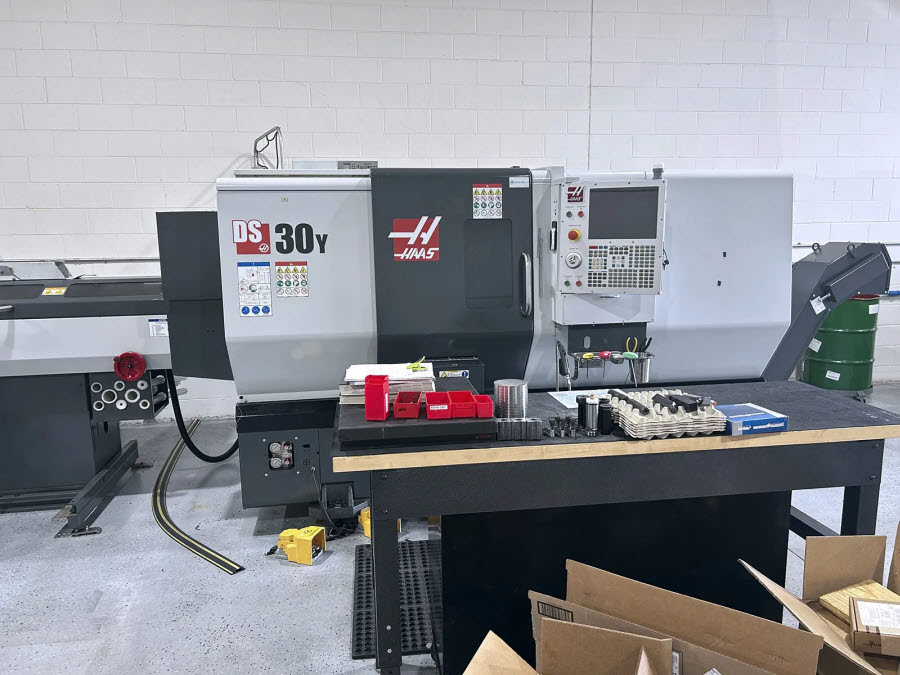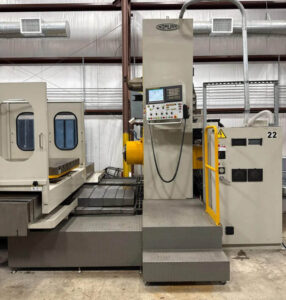

A tailstock supports a part while you cut it. A sub-spindle grips the part so you can work on the other end. That distinction sounds simple until you compare two used lathes with similar chuck sizes and very different equipment behind the turret.
For a long shaft, support may decide whether the turning process is practical. For a short fitting, getting the cutoff end finished may be the bigger problem. Buying a second spindle does not automatically solve both jobs.
Premier’s used multi-axis CNC lathes cover different machine layouts. The useful comparison starts with the part and the order of operations, not the number of axes in the listing.
A long stepped shaft needs support before it needs another spindle
Consider a hypothetical steel shaft with several bearing journals, a shoulder and an external thread. Much of its length extends beyond the main chuck during turning. The immediate concern is the unsupported length under cutting load.
A tailstock center supports the free end through a prepared center hole. The main spindle drives the part, and the tool works along the supported shaft. The center, support force and contact geometry belong in the process plan. More pressure is not automatically better, especially on a slender part.
The tailstock also takes up space. Its body and center can restrict access to the end face or a nearby shoulder. If the finished drawing does not permit a center hole, the shop needs a different support arrangement or a later operation that removes it. A steady rest may suit some operations, but it supports the outside diameter rather than doing the same job in the same location.
For this hypothetical shaft, a sensible route could be to prepare the center hole, turn the journals and thread with support, then handle the remaining end detail in another setup. A second setup is not necessarily a process failure. It may be preferable to forcing the whole shaft onto a machine with the wrong support geometry.
CMZ’s explanation of tailstock machining addresses longer parts and documents machines that have both a tailstock and a sub-spindle. That is a useful reminder: these devices solve different problems, and some machine layouts provide both.
A shop whose work mostly resembles this shaft should compare supported working length across Premier’s used CNC lathe inventory. A nominal bed length alone does not show the space left after the chuck, center and tools are in position.
A short fitting makes the second end the main issue
Now consider a hypothetical bar-fed fitting with a turned outside diameter, a front bore, and a rear face and chamfer that must be finished after cutoff. It has enough sound material for a receiving collet or soft jaws to grip without damaging a functional surface.
The main spindle machines the first end and establishes the receiving diameter. The sub-spindle approaches, grips that diameter, and holds the part through the planned transfer and cutoff sequence. After separation, tools approach the cutoff end to face it to length and finish the chamfer.
That is the kind of routing where a sub-spindle deserves attention. Sandvik Coromant’s turning-center guidance discusses second-side machining and the use of sub-spindles with bar feeding. It also separates that capability from lower-turret arrangements used for simultaneous work.
The receiving grip has to leave something to machine
For the fitting, the receiving jaws need enough engagement to resist the second operation. They must also leave the rear face accessible. Gripping farther along the body may improve access but reduce engagement; gripping close to the cutoff face may put the jaws where the tool needs to go.
A thin wall adds another concern. The grip that holds the part during facing may distort a bore or mark a finished diameter. Soft jaws, collets and a different gripping feature can change the route, but their suitability must come from the actual part geometry.
The handoff does not preserve every relationship automatically. The part still seats against a locating surface and enters a second workholding system. Chips, seating variation and clamping distortion can affect the relationship between the first and second operations. The drawing’s datum scheme needs to survive that transfer.
The control must coordinate the handoff
A rotating transfer requires the machine’s specified spindle synchronization and chuck-control sequence. The program must account for approach positions, gripping confirmation, cutoff, withdrawal and tool clearance. Some jobs use a stopped transfer instead. The correct method belongs to the machine’s documentation and the application, not a generic sample program.
A CAM post that programs the first spindle is not proof that it handles the second spindle and transfer logic correctly. The setup also needs suitable tool orientations and offsets for back-working. A sub-spindle badge does not establish that the turret can reach every rear feature with the holders supplied.
For this fitting, the result may be a completed turned part. Add a feature outside the available tool access, and another operation may remain. Call it done in one only after the whole route supports that claim.
Can one machine cover both jobs?
Some can, but an opposed spindle is not a universal tailstock replacement. A center fitted to a sub-spindle changes the clearance and support arrangement. The machine builder must support the intended use, including the force control and operating method.
CMZ’s TTS configuration description gives a specific example of a tailstock option attached to the sub-spindle assembly. That is documented hardware for that layout, not permission to treat every second spindle the same way.
For mixed work, compare the two routes separately. The shaft needs support and access along its length. The fitting needs a dependable receiving grip and room for second-end tools. Neither requirement disappears because both parts fit the main chuck.
Talk with Premier Equipment about the part drawing, material, gripping surfaces and operations you want to keep on the lathe. Those details give the team a better basis for discussing an available machine than a request for the most options.
Frequently asked questions
Does a tailstock machine the back of the part?
A tailstock center supports the free end; it does not grip and drive the part for second-end machining. Finishing that end may require retracting the support, changing the support method or using another setup.
Does a sub-spindle mean both spindles cut at once?
No. Simultaneous cutting requires a suitable tool and machine layout. A single turret may have to divide its time between spindles. Second-end capability and simultaneous cutting are separate buying questions.
Should short production runs rule out a sub-spindle?
No fixed batch size decides it. Compare the actual transfer setup with the separate second-operation setup it would replace. Repeatability of the work, gripping difficulty and programming readiness matter more than a universal quantity threshold.
Can I assume the sub-spindle matches the main spindle?
No. Compare its documented chuck or collet capacity, power, speed and available working space separately. A part that fits the main spindle may not suit the receiving spindle or its installed workholding.