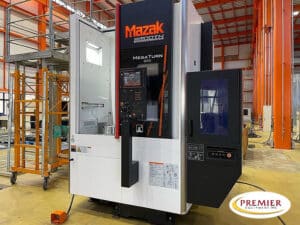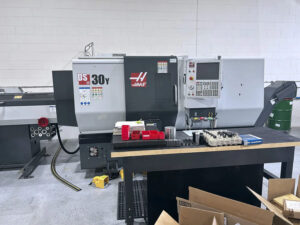

A large housing can fit inside a boring mill’s travels and still be difficult to machine. Add an angle plate, support the casting, and rotate the setup toward the next bore. The part that looked manageable in the drawing may now need more clearance or table capacity than the machine provides.
The main difference between a floor-type and table-type horizontal boring mill is how the machine positions the work relative to the spindle. A table-type machine carries the work on a moving table. A floor-type machine moves its column along the work area, with the part supported on floor plates or an appropriate table arrangement. Neither design wins every large-part job.
When comparing used CNC boring mills, start with the complete setup and the surfaces you need to reach. The largest raw casting is only part of that decision.
What changes when the table moves?
A table-type boring mill mounts the workpiece and its fixture on the machine’s table. The table provides part of the positioning motion; other movements depend on the machine’s design.
For example, the current FERMAT WFT 13/15 specifications identify cross travel of the table, vertical travel of the headstock, longitudinal travel of the column and spindle extension. That example matters because table-type does not mean the table supplies every axis of movement.
A suitable rotary table can present several sides of a housing to the spindle while retaining the same clamping setup. That can be useful when the relationship between features on different faces matters. Whether the process holds the required tolerances still depends on the machine, fixture, indexing accuracy and machining method.
Table capacity must cover the workholding as well as the part. An angle plate, risers and clamps occupy space and add weight. An off-center casting also needs a load-distribution review against the machine builder’s limits. A total weight below the advertised maximum does not answer every loading question.
What changes with a floor-type boring mill?
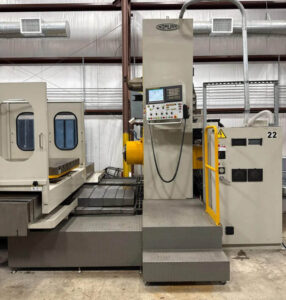
A floor-type machine moves its column along a bed beside the work area. That arrangement can suit a long machinery base, large weldment or casting that would be awkward to carry through the travel of a conventional table-type setup.
The work does not always sit on fixed floor plates. The FERMAT WRF floor-type series, for example, offers floor plates and rotary tables. Confirm which equipment belongs to a used machine’s actual sale package. An optional table shown in a current brochure may not come with an older listing.
TOS VARNSDORF describes its floor-type boring machines as suitable for large, heavy box-shaped and irregular workpieces. That supports the application, not a blanket rule that every heavy job requires a floor-type machine. Some table-type configurations carry substantial loads.
The practical question is whether moving the machining unit along the work gives you a better process than moving the loaded table.
Compare the complete loaded setup
Before choosing between the designs, map the job in its machining position:
- Loaded dimensions: Include the fixture, supports, clamps and any projecting features.
- Mass and distribution: Establish the combined load and where it acts on the table or support arrangement.
- Access to each feature: Trace the spindle, toolholder and cutting tool into position, including approach and withdrawal.
- Rotating clearance: If a table will index, account for the full sweep of the setup rather than its width in one orientation.
- Reach under cutting load: Separate available axis travel from a workable tool and spindle extension for the operation.
These are process decisions. A machine can reach a coordinate without providing a useful cutting arrangement there. A deep bore behind a tall fixture may require an extended spindle, a long boring bar or a different attachment. Each changes the application that needs to be evaluated.
Axis letters also deserve a careful read. The WFT and WRF examples assign different movements to some axes. Do not assume that the Z travel in two listings describes the same physical motion. Ask for the axis diagram and documentation for the exact machine.
Two hypothetical jobs, two different reasons to buy
Consider a repeat family of gearbox housings. Each casting needs work on several sides, and the complete loaded fixture fits within a suitable rotary table’s limits. A table-type boring mill could keep those faces accessible without repeatedly removing the housing from its fixture.
Now consider a long fabricated machinery base with mounting pads and bores distributed along its length. Carrying the entire loaded assembly through table travel may be impractical. A floor-type layout could let the column move between features while the base remains supported on floor plates.
Those examples describe possible applications, not guaranteed outcomes. The housing may prove too tall once fixtured. The machinery base may require an attachment or access position that a particular floor-type machine cannot provide. Prove the proposed setup against the part drawing before committing to either design.
If the work instead fits a palletized production process, used horizontal machining centers may also deserve a comparison. Our guide to boring mills, VBMs and HMCs covers that broader equipment choice.
The installation belongs in the purchase decision
For a used boring mill, the machine price is only one part of the project. Establish what comes with the machine and what must be installed at your facility.
Floor plates, rotary tables, attachments and tool-changing equipment can change both the process and the installation footprint. Review foundation requirements, utility connections, crane access and the space needed to load and service the machine. Use the manufacturer’s installation requirements and qualified installation advice for the exact configuration. Do not assume the existing shop slab is suitable.
A larger machine makes sense when its additional capacity solves work you intend to run. Buying unused travel while overlooking the fixture or installation can leave the actual production constraint unresolved.
Bring Premier the setup you need to run
Send our team the part drawing, material, loaded dimensions and weight, critical bores, required tolerances and anticipated batch size. Include the fixture concept and any building restrictions you already know.
We can use those details to narrow the available machines and identify questions that need answers from the seller, machine documentation or an application specialist. Contact Premier Equipment to discuss the work before choosing a table-type or floor-type boring mill by size alone.
Frequently asked questions
Can a floor-type boring mill use a rotary table?
Yes. Some floor-type machines support rotary-table arrangements as well as floor plates. Confirm the included table, its loading limits and its integration with the particular machine. Floor-type does not automatically mean fixed workholding only.
Is a table-type boring mill limited to small parts?
No. Table-type machines can handle substantial workpieces. The useful limit depends on the exact table, loaded fixture, travel, clearance and application. The category name alone does not establish capacity.
Does longer spindle travel mean a deeper bore is practical?
Not by itself. Bore depth also involves tool reach, support, cutting conditions, chip removal and the required tolerance. Compare the complete cutting arrangement rather than selecting a machine from its spindle travel alone.