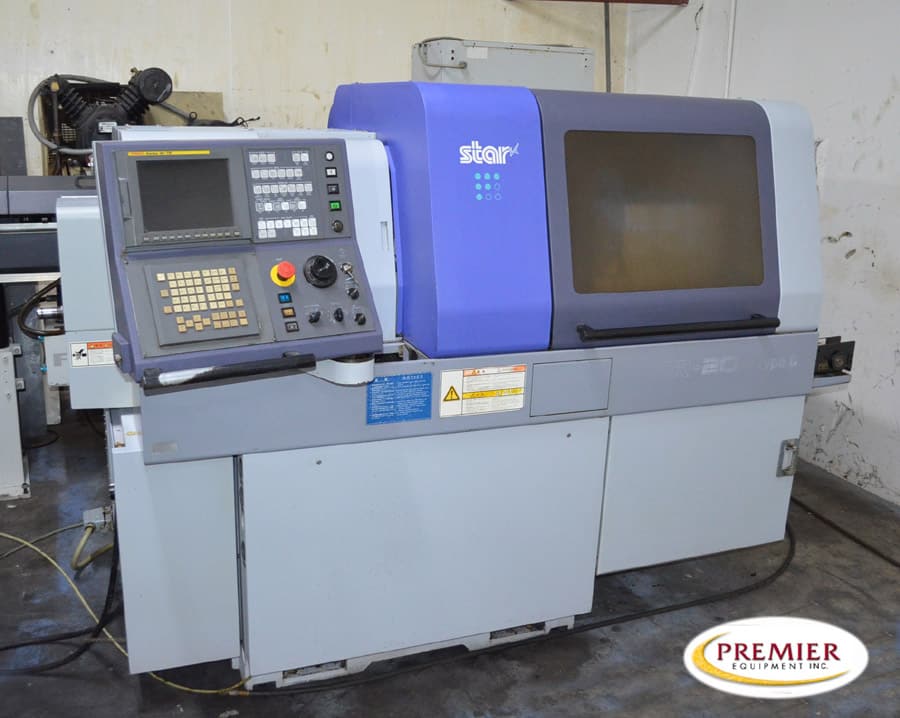

A short part does not automatically belong in chucker mode. A long part does not justify a Swiss lathe by itself. The useful question is where the material needs support while each feature is being cut.
A Swiss lathe guide bushing supports the stock close to the cutting zone. In guide-bushingless operation, often called chucker mode, the spindle collet holds the stock without that separate support. On a machine designed for both arrangements, the choice changes the unsupported length, available machining length, stock requirements and material left at the end of the bar.
Buy for the process your parts need. Then decide whether changing between modes is worth paying for.
Start with the weakest section during machining
The finished drawing can hide the hardest moment in the cycle. A part may be short overall but have a narrow stem that becomes flexible before a cross-hole or groove is finished. Another part may look slender on the print yet remain well supported through a workable operation sequence.
Look at the material that remains when the tool applies its load. Consider the distance from the support to the cut, the smallest section carrying that load, and the surface finish and tolerance required there. Those conditions are more useful than applying one length-to-diameter rule to every material and part shape.
In conventional Swiss operation, the sliding headstock feeds bar through the guide bushing. Keeping the cut close to that support helps control deflection. The bushing does not make an unsupported finished section rigid, and it does not remove the need for sensible cutting forces or tool selection.
For a family of slender pins, that near-cut support may be the reason to buy the machine. For short, sturdy fittings, the same support may add stock and setup demands without solving a difficult rigidity problem. Premier’s Swiss lathe inventory is the right category to compare once that distinction is clear.
What changes when the guide bushing comes out
Chucker mode brings the workholding problem back to the spindle collet and the material projecting beyond it. Short projection can make good sense for compact parts. As projection grows, cutting loads have more opportunity to bend the stock.
The change also affects how the program uses the machine. Tool positions, clearances, usable stroke and the front-to-back operation split need to match the selected arrangement. A program proven with a guide bushing is not automatically ready to run without it.
Citizen provides a concrete example in its third-generation Cincom L20 specifications. The published machining-length entries distinguish guide-bushing configurations from GBL operation. For the listed 20 mm guide-bushing specification, Citizen gives 200 mm per chucking; the GBL entry is a maximum of 50 mm per chucking.
Those are published limits for that generation and configuration, not permission to cut every part within them. They do demonstrate why the longest machining-length number in an advertisement cannot stand in for the capacity of both modes. An older L20 or another manufacturer’s machine needs its own documentation.
Removable does not always mean convertible
Not every Swiss machine supports guide-bushingless operation. A missing guide bushing is not evidence that a machine is ready to run as a chucker. Conversion capability comes from the machine design and its approved equipment, not the fact that somebody can unbolt a component.
There is another distinction worth making. Mazak’s SYNCREX product information describes a removable guide-bushing adapter so operators can preset the guide bushing outside the machine. That is a setup feature. The statement alone does not establish guide-bushingless capability.
For a used machine, the model designation, generation and included conversion equipment have to agree. A brochure describing an available arrangement does not prove the hardware is included in a particular sale. The OEM or qualified applications specialist should resolve the exact configuration before the purchase rests on a two-mode production plan.
If most of the work is short chucking work, compare a suitable conventional CNC lathe as well. A convertible Swiss may still win through its tooling layout or backworking capability, but removing the bushing does not make it the best general-purpose turning center for every job.
Bar stock belongs in the mode decision
A guide bushing needs a workable relationship with the stock passing through it. APSX’s Swiss operating guidance explains the difference between a collet gripping the bar and a bushing supporting it while allowing passage. Diameter variation, roundness, straightness and surface condition affect that relationship. Material that binds or moves inconsistently through the support can turn a promising cycle into a difficult process.
Do not reduce this to a universal statement that Swiss turning always requires ground bar. The appropriate stock condition and allowable variation come from the bushing system, material and application. Price the stock your proposed process actually requires rather than using the lowest material quote as the starting assumption.
Chucker mode removes the guide-bushing interface, but stock quality still matters. The spindle collet must grip properly, the feeder must handle the bar, and the material must run within the machine and feeder requirements. Bushingless does not mean any bar is acceptable.
For repeat work, carry the material specification into the purchasing conversation. A cheaper bar that needs extra preparation, produces inconsistent gripping or changes the process is not necessarily a cheaper source of finished parts. A more expensive stock condition should likewise earn its place through the production requirement rather than habit.
Count usable parts per bar, not an assumed scrap percentage
Guide-bushingless operation can reduce the bar-end length that the process cannot use on suitable machines. The value comes from the actual feeder, collet arrangement, required gripping length and part pitch. There is no single remnant allowance that applies across Swiss lathes.
Compare the approved usable length in each mode with the material consumed per part. Part pitch includes cutoff allowance and any facing or spacing stock, not simply finished length. A shorter leftover piece helps only when the recovered length yields usable production or reduces material consumption across the job.
Expensive material can make that difference worth attention. It still needs to be weighed against setup time, process stability and accepted output. Saving stock while adding rejects or slow finishing passes can cost more than it saves.
Keep the comparison on one consistent basis: the same part drawing, material requirement and acceptable finished quantity. Use the shop’s actual bar pricing and proven cycle assumptions. A sales claim about reduced waste is not a completed cost comparison.
Three part situations that lead to different choices
Consider a short connector with a stout body, an axial hole and flats near the spindle. If the working projection stays short and the machine supports the arrangement, chucker mode deserves a serious look. The part does not need a long supported turning zone simply because it comes from bar stock.
Now consider a pin with a long reduced-diameter section and a demanding surface finish. Guide-bushing support may be central to the turning sequence. Removing it to recover bar-end material can force a different process that gives away the stability the shop bought the Swiss machine to get.
A stepped component is less obvious. Its overall length may look reasonable for bushingless operation, but a small neck, deep groove or interrupted milling cut can decide the issue. The applications discussion needs the intermediate shape and operation order, not just a photograph of the finished part.
These are application examples, not approved setups. The same nominal dimensions can lead to different decisions when material, clamping, tool engagement or tolerance changes. A trial and a reviewed process are more useful than a blanket rule about what counts as a long part.
Decide how often the machine will change jobs
A convertible machine provides an option. It does not require the shop to switch modes for every order.
If long supported turning work fills most of the schedule, keeping a machine in guide-bushing mode may be the practical choice. A short job that runs acceptably in the existing setup may not justify conversion and another prove-out. Grouping similar jobs can be more useful than chasing a small material advantage on every batch.
A shop with recurring short-part families has a different case. It can develop a stable bushingless process and spread the setup effort over repeat production. Include the required collets, adapters and tooling in the project budget, with their availability established before committing to a delivery date.
Premier’s used CNC financing information can help start the funding discussion, but the equipment scope should come first. Financing a machine does not fill in missing application tooling.
Bring Premier the part drawing, material, proposed operation sequence and expected job mix. Contact the Premier team to discuss suitable machines and what is included with each one. The goal is a machine that supports the work, with a clear reason for the mode you expect to use.
Frequently asked questions
Can every Swiss lathe run in chucker mode?
No. Guide-bushingless operation must be supported by the specific machine and configuration. Removable bushing components, a similar model name or a newer family brochure do not establish that a particular used machine has the required capability or equipment.
Is guide-bushingless mode always better for short parts?
No. Short overall length can hide a flexible stem or a demanding cut away from the collet. Chucker mode is a candidate when the projection and cutting loads suit the support available, and when its production benefits justify the setup.
Does chucker mode eliminate the need for good bar stock?
No. It removes the guide-bushing interface, but bar straightness, diameter consistency, collet grip and feeder requirements still matter. Specify the material condition for the actual workholding and process rather than assuming bushingless operation accepts unrestricted stock.
Will changing modes reduce cycle time?
Not automatically. Tool access, operation sequence, part transfer and the cuts themselves determine cycle time. Material utilization may improve without a faster cycle. Compare accepted parts over the full production run, including conversion and prove-out time, before choosing the mode.