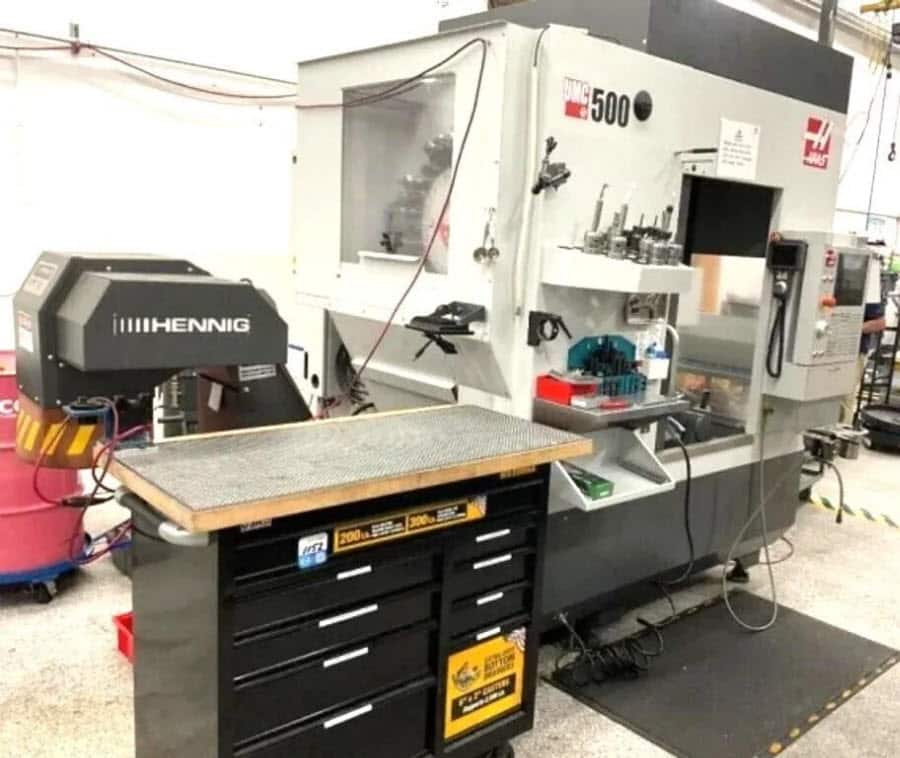

The UMC-750 gives you more linear travel and a larger platter than the UMC-500 in the published configurations compared here. That does not automatically make it the better used-machine purchase. A smaller part can need substantial clearance once it sits on a raised fixture, and a larger platter does not tell you what will clear during a tilted cut.
Choose between these machines using the assembled job: stock, fixture, clamps, toolholder and required machining angles. Then compare the actual used machines, including their generation and options. The badge alone will not tell you whether the job fits.
Premier’s used Haas UMC listings are the place to start that equipment comparison. Keep the intended part and fixture beside you as you compare configurations.
What the published dimensions tell you
The table below uses the specifications on Haas Automation UK’s exact UMC-500 product page and UMC-750 product page. These are published product configurations, not a specification sheet for every older machine bearing either name. Confirm a used machine’s dimensions and limits from its own documentation.
| Published specification | UMC-500 | UMC-750 |
|---|---|---|
| X travel | 24 inches | 30 inches |
| Y travel | 16 inches | 20 inches |
| Z travel | 16 inches | 20 inches |
| Platter diameter | 400 mm | 500 mm |
| Maximum weight on platter | 500 lb | 660 lb |
| Approximate maximum spindle nose to platter/table distance | 20 inches | 24 inches |
The UMC-750 gives the buyer more room in each linear direction in this comparison. Its larger platter also provides more mounting area, and its published weight limit is higher. Those differences can matter when a fixture is broad, tall or heavy.
None of these measurements is a guaranteed five-axis part envelope. Linear travel describes axis motion. Platter diameter describes the mounting surface. Maximum spindle distance does not describe the space remaining under an installed cutting tool.
Weight deserves the same care. Account for the workholding as well as the stock, and ask Haas to confirm allowable loading for the proposed arrangement. Staying below a published weight figure does not prove that an offset load or a tall assembly is appropriate.
Start with the fixture, not the finished-part drawing
A finished part drawing leaves out much of what occupies the machine. Stock allowance, jaws, a riser, a baseplate and the fasteners can make the setup much larger than the part itself.
Raising the part may improve access to its sides, but it consumes vertical room and changes the space swept during tilt. Lowering it can recover clearance above the work while putting clamps or the fixture nearer the toolholder. Neither choice is free.
A hypothetical example is a small aluminum housing with side ports. Its outside dimensions may fit comfortably on the UMC-500 platter. A tall vise and riser could still leave the spindle or toolholder with an awkward approach to a low side feature. A different fixture may solve that problem without moving to a larger machine.
Now consider a hypothetical broad mounting bracket on a baseplate. The fixture needs support and fastener space beyond the bracket’s outline. The UMC-750’s larger mounting surface and travels may make that arrangement more practical. That is a reason to study the 750, not proof the bracket clears every angle.
Follow the job through tilt and rotation
A setup that fits with the platter level can fail the clearance test when tilted. The part’s corners, fixture edges and clamps move through space as the rotary axes change position. Tool approach matters at those positions too.
Height can become a side-clearance problem
A tall fixture does more than reduce room above the platter. Tilting it moves the upper portion sideways relative to the rotary center. Compare the complete swept assembly with the exact machine’s enclosure and structural limits.
Platter diameter is not maximum rotating part diameter. Parts can extend beyond a mounting surface in some arrangements, but the permitted overhang and motion need an application-specific review. Do not use the 400 mm or 500 mm platter measurement as a universal part-size cutoff.
Tool reach can decide the purchase
The cutter tip reaching a surface is only part of the problem. The holder and spindle must also approach without contacting the fixture or workpiece. A longer tool may create clearance, but the cutting process still has to work with that tool assembly.
Build the proposed setup into the CAM simulation with the correct machine geometry and post. Have the application reviewed against machine drawings where clearance is tight. Simulation based on a generic UMC model is not proof that an older machine with different details will behave identically.
Buy the extra room when the work needs it
The UMC-500 deserves serious consideration when the assembled jobs fit with practical tooling and the smaller machine suits the shop. Haas describes it as a compact model for smaller parts. There is little value in paying for a larger arrangement solely because its model number sounds safer.
The UMC-750 becomes more compelling when fixture width, assembled height, load or required axis motion pushes the smaller model too close to a limit. Extra room can make a workable setup less restrictive. It cannot rescue an unsuitable clamping method or guarantee access to an undercut.
Compare floor layouts using the actual installation drawings, including service access and ancillary equipment. A compact machine with added automation can occupy a very different area from the basic machine shown in a brochure.
If neither UMC accommodates the planned setup well, compare other used five-axis machining centers before redesigning the entire job around one listing.
The used machine’s equipment still matters
Capacity is the first decision here, but two machines of the same nominal size may have different spindles, tool capacities, workholding or automation. Separate standard and SS models, and confirm the specific options rather than borrowing details from a current product page.
Ask what workholding and accessories come with the sale. Confirm whether the quoted package includes the pictured vise, holders and fixtures.
For a useful comparison, send Premier your part and fixture requirements, along with material, required angles and production needs. The aim is to find a machine that accommodates the complete setup, not simply the largest machine within the budget.
UMC sizing questions
Is the UMC-500 only for parts smaller than 400 mm?
No. The published 400 mm figure is platter diameter, not a universal rotating-part limit. Actual part fit involves workholding, overhang, tilt, tool access and the machine’s documented envelope.
Will the UMC-750 solve a tall-fixture clearance problem?
It provides more published Z travel and spindle-to-table distance in this comparison, but that is not a guarantee. The fixture’s position during tilt and the spindle approach can still restrict the job.
Can I use these specifications for an older UMC-750?
Use them for an initial comparison only. Obtain the older machine’s drawings and specifications, then confirm its options and configuration. Current product information does not establish an older generation’s capacity.