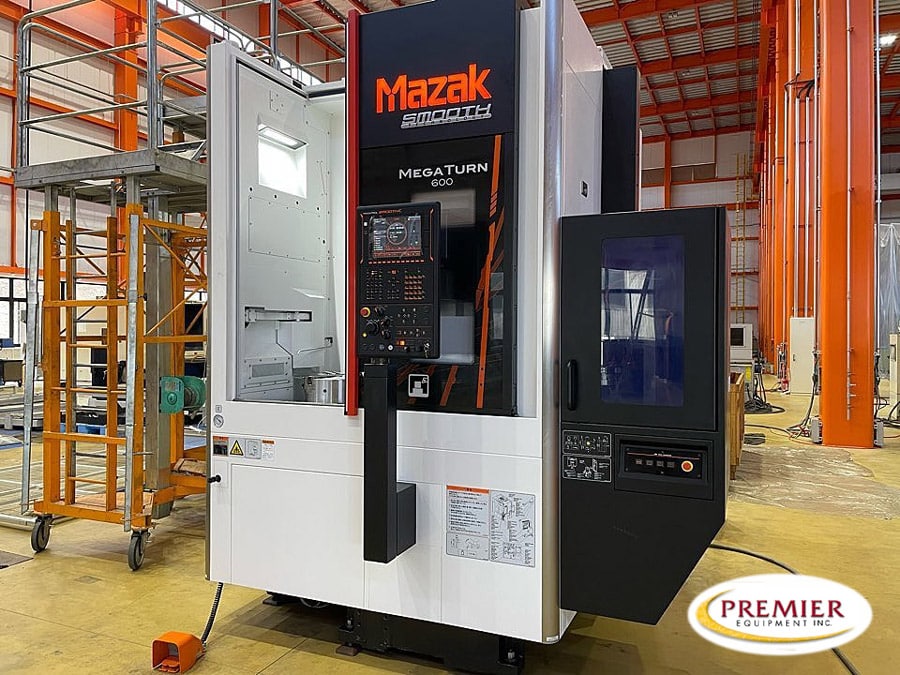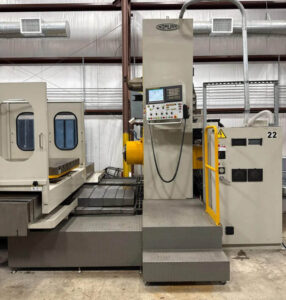

A VTL’s chuck diameter tells you the size of its workholding hardware. It does not tell you the largest part the machine can finish. A workpiece may extend beyond the chuck and still suit the machine. Another may sit comfortably on the table but leave no room for the tool to cut its lower shoulder.
The usable capacity comes from several limits working together: the rotating assembly, the cutting envelope, tool access and the permitted load. The smallest relevant limit decides the job.
When comparing Premier’s used CNC VTL and VBM machines, keep those specifications separate. A larger number beside one heading cannot make up for a shortfall somewhere else.
What the diameter figures actually describe
Read each figure against the builder’s drawing and installed equipment.
| Specification | What it describes | What it does not establish |
|---|---|---|
| Chuck diameter | Nominal size of the chuck body | The permitted grip range of every jaw arrangement |
| Table diameter | Size of the rotating table or faceplate | Maximum cutting diameter or allowable overhang |
| Swing | Clearance for a rotating envelope at the stated location | Tool access to every surface inside that envelope |
| Maximum turning diameter | The builder’s stated cutting-diameter limit | Capacity at every height, with every holder or fixture |
| Work height or turning length | A stated vertical machining or workpiece limit | Space remaining after fixtures, jaws and tools are added |
| Load rating | Permitted load under specified conditions | Approval for any weight distribution or spindle speed |
A jaw arrangement can reach beyond the nominal chuck body. That does not make the chuck size irrelevant. Jaw engagement, stroke, fastening and permitted speed still govern the grip. On a larger table-style machine, fixtures and clamps may locate the work without a conventional self-centering chuck at all.
Swing needs the same care. The raw casting, protruding clamps and extended jaws all rotate. The finished outside diameter may be smaller than that complete rotating envelope.
A real model shows why separate limits matter
Okuma Europe’s V40R specifications list a maximum turning diameter of 400 mm and a maximum turning length of 450 mm. Those are two distinct limits, not a statement that any 400 mm by 450 mm workpiece can be machined in any setup.
The published summary does not establish the jaw arrangement or fixture clearance of a particular used V40R. Nor should those figures be assigned to another Okuma model just because it belongs to the same vertical-lathe family. Use the specifications for the exact model and configuration being considered.
That distinction matters when a listing leads with chuck size. The chuck may be the easiest number to recognize, but the cutting diameter and usable height answer different questions about the part.
A flanged housing can fit and still block the tool
Consider a hypothetical housing with a broad flange and a narrower raised hub. The flange fits within the stated turning diameter, and the housing clears the enclosure when rotated. It looks like a match until the process calls for turning a shoulder near the jaws.
The OD tool needs to reach the shoulder without its holder touching a jaw. A boring bar must enter the housing without the turret or ram contacting the hub. The tools also need safe approach and withdrawal paths. A static view of the cutting edge touching the surface does not prove the full motion will clear.
Raising the part trades one restriction for another
Taller jaws or a fixture may lift the flange away from the chuck and give the OD tool more room. They also raise the top of the housing and consume vertical space. That can reduce the available approach distance for a long boring bar or interfere with tool changes.
Extending the tool is another possible response, but it changes the cutting setup. Sandvik Coromant’s guidance on long overhangs explains the vibration and collision concerns associated with long boring bars. Reaching the surface and cutting it acceptably are separate requirements.
For this housing, a machine with more clearance around the tooling may be a better fit than one with a larger chuck but a crowded working area. The part drawing alone cannot show that difference. The comparison needs the stock shape, workholding and actual tool assembly together.
Weight is a separate limit, even when the part is small enough
A compact, heavy forging can pass the diameter comparison and still exceed the machine’s permitted work load. A large, light ring can present the opposite problem: acceptable weight but difficult support, clamping and clearance.
Determine how the builder defines its load rating. The part, fixture, adapter and added workholding all contribute to the rotating load, but the specification may state allowances relative to standard equipment. Do not silently treat a listed workpiece rating as an unrestricted total table load.
Weight distribution matters too. An off-center load creates different demands from a balanced part centered on the spindle. Permitted speed and loading conditions need to come from the machine and workholding documentation. There is no safe universal reduction factor to apply to every used VTL.
Vertical loading can make heavy round work easier to position, but gravity is not a substitute for secure clamping. It also does not establish that a vertical machine will hold tighter tolerances than every horizontal lathe. Compare the actual machines and processes if both layouts are candidates in the used CNC lathe inventory.
Compare the setup before comparing brands
Premier’s VTL brands and models overview can help with the broader search. For part fit, narrow the discussion to the surfaces that must be machined in each setup and the hardware occupying the space around them.
Send Premier Equipment your application details, including the raw stock dimensions, weight and proposed gripping arrangement. Point out a deep bore, low shoulder or tall hub early. Those features can eliminate a machine that looks suitable by chuck diameter alone.
Frequently asked questions
Can a VTL turn a part wider than its chuck?
Yes, some setups grip a part whose outside diameter exceeds the chuck body. The actual jaw or fixture arrangement must support that part within the machine’s cutting, clearance, load and speed limits. Chuck diameter alone neither approves nor rules out the job.
Is swing the same as maximum turning diameter?
No. Swing describes rotating clearance at a specified location. Maximum turning diameter describes the builder’s stated cutting capacity. The tooling and workholding can impose further restrictions within either published limit.
Will a larger chuck fix a tool-clearance problem?
Not necessarily. A larger chuck or taller jaws can occupy more of the working area. The tool holder, turret or ram may still interfere with the part. Resolve the specific collision geometry before choosing larger workholding.
Does fitting inside the published dimensions prove a heavy part is suitable?
No. Dimensional fit and load capacity are separate. The machine’s load definition, fixture weight, weight distribution and permissible operating conditions still apply, even if the part clears every surrounding surface.